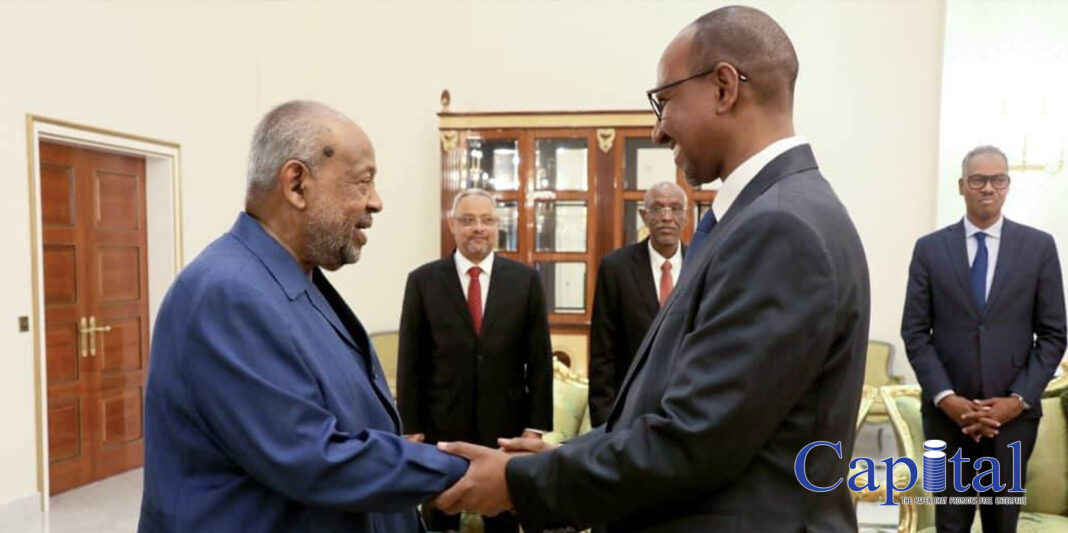
A key high-level exchange saw an eminent Ethiopian delegation, led by Prosperity Party Deputy Head Adem Farah, hold discussions with Djiboutian President Ismail Omar Guelleh to navigate emerging circumstances in the strategically vital logistics domain. The conversation prioritized crafting a reciprocal arrangement and alleviating recent operational constraints encountered by Ethiopian shipping enterprises.
This engagement follows recent clarifications from Djiboutian authorities regarding the authorization for designated Ethiopian logistics entities, including the Ethio-Djibouti Railway SC (EDR), to operate as multimodal transport operators (MTOs) within Djibouti.
Responding to a request from the Ethiopian Maritime Authority for six selected MTOs to conduct operations in Djibouti, the Djibouti Ports and Free Zones Authority (DPFZA) cited local regulations, stating that only Bills of Lading issued by MTOs operating as shipping lines are legally valid for cargo movement within Djibouti’s ports, free zones, and corridors.
In a communication dated November 10, the DPFZA elaborated, “It is noted that a Non-Vessel Operating Common Carrier (NVOCC) does not own or operate vessels. Consequently, the DPFZA emphasizes that a Bill of Lading issued by an NVOCC lacks legal recognition within the Djibouti ports and corridors due to its operational status.”
While some sector analysts argue that Djibouti lacks the legal basis to restrict Ethiopian operators serving only their domestic market, the recent high-level talks sought to resolve these issues.
The Ethiopian delegation—comprising Alemu Sime, Minister of Transport and Logistics; Berhanu Tsegaye, State Minister of Foreign Affairs and former ambassador to Djibouti; and Takele Uma, CEO of EDR—addressed issues related to port efficiency and unilateral tariff adjustments during the December 18 meeting in Djibouti.
The discussions, which also included Djibouti’s Foreign Affairs Minister Abdoulkader Houssein Omar, Minister of Infrastructure and Equipment Hassan Houmed Ibrahim, and DPFZA Chairman Aboubaker Omar Hadi, were described as highly productive. President Guelleh instructed both sides to collaborate and strengthen bilateral cooperation on various port-related matters.
Sources indicate that the agenda also included fertilizer transport and the operations of the EDR, alongside commitments to ensure efficient service delivery at the port. A principal concern raised involved the operational challenges faced by EDR—a joint venture between the two governments—in providing transit services within Djibouti. Despite its binational nature, EDR has faced obstacles in staff deployment and in obtaining an MTO permit in Djibouti, unlike in Ethiopia.
“The benefits secured by EDR in Ethiopia should be reciprocally accessible in Djibouti,” sources from EDR previously noted.
During the consultations, the principle of reciprocity was mutually acknowledged, and President Guelleh emphasized the need to eliminate unnecessary operational impediments. Both sides also agreed on the urgency of discontinuing unilateral tariff changes imposed by certain administrative bodies in Djibouti.
The issue of EDR’s MTO authorization mirrors the challenges facing other licensed Ethiopian operators, whose operations were expected to begin two months ago. An MTO provides comprehensive logistics solutions, integrating sea, land, and air transport.
The six enterprises granted MTO licenses in Ethiopia in March 2025 are Gulf Ingot, Panafric Global, Tikur Abay Transport, Cosmos MTO, EDR, and the Ethiopian Railway Corporation. Several had initiated preparations to serve clients before Djibouti’s latest communication.
Efforts to obtain further comments from Ethiopian Transport and Logistics Minister Alemu and Ethiopian Maritime Authority Acting Head Fraol Tafa on December 19 were unsuccessful.