Bank races past ETB 5 billion capital threshold, sidestepping NBE push for forced mergers
ZamZam Bank’s latest annual report shows impressive growth in assets, profit and capital, but also reveals a heavy dependence on complex risk models and management judgement that could mask future problems in its financing book. While the bank’s performance headline looks strong, analysts say the way it measures and times credit losses deserves close attention from shareholders.
The bank’s total assets jumped to ETB 16.6 billion as of June 30, 2025, up from ETB 9.4 billion a year earlier, driven largely by a 39 percent increase in financing to customers. Net profit after tax reached about ETB 940.8 million, with earnings per share climbing sharply from 5.9 to 41.4, underscoring a breakout year for the young full-fledged interest‑free bank. Deposits grew to ETB 11.62 billion and paid‑up capital rose to ETB 2.65 billion, supported by a rapidly expanding customer base and branch network.
Behind these results sits an elaborate Expected Financing Loss (EFL) framework that uses probability of default (PD), loss given default (LGD) and exposure at default (EAD), combined with forward‑looking macroeconomic scenarios. Management acknowledges that EFL outcomes depend on numerous assumptions and model inputs, including inflation, exchange rates and GDP projections, which are weighted across base, downside and optimistic scenarios for different portfolios. The bank concedes that changes in these parameters can materially alter loss allowances and, by extension, reported profit and capital, introducing significant model risk.
ZamZam uses the standard three‑stage approach under IFRS 9, with 12‑month EFL for Stage 1, lifetime EFL for Stage 2, and lifetime EFL for credit‑impaired Stage 3 exposures. The shift from Stage 1 to Stage 2 is based on what the bank calls a “significant increase in credit risk,” determined through a mix of quantitative factors (such as delinquency) and qualitative triggers (such as covenant breaches or forbearance), plus macro‑driven PD movements. The report explicitly notes that this assessment involves management judgement and that the criteria are periodically reviewed to ensure they do not flag exposures “too early” or cause “unwarranted volatility” in loss allowances.

Critics argue that such flexibility can cut both ways: it allows the bank to smooth earnings by delaying upgrades to Stage 2 and Stage 3, thereby postponing higher lifetime loss recognition on weakening financings. At June 30, 2025, gross financing to customers totalled about ETB 6.81 billion, with Stage 3 non‑performing exposures of ETB 356.7 million and total loss allowances of ETB 140.1 million; how much sits in Stage 1 versus Stage 2 is heavily shaped by these staging judgements.
The annual report outlines a clear policy on restructured or forborne financings, stating that loans renegotiated due to borrower difficulties are treated as credit‑impaired unless there is evidence of sustained improvement. When a loan is modified but not derecognised, the bank requires a “probation period” during which the customer must demonstrate good payment behaviour before the exposure can migrate back to 12‑month EFL treatment.
However, the document concedes that some indicators of increased risk, such as past delinquency or forbearance, may continue to signal elevated default risk even after they are no longer present, leaving room for management to decide when that risk has truly subsided. Analysts warn that largely qualitative probation criteria can introduce optimism bias, keeping reported non‑performing levels and EFL charges lower than underlying risk in an environment of economic and FX volatility.
The bank’s risk note emphasises that EFL calculations are “outputs of models with a number of underlying assumptions” and that macro‑scenario weights and parameters are reviewed by internal experts at least annually. While this reflects a sophisticated risk framework for the Ethiopian market, it also means small shifts in assumptions could materially change future profit trajectories and capital buffers, especially if macro conditions deteriorate more than the base case anticipates.
At the same time, ZamZam Bank has scored a major strategic milestone on the capital side. Ethiopia’s first full-fledged interest‑free bank has now met the ETB 5 billion paid‑up capital requirement set by the National Bank of Ethiopia (NBE), well ahead of the June 2026 deadline.
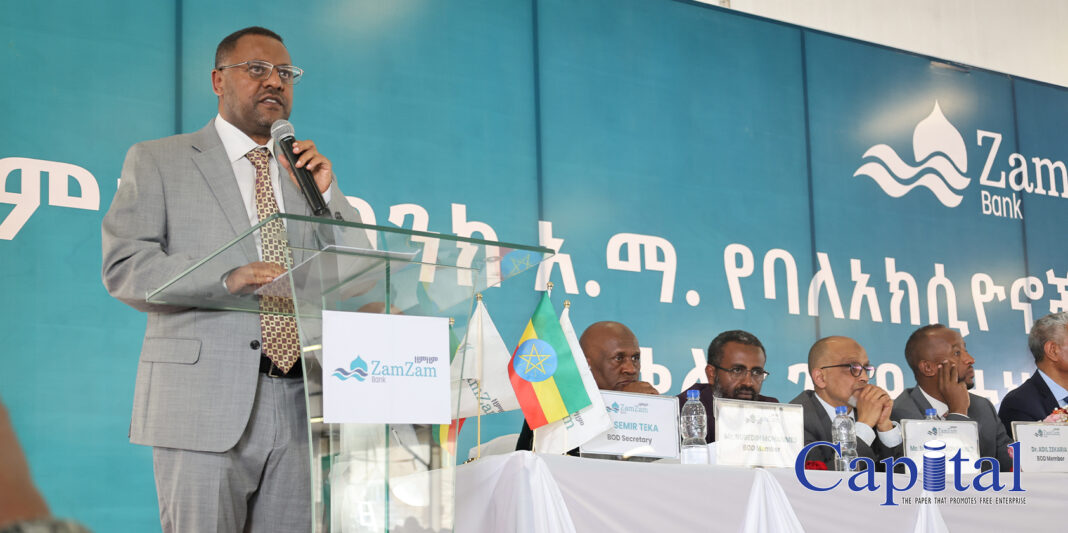
According to disclosures at the bank’s General Meeting, paid‑up capital—initially around ETB 1.5 billion when the current Board took over—has doubled and reached the NBE’s ETB 5 billion threshold through an aggressive share sale that raised more than ETB 2.5 billion in just two to three months. Board Chairperson Nassir Dino told shareholders that two months earlier the NBE had called the bank for talks and floated a proposal for a merger with Hijra Bank, another interest‑free institution, in case ZamZam failed to meet the capital requirement.
“We were offered a proposal from the National Bank, you and Hijra Bank to join,” Nassir said, “but we did not accept the request because we knew our capabilities and the commitment of the Ummah (Muslim community).”
Under a 2021 directive, all 32 banks operating in Ethiopia are required to raise their paid‑up capital to ETB 5 billion by June 2026, a target that has placed intense pressure on smaller institutions. Regulators have indicated that banks unable to meet the threshold may be subject to forced mergers with stronger peers, with the stated aim of reducing the number of institutions and creating a smaller group of well‑capitalised, more competitive banks.