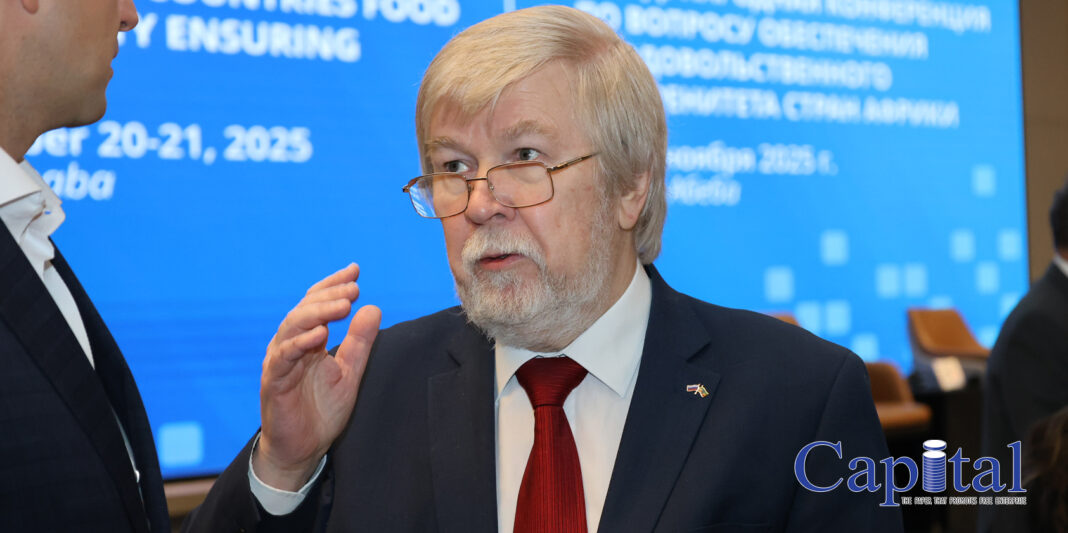
Russia and Ethiopia are entering what Moscow’s Ambassador in Addis Ababa describes as a “breakthrough” phase in their more than century-old diplomatic relationship, with 2025 marking a turning point in political trust and economic engagement. From nuclear energy cooperation and expanding high-tech trade to a sharp increase in scholarships for Ethiopian students, Evgeny Terekhin, Ambassador Extraordinary and Plenipotentiary of the Russian Federation to Ethiopia outlines how the two countries are moving from traditional political solidarity to concrete projects on the ground. He also emphasizes joint opposition to neo-colonialism, support for a more multipolar world order, and a growing network of people-to-people links that he believes will anchor the partnership over the coming years. Excerpts
Capital: Ethiopia and Russia often describe their relations as based on friendship, mutual respect, and trust, with more than a century of diplomatic history. How would you characterize the evolution of this relationship from its origins to the present day?
Evgeny Terekhin: Our diplomatic relations were established in February 1898, which means almost 128 years ago. During this long period, these relations have passed through many ups and downs, downs and ups. So, it would be rather difficult to give a full review of their development in one short interview. But I would like to concentrate on the outcomes of the present year, which is now expiring. This year, 2025, has really demonstrated a breakthrough in the history of our relations.
Especially in the economic sphere, we have moved forward, first of all in the field of peaceful exploration and use of nuclear energy. Vital agreements were signed in this regard, especially those which were signed in the presence of President Putin and Prime Minister Dr Abiy in Moscow in September this year. But our economic relations are not limited to this single project. For instance, let us take our bilateral trade. I cannot present right now the full precise statistics of the year because it has not finished yet. But if we take the results of the first ten months of the year, they were almost threefold higher than during the same period of the previous year. What is necessary to stress is that the structure of our bilateral trade is also changing. For instance, 70 percent of Russian exports to Ethiopia this year were high-technology products. Besides that, we are exploring other possible fields of cooperation, and I am sure that soon we will be able to speak loudly about new projects.
Capital: Russian and Ethiopian officials highlight growing cooperation in areas such as energy, nuclear technology for peaceful purposes, manufacturing, agriculture, and geospatial/space technologies. Can you give specific examples of ongoing or planned projects in these fields?
Evgeny Terekhin: Well, first of all, let us take into consideration one fundamental thing. The project of a nuclear power plant is not an easy case. It is a huge project. As any huge project, it needs time, huge investment, enough skilled manpower, etc. So we are moving stage by stage, step by step. But our movement is very steady. We are not losing time. We are really moving at a good pace. Now we are finishing the first stage of this project, the formulation of different legal documents, preparatory projects, and so on and so forth. I hope that soon we will be able to turn to the next stage, the stage of practical works.
Capital: Russia offers scholarships for Ethiopian students and hosts cultural events such as “Days of Russia in Ethiopia,” while Ethiopia is receiving growing numbers of Russian visitors. How central are education, tourism, and cultural exchanges in your strategy to deepen ties?
Evgeny Terekhin: All the three directions you have mentioned, we can group them into one. I mean humanitarian cooperation.
Russia has traditionally been a destination for those Ethiopians who wanted to get higher education. Of course, the numbers were different from time to time. At the apex of this process, during the last period of the Soviet time, we were accepting up to six or seven hundred Ethiopian students per year. After the collapse of the Soviet Union, our country had to pass through a rather difficult time, and naturally these numbers dropped. But as soon as our country started reviving, we started reviving the number of scholarships allotted for students. Let me present to you one example. When I came here as Ambassador around six years ago, we were allotting to Ethiopia only 30 scholarships per year.
This year we have allotted more than 150, and I am sure that next year we will manage to enlarge this number. And I should say that despite anything, Russian education is still very popular among Ethiopians. According to my knowledge, there were more than 1,500 applications this year to get scholarships in Russia. So we will do our utmost to enlarge these numbers.
Capital: Officials on both sides say economic and trade ties still lag behind their political relationship, despite recent momentum. What are your current priority sectors for Russian investment in Ethiopia, and what specific projects are on the table?
Evgeny Terekhin: Well, we are trying to diversify directions of cooperation here. Of course, I have to admit that it was not an easy task to attract Russian investments here. You know there is such a saying that “money likes silence”. Unfortunately, the situation in Ethiopia for a certain time was not good to bring massive investments.
But as soon as the situation is improving, it is enhancing the flow of foreign investment, including from Russia. I would refrain, right on the spot, from speaking about concrete amounts or contracts and projects; it is not my money. First I have to consult with those who invest. But I may say that step by step our investment is coming here and it is being employed in different spheres. So, I may say that Ethiopia is becoming more investment-attractive country Russia.
Capital: Are there plans to expand Russian language and cultural centers in Ethiopia, or to support Ethiopian cultural presence in Russian cities to balance the relationship?
Evgeny Terekhin: We have Russian language courses at the Pushkin Center near Arada. Actually, we can divide the students of these courses into two groups. One group is constituted by those who are simply interested in Russian culture and Russian language, and who would like to read the great Russian writers in the original language. And the second group is made up of Ethiopian youth who are planning to go to study in Russia. While preparing to go for studies, they prefer to start studying Russian here before they come to our country. Thus, they will save time there for learning the language.
As for the Ethiopian cultural presence, let me mention that the first Amharic language classes were initiated at one of the Russian Universities as long back ago as in the middle of XIX-th century. Presently, Amharic is studied at four Russian Universities. Moreover, starting from recently Amharic classes are given in one of Moscow secondary schools.
Capital: Many Ethiopian professionals trained in Soviet and Russian universities occupy key positions at home. How is the embassy working to reactivate or organize this alumni network as a bridge between the two societies?
Evgeny Terekhin: It is one of the tasks of any embassy working in a foreign country to serve as a bridge not only between governments but also between the peoples of the corresponding countries. So, we are doing our utmost to enlarge the circle of our relations with Ethiopian people from every walk of life and from every corner of the country. Alumni of Russian Universities are playing important role in this respect. So, we have established very close relations with the recently revived Association of Soviet/Russian Universities alumni.
We are open for contacts with our Ethiopian friends and we are working on enlarging these contacts in any professional sphere as well. We are not limiting ourselves to anything. We are open for dialogue, we are open to listen to ideas, we are eager to help if we can. So, you may understand that our day-to-day life and work goes far beyond official office hours.
Capital: Ethiopia has often opposed Western sanctions on Russia, while Russia criticizes what it calls neo-colonial approaches in Africa. How do these shared stances translate into joint diplomatic action at the UN and other multilateral platforms?
Evgeny Terekhin: Russia has always been against any forms of colonialism or neocolonialism. I think there is no need to remind what decisive role the former Soviet Union played in the liberation of former colonial peoples and countries. Unfortunately, in many cases, colonialism was defeated only formally, but it changed its skin, changed its appearance. Now it is trying to reach its aims under the cover of different forms of modern neocolonialism. We are strongly opposing these attempts.
Actually, in my understanding, all these attempts are a manifestation of the desire of the former metropolises or the so-called collective West to keep their world dominance. The voice of the global South and East is rising higher and higher and it is becoming more and more audible. And I believe that together we will overcome any possible conspiracies against the natural way of the world’s development.
Capital: Both countries talk about building a more “polycentric” or multipolar world order. What would a fairer global governance system look like from Moscow’s perspective, and what role is envisaged for African states like Ethiopia in that system?
Evgeny Terekhin: We have always called for the building of a multilateral or multipolar world. That means that we are struggling against any attempts to establish somebody’s dominance in the world. After the collapse of the Soviet Union in 1991 certain forces in the West were drunk with the thought that they had won the so-called Cold War. They were thinking that now the game is finished, that now they are the unilateral rulers of the world. This would not work.
This would not work unless all the freedom-loving peoples do not accept these ideas. So we are happy that our Ethiopian friends are marching with us hand in hand in the struggle against these modern forms of neocolonialism. And we are sure that, helping each other and relying on each other’s shoulder, we will manage to construct a genuinely modern and just way of world affairs, a genuinely just world and life.
Capital: You have spoken previously about the “personal, trust-based dialogue” between the leaders of Russia and Ethiopia as a driver of relations. What concrete outcomes have emerged from recent high-level meetings, and what new agreements should we expect next?
Evgeny Terekhin: Let us proceed from one understanding. The contact and mutual understanding demonstrated at the highest level between the leaders of our two countries actually lays the solid basis for the whole complex of our bilateral relations.
So I may say that whatever positive development in our bilateral relations you see is a direct or indirect result of these contacts. Be it the project of a nuclear power plant, be it cultural or humanitarian assistance and cooperation, be it the development of bilateral trade, all this has one common solid basis which was laid down by the leaders of our two countries.
Capital: If you were to outline a five-year roadmap for Russian-Ethiopian relations, what would be the top three priorities you want both governments to focus on—politically, economically, and socially?
Evgeny Terekhin: I am sure that we will show a good pace in our movement along the road of building a new architecture of the world’s political structure based on genuine justice and equality. This architecture should be free of unilateral dominance, free of coercion and free of undue threats, and so on. In the economic sphere, I wish to see the flourishing economies of our two countries, and I believe that the positive developments in the political sphere and the strengthening of peace in our two countries will be the main guarantee of this economic growth. And in the social sphere, I solidly trust that if we manage to move forward in the political sphere, if we manage to build peace and really manage to develop our economies, this will inevitably be reflected in a huge enhancement of the social life of our two peoples.