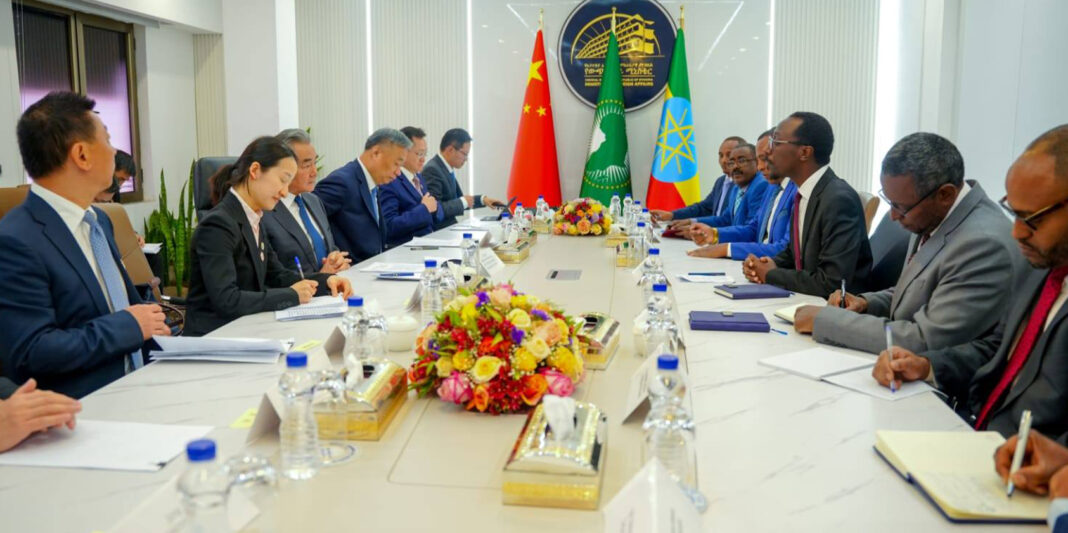
The official launch of the 2026 China-Africa Year of People-to-People Exchanges took place Thursday at the African Union (AU) headquarters here, drawing senior African leaders and diplomats who pledged to deepen cultural ties amid global turbulence.
Chinese Foreign Minister Wang Yi read a congratulatory letter from President Xi Jinping and delivered a keynote address to more than 200 attendees, including AU Commission Chairperson Mahmoud Ali Youssouf, Republic of Congo Foreign Minister Jean-Claude Gakosso — FOCAC’s African co-chair — and Ethiopian President Taye Atske Selassie.
Wang described the year-long programme as a key commitment from Xi and African leaders to strengthen youth exchanges, vocational training and cultural dialogue, building on platforms like the China-Africa Future Leaders’ Dialogue and Youth Festival. Xi’s letter outlined principles for mutual civilizational learning to advance a shared future, providing guidance amid rising Global South influence, Wang added.
African speakers hailed the launch as a milestone for FOCAC implementation, expressing readiness to expand cooperation in education, tourism, arts and youth programmes. They praised China’s consistent support — from annual foreign minister visits to Africa, to achievements in trade, agriculture and infrastructure aligning with AU agendas — and voiced gratitude for backing the continent’s development.
Wang warned of a world facing “profound changes unseen in a century,” with power politics challenging international norms and developing countries’ rights. He urged China and Africa to prioritise development, people-centred policies and openness, while African leaders endorsed Xi’s Global Governance Initiative against hegemonism and in defence of multilateralism.
Participants affirmed the “brotherly” China-Africa bond as mutually beneficial, committing to deepen Belt and Road and FOCAC partnerships for common prosperity. The event signals renewed momentum for South-South solidarity as both sides navigate trade shifts, geopolitical strains and shared ambitions under Agenda 2063.