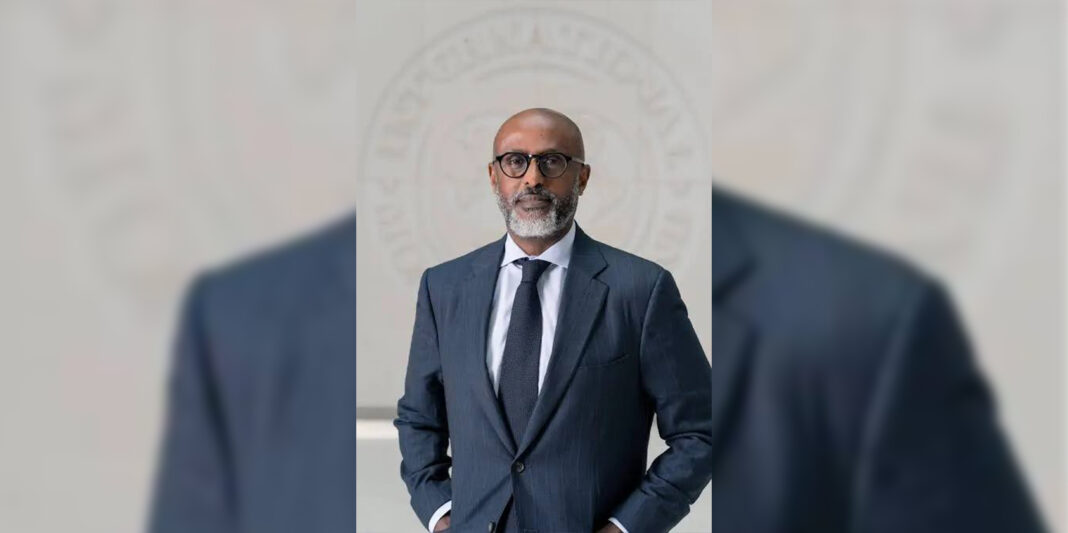
The International Monetary Fund (IMF) has formally opened the selection process for a new director of its African Department following the announcement that Ethiopian economist Abebe Aemro Selassie will retire on May 1, 2026. This marks the conclusion of a pivotal decade for the department, as Abebe has served at its helm since 2016, navigating the institution through some of the most significant global economic disruptions in recent history.
Throughout his tenure, Abebe oversaw the IMF’s engagement with 45 countries across sub-Saharan Africa. His leadership was particularly critical during the COVID-19 pandemic, during which the Fund provided approximately $60 billion in financial support to the region. Managing Director Kristalina Georgieva credited him with reinforcing the organization’s role as a trusted partner and significantly expanding the continent’s influence within the institution, most notably through the addition of a 25th chair to the IMF Executive Board.
Abebe’s career at the IMF spanned 32 years, beginning in 1994. Before leading the African Department, he held various high-level roles, including Deputy Director, Mission Chief for South Africa and Portugal, and Senior Resident Representative in Uganda. His work also extended to programs in Turkey, Thailand, Romania, and Estonia. Georgieva highlighted that his strategic vision and dedication helped align the Fund’s mission with the aspirations of Africa’s people—particularly its youth—for good governance and lasting prosperity.
The search for a successor comes as the IMF prioritizes several critical initiatives for the continent. These include reforming the global financial architecture to ensure stability and equity, specifically by addressing high borrowing costs that see African nations paying significantly more in interest than advanced economies. The Fund is also pushing for quota reforms to better reflect Africa’s $3.4 trillion collective GDP, as the continent currently holds less than 5% of voting shares.
Other key areas of focus for the incoming director will involve unlocking investments for sustainable growth and job creation. With Africa’s working-age population projected to reach one billion by 2050, the IMF is looking toward the African Continental Free Trade Area (AfCFTA) to boost intra-African trade and create millions of jobs. Furthermore, the institution remains committed to climate finance and debt relief, acknowledging that while Africa contributes less than 4% of global emissions, it suffers disproportionately from climate-related disasters.
As the selection process begins, the IMF seeks a leader capable of maintaining the momentum of Abebe’s visionary leadership. The legacy he leaves behind is one of strengthened multilateral cooperation and enhanced global engagement, strictly in alignment with the aspirations of Agenda 2063 for inclusive growth across the continent.