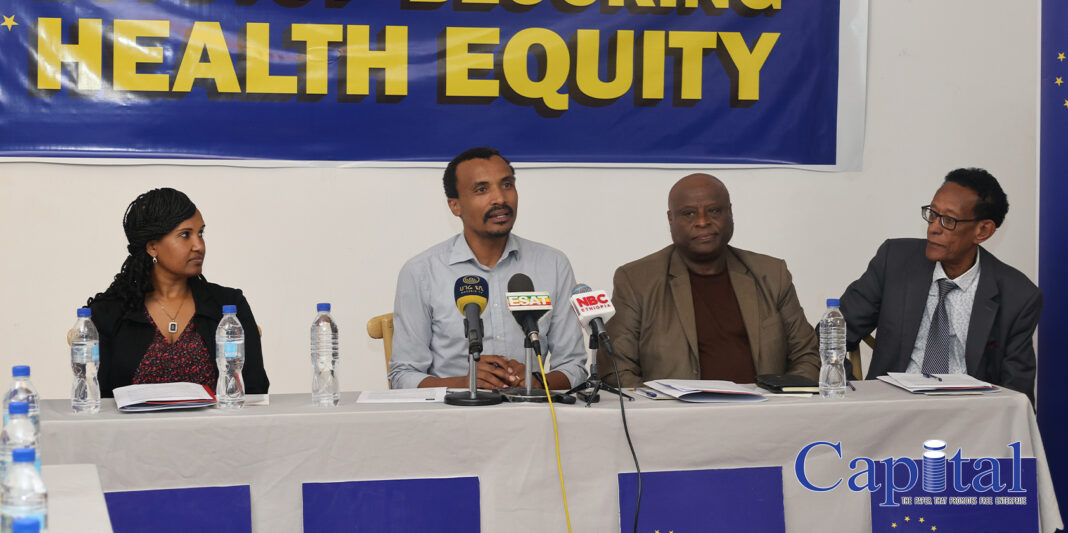
Ethiopian civil society leaders and international health advocates have united to deliver a strong message to the European Union (EU), urging it to stop the “stalling tactics” that they believe are hindering negotiations for the Global Pandemic Treaty.
As the May 2026 deadline approaches, the coalition warns that the world risks repeating the severe inequities experienced during the COVID-19 pandemic.
AIDS Healthcare Foundation (AHF) Ethiopia, along with other prominent civil society organizations, has criticized the European Commission’s position regarding the World Health Organization (WHO) Pandemic Agreement.
Although the main agreement was approved in May 2025, it has been labeled an “empty shell.” A vital aspect of this agreement—the Pathogen Access and Benefit-Sharing (PABS) Annex—remains entangled in unresolved political disputes.
The coalition accuses the European Commission, backed by countries like Germany and Switzerland, of actively obstructing “equity provisions” intended to ensure that developing nations are not marginalized during future global health emergencies.
“The current negotiation is not about partnership; it is about exploitation,” stated Abebe Kebede, Executive Director of the Consortium of Reproductive Health Associations (CORHA).
“We cannot permit a system that takes pathogen data from the Global South to create profitable products in the Global North, only to sell those products back to the data providers at unaffordable prices. This is not cooperation; it is colonialism.”
In theory, the proposed system would establish a legal framework requiring Low- and Middle-Income Countries (LMICs) to swiftly share genetic data and pathogen samples during new outbreaks. In return, they would be assured a fair share of the resulting vaccines, diagnostics, and treatments.
However, AHF and its partners contend that EU negotiators are advocating for a weak, voluntary system. Abebe emphasized that without binding legal language, the framework will fail, leaving the Global South vulnerable while pharmaceutical companies and wealthy nations profit from global scientific collaboration.
Egigayehu Dametew, Executive Director of the Askus Positive Children and Youths Association, added, “We are here to send a clear message to the European Commission: stop obstructing health equity. Without a strong and binding PABS Annex by May 2026, we are not merely delaying a document; we are undermining the world’s ability to respond to the next pandemic. We are choosing to leave half the world defenseless.”
To address this impasse, the coalition—including Ethiopian organizations such as NEP+ (Network of Networks of HIV Positives in Ethiopia), ISHIDO, and CORHA—has outlined non-negotiable demands for EU decision-makers in Brussels.
They argued that no country should ratify the Pandemic Treaty unless the PABS Annex includes strict, binding equity provisions, emphasizing that partial or voluntary commitments are unacceptable.
These NGOs insisted that all commercial users and manufacturers must be part of legally binding contracts, which should include annual financial contributions to a central fund and automatic licensing to enhance production in developing countries during health emergencies.
Additionally, they urged the EU to abandon its opposition to “no registration, no access” policies. They cautioned that if pharmaceutical companies are allowed to obtain data anonymously, enforcing benefit-sharing agreements will be impossible.
Without these binding provisions, efforts by African nations such as Rwanda, South Africa, and Senegal to establish vaccine manufacturing capacity will only amount to “empty promises.” Tolessa Olana Daba, Prevention, Africa Union Liaison & Advocacy Manager (PAULAM) at AHF Ethiopia, likened the current negotiations to the early days of the HIV/AIDS epidemic when life-saving antiretroviral drugs were either unavailable or unaffordable in Africa.
“We have seen this situation before. We watched millions die while effective treatments existed in the West,” Tolessa stated. “The HIV community fought for decades to gain access to medicine as a basic human right. Now, we see history repeating itself. The EU’s position is ethically indefensible. While the people of the Global South wait for the next virus, they are protecting corporate monopolies.”
Aklilu Nega, Executive Director of the Integrated Services on Health and Development Organization (ISHIDO), emphasized that the issue extends beyond health to sovereignty. “Health sovereignty should not be an unreachable dream for Africa,” he remarked, noting that if data leaves the continent without Africa having the right to determine the distribution of resulting products, African nations will remain mere suppliers rather than sovereign entities.
The May 2026 deadline to finalize the PABS Annex is now viewed not as a diplomatic goal but as a countdown to a failure in global leadership. AHF and its partners have called on the European Parliament to pressure the European Commission.
Abebe delivered a final warning to the international community: “The question is not if the next pandemic will come, but when. If we allow this Annex to fail due to narrow political and commercial interests, blood will be on our hands. We urge the EU to stand on the right side of history. The era of ‘voluntary’ equity is over; we need a system that prioritizes human life over regional monopolies.”