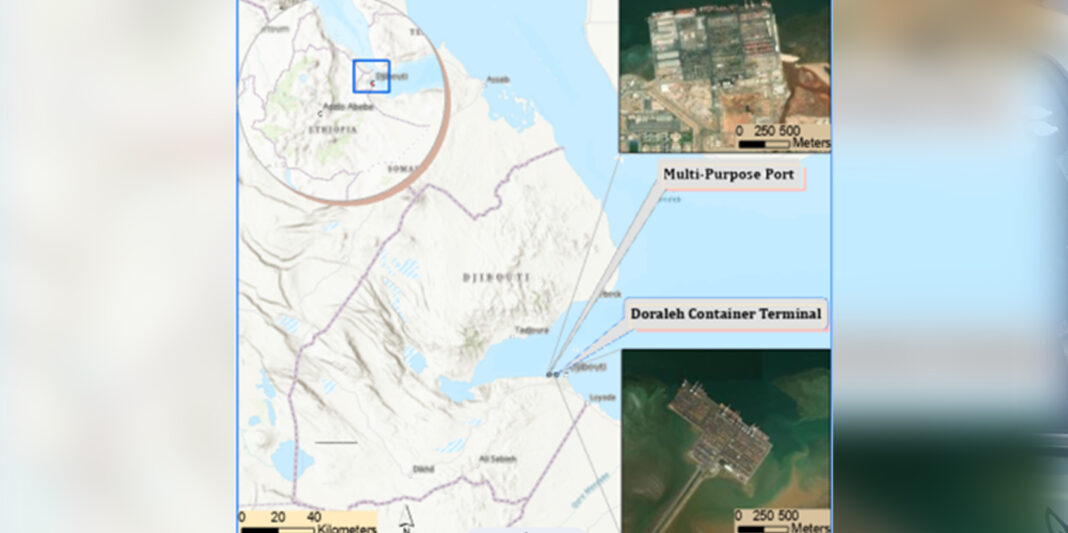
(This piece draws on preliminary findings from an ongoing academic study using satellite-based radar analysis to monitor economic activity at the Port of Djibouti.)
On February 28, the world’s attention was fixed on the flashes over the Strait of Hormuz—one of the world’s busiest oil chokepoints, as missiles and drones traded fire across a narrow stretch of sea. But thousands of kilometers away, something else quietly froze—the movement of steel containers at the Port of Djibouti. While headlines focused on missiles, the satellite imagery captured a quieter kind of shock: the sudden halt of Ethiopia’s economic engine.
From space, the signal was unmistakable. Long before the first 8,000 Birr jerrycan appeared on the black market in Mekelle or the first queue formed at an Addis gas station, the satellites saw the stall. When activity at the waterfront stumbles, the ripple effect is felt not just in data, but in the frantic search for a liter of fuel.
The Umbilical Cord of a Nation
For Ethiopia, a landlocked nation of over 120 million, the sea is not a distant horizon but a narrow dependency. Nearly 95 percent of its external trade flows through a single gateway: the Port of Djibouti. It functions as an economic lifeline—an umbilical cord through which the nation breathes. When that cord is pinched by global conflict, the effects are immediate. Every container unloaded is a breath in the country’s trading lungs; every delay is a missed pulse. There is no Plan B port, no backup highway to the sea—just one narrow dependency, running through one small neighboring country.
Eyes in the Sky
To understand this disruption, synthetic aperture satellite radar is used— a technology that peers through clouds and darkness, bouncing radar waves off metal surfaces to count containers the way a doctor counts heartbeats on a monitor. Unlike a camera that needs sunlight, this radar cuts through the ‘fog of war’ and nighttime alike, seeing the physical weight of our economy even when the world is looking the other way. Think of it like sonar on a submarine: except instead of mapping the ocean floor, the radar is mapping the density of human commerce. The denser the stacking of steel containers, the stronger the signal bouncing back to the satellite. When that signal drops, it means fewer goods are moving — before any official report is filed, before any economist has run the numbers.
In technical terms, publicly available Sentinel‑1 SAR imagery is processed to track changes in backscatter over time, turning raw radar echoes into a simple story: more signal, more activity; less signal, fewer containers in motion.
On February 18, the port was a hive of activity. By February 28—the day the conflict escalated—the satellite data told the story before any economist could: something had gone deeply wrong at the Port of Djibouti. This wasn’t a gradual slowdown; it was a sudden shock to the system.
Four Moments That Tell the Story
What emerged from this analysis was a remarkably clear narrative, unfolding across four key moments—four snapshots in time, like frames from an economic MRI: February 18 (ten days before the shock), February 28 (the day of disruption), March 10 (ten days after), and March 20 (twenty days after).
Before the disruption, both major terminals—the Dorelah Container Terminal and the Multi-purpose Port—showed stable levels of activity. Then came the break.
In this type of radar analysis, the numbers themselves matter less than the direction and size of the change — think of it like a fever reading: 37°C means little until you know that 40°C is dangerous. At Dorelah, activity dropped sharply from 2.67 on February 18 to 1.88 on February 28—a decline of nearly 30 percent. At the Multi-purpose Port, the signal fell even more dramatically, from -4.27 to -5.17. This was not a gradual slowdown. It was abrupt, synchronized with the onset of geopolitical tension, and clearly visible from orbit. In practical terms, fewer reflections mean fewer containers moving—an immediate slowdown in trade.
The pattern echoes the early days of March 2020 — not a gradual economic cooling, but a sudden cardiac event in the global trading system. Then, too, ports slowed, ships idled, and supply chains froze almost overnight. The world discovered, in real time, how fragile and interconnected trade truly is. What we are seeing here, on a smaller but no less telling scale, is the same shock dynamic: a sharp interruption, followed by an uneven and incomplete recovery. If COVID-19 was the stress test that exposed the brittleness of global supply chains, this moment is the aftershock — quieter, less visible, but traveling just as far.
The invisible signals from space are the quiet echo of a far more turbulent reality on the ground. Escalating tensions in the Middle East disrupted shipping routes, increased insurance costs, and strained global energy supplies. As oil prices surged and uncertainty spread across global markets, the effects quickly reached countries far beyond the conflict zone—including Ethiopia.
An Uneven Recovery
In the days that followed, activity at the Port of Djibouti began to rebound—but not uniformly. By March 10, Dorelah had almost fully recovered, rising back to 2.64, close to its pre-shock level. The Multi-purpose Port, however, showed only partial recovery, reaching -4.15. By March 20, Dorelah stabilized, while the Multi-purpose Port slipped slightly again, suggesting lingering volatility.
This divergence is more than a technical detail. It reveals something fundamental about how economic systems absorb shocks. Even within a single port, not all terminals respond the same way. Some recover quickly, others lag behind. Some are resilient, others more exposed. The port, in this sense, behaves less like a single organism than an ecosystem—a collection of interconnected yet unequal parts. Recovery, in other words, was not a tide lifting all ships equally.
Real-Time Vision
Traditionally, understanding such disruptions would require waiting months for official trade statistics or piecing together fragmented reports. By the time the data arrives, the moment has already passed. Satellite observation compresses time. What once took months to understand can now be seen in days. A delayed shipment of fuel is not just a logistical issue—it is a longer line at the pump, a higher transport cost, and a rising price of bread on the table. Traditional trade statistics for March 2026 will be published sometime in late 2026 or early 2027. The satellite saw the same story on March 10.
For Ethiopia, this matters deeply. With no direct access to the sea, even minor disruptions at its primary gateway can cascade into broader economic stress—delays in fuel deliveries, rising costs of goods, and pressure on already vulnerable supply chains. In an era of increasing geopolitical uncertainty, the ability to detect these shifts early is not just useful; it is essential.
The View from the Pump
By March 17, cars in Addis Ababa were already queuing for blocks to buy fuel. Emergency directives had been issued to prioritize gasoline for security forces. The satellite had seen this coming three weeks earlier. Satellite observation, in this sense, compresses time: it allows us to see the long line at the pump before the cars even arrive. For a family that suddenly finds a jerrycan of fuel costing around 8,000 Birr—roughly a month’s income for many—the abstraction of “port activity” becomes a very concrete crisis.
The stakes of a fuel shortage in Ethiopia are never purely logistical. History offers a sobering reminder: during the 1974 oil crisis, soaring fuel and food prices became accelerants to the political unrest that ultimately contributed to the fall of Emperor Haile Selassie’s government. Ethiopia today faces its own constellation of pressures — inflation, unresolved conflict, and economic strain. In such conditions, a sudden fuel shortage does not simply inconvenience — it can amplify existing tensions in ways that are difficult to contain. As the International Energy Agency (IEA) triggers record-breaking emergency oil releases to stabilize the global market, Ethiopia’s struggle reminds us that for landlocked nations, the ‘political’ price of oil is always higher than the market price.
From Orbit to Insight
The view from space confirms what Ethiopian traders have long understood: our pulse begins at the sea. But as global uncertainty grows, this satellite intelligence offers us a “Geospatial Early Warning System.” The question is what we do with that knowledge. It tells us that we must accelerate our transition to electric mobility and resilient corridors —so that the next time a distant conflict erupts, the shock is absorbed—not amplified.
There is one quiet footnote of resilience worth noting. Ethiopia’s aggressive push toward electric vehicles — particularly electric buses in Addis Ababa — offers a glimpse of what structural insulation could look like. It is too early to claim the transition softened this particular blow significantly. But directionally, it points toward the right answer: a nation that is less linked to imported oil is a nation less vulnerable to the next distant conflict that disrupts the sea.
What Comes Next
This is only the beginning. With more data and broader application, such methods could track long-term trade trends, compare ports across regions, and even serve as early warning systems for economic disruption. They offer policymakers and the public something that has long been elusive—real-time visibility into the hidden mechanics of the global economy.
And this story is not yet finished. The conflict at the Strait of Hormuz continues, and with it, the dynamics at the Port of Djibouti remain in flux — subject to new disruptions, partial recoveries, and shifts we have not yet seen. An ongoing study is tracking these movements in real time, building a more complete picture of how a distant war reshapes trade patterns across weeks and months, not just days. Upon completion, that work is expected to offer researchers, planners, and policymakers a richer toolkit — one that moves early warning from concept to operational reality.
The Silent Resilience: A New Kind of Shield
While the radar signals from Djibouti reveal our dependency on the sea, another story of resilience is unfolding quietly on the streets of Addis Ababa. For years, the “umbilical cord” of the Ethiopian economy has been a series of diesel-choked trucking routes. But today, the growing fleet of electric buses and vehicles represents a “Silent Resilience”—a deliberate attempt to unplug the nation’s mobility from the volatility of the Strait of Hormuz.
Every electric bus powered by The Grand Ethiopian Renaissance Dam (GERD) is one less vehicle that needs to wait in a three-block line at a gas station. It is a form of structural insulation. While it is too early to say that this transition has fully softened the blow of the current 30% drop in port activity, the direction is clear: a nation that moves on its own electrons is a nation less vulnerable to a distant missile strike or a sudden surge in Brent crude. In the language of satellite intelligence, this is “decoupling”—breaking the rigid link between a distant conflict and the local price of a commute.
Conclusion: The Economy Has a Shadow
What happened between February 18 and March 20 is a quiet warning. In a deeply connected world, distance offers little protection. The next time a conflict erupts, its effects may already be unfolding — not yet in headlines or statistics, but in the slowing movement of goods, the rising price of essentials, and the subtle signals captured from space. For countries like Ethiopia, that shadow stretches all the way from a distant strait to the price of bread at home. The economy casts a shadow. We are only beginning to learn how to read it — and who will act on what it says.