A meaningful stage honoring the sacrifice and solidarity of nations that fought in the Korean War was held at Gwanghwamun Square in Seoul, featuring a performance by descendants of Ethiopian Korean War veterans.
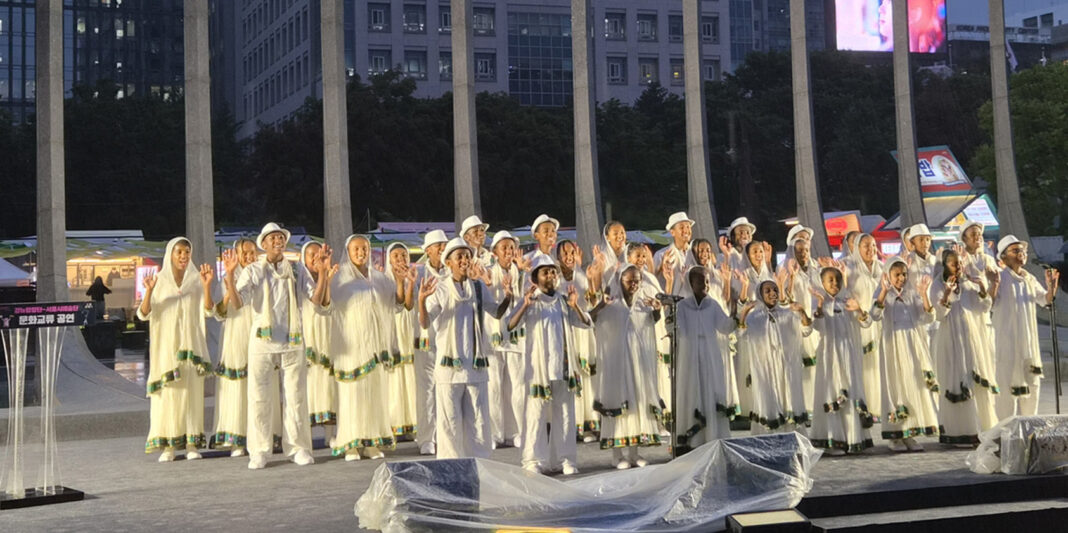
On the afternoon of the 22nd, the cultural exchange performance “Courage of That Day, Song of Today” was held at the Garden of Gratitude in Gwanghwamun Square, bringing together the Kagnew Choir, composed of descendants of veterans from Ethiopia’s Kagnew Battalion, and the Seoul Metropolitan Arts Company. The performance was arranged to honor the dedication of Ethiopia’s Kagnew Battalion, which fought for the Republic of Korea during the Korean War, and to carry the ties between the two nations forward through the culture and friendship of future generations.
The event gained added significance by being held at the Garden of Gratitude, which symbolizes the sacrifice of the 22 participating nations and the Republic of Korea. About 300 people attended, including Seoul Mayor Oh Se-hoon, figures from the veterans affairs and cultural and arts communities, and citizens.
The performance opened with a string quintet by the Seoul Philharmonic Orchestra, followed by a b-boy performance and the Seoul Metropolitan Choir’s renditions of “Longing for Mount Kumgang” and “Beautiful Country.” The Kagnew Choir performed “Spring in My Hometown” and “Hollo Arirang” in Korean, conveying gratitude for the sacrifice of the veteran generation and a message of peace. At the end of the performance, a flower bouquet presentation and a “Light of Gratitude” ceremony were held together by a children’s press corps and the choir.
The Kagnew Choir is a group composed of descendants of Ethiopian veterans, founded in 2018. This visit to Korea includes veteran Tesfaye Asmamaw (95) and 34 members aged 8 to 16, who have been visiting Korea on a 36-day schedule since June.
Ethiopia was the only African nation to deploy ground forces during the Korean War. The Kagnew Battalion, organized by Emperor Haile Selassie around the Imperial Guard, arrived in Korea in 1951 and was deployed to major battles including the Battle of Jeokgeun Mountain and the Iron Triangle offensive and defensive campaign. A total of 3,518 troops served until the armistice. After the war, the battalion also contributed to postwar reconstruction, including operating the “Bohwawon” childcare facility for war orphans.
Mark (14), a member and descendant of a veteran, said, “I am proud that Korea has not forgotten my grandfather’s sacrifice,” while Blin (15) shared, “I hope the friendship between the two nations continues for a long time.”
Meanwhile, the Garden of Gratitude has been establishing itself as a new historical and cultural landmark since its opening in May. It features 23 stone pillars symbolizing the 22 participating nations and the Republic of Korea, along with “Light of Gratitude 23” and “Freedom Hall,” a media art exhibition space. About 1.34 million people visited during the ten days immediately following its opening.
Seoul Mayor Oh Se-hoon said, “What the Kagnew Battalion defended went beyond the territory of the Republic of Korea to freedom and the future,” adding, “This is a meaningful occasion where the courage of that day carries on into the song of today.”