Ray Dalio’s ‘How Countries Go Broke: The Big Cycle’ is not a book about one country, one government or one moment of bad policy. It is a warning about a recurring economic pattern: countries become vulnerable when debt rises faster than their ability to earn, produce, tax and repay. Eventually, the bill arrives through inflation, currency weakness, financial instability or painful austerity.
Ethiopia should read that warning carefully—not because it is destined to “go broke,” but because it is now attempting a difficult recovery from many of the conditions Dalio identifies: foreign-exchange scarcity, heavy public obligations, weak domestic revenue, import dependence, inflation and the temptation to solve structural problems with short-term financial measures.
Dalio’s central argument is straightforward. A country enters danger when debt-service costs consume an ever-larger share of government revenue, while buyers become less willing to finance new borrowing. At that point, policymakers face unpleasant choices: raise taxes, cut spending, borrow at higher interest rates, default or rely on the central bank to create money. The latter can ease pressure temporarily, but risks devaluing the currency and fuelling inflation.
For Ethiopia, the language is different, but the logic is familiar.
For years, Ethiopia’s growth model relied heavily on public investment, large infrastructure projects, state-led financing and external borrowing. Roads, railways, industrial parks, dams and public enterprises were meant to create the foundation for industrialisation. Some of these investments were necessary. No country can develop without infrastructure.
But infrastructure does not repay debt by itself. It must be followed by exports, productive firms, jobs, tax revenue and foreign-exchange earnings. When those returns arrive slowly, debt accumulates faster than repayment capacity.
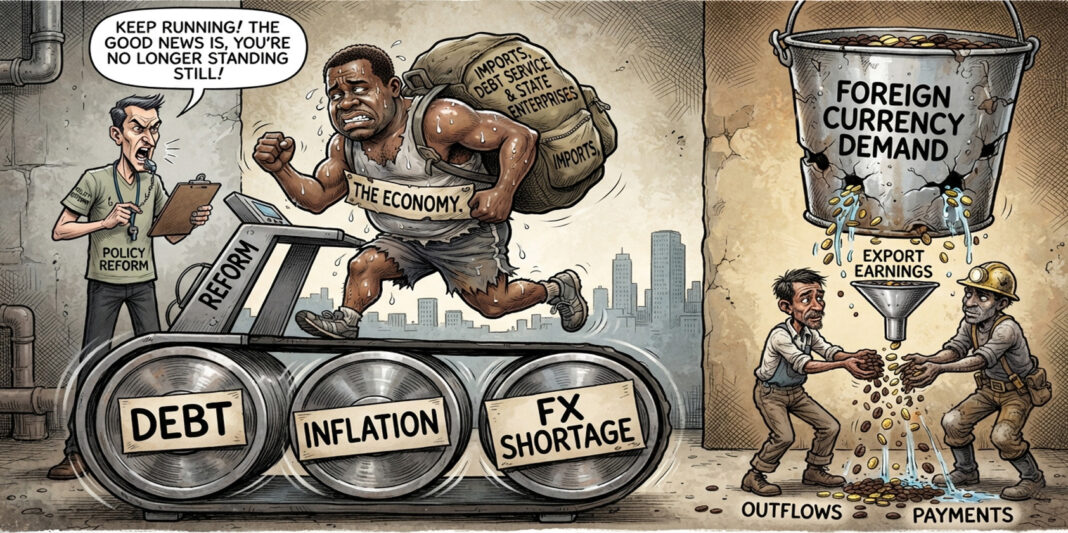
That is where Ethiopia’s challenge lies. The country has not merely faced a public-debt problem. It has faced a foreign-currency problem. Ethiopia earns hard currency through exports, remittances, tourism and foreign investment, but it needs even more hard currency for fuel, machinery, medicines, industrial inputs, debt service and essential imports.
For too long, the difference was managed through foreign-exchange controls, rationing and an overvalued currency. This did not eliminate the shortage. It only distributed it through queues, privilege, informal markets and administrative discretion.
The July 2024 shift toward a market-determined exchange rate was therefore a necessary correction. It recognised an uncomfortable truth: a currency cannot remain artificially strong when the country lacks enough foreign exchange to support it. Since then, Ethiopia has recorded stronger export performance and improved reserve buffers, while the parallel-market premium has narrowed from earlier extremes. The IMF has stressed that maintaining adequate reserves and exchange-rate flexibility is essential for cushioning external shocks.
But correction is not the same as cure.
The depreciation of the birr has made imports more expensive. That means higher costs for fuel, fertiliser, medicines, transport, machinery and consumer goods. Inflation reached 13.9 percent in June 2026, driven largely by food and non-food price pressures. For ordinary citizens paid in birr, macroeconomic reform can feel less like stabilisation and more like a reduction in daily purchasing power.
This is the political danger of reform. A government can be technically correct and socially unsuccessful at the same time if the burden of adjustment falls too heavily on households, wage earners and small businesses.
Dalio’s book reminds us that debt crises are never only about accounting. They are about the distribution of pain. When prices rise faster than incomes, when jobs do not grow, when access to foreign currency depends on connections and when public services remain weak, economic hardship becomes a crisis of trust.
Ethiopia must therefore avoid treating exchange-rate liberalisation as the end of reform. It is only the beginning.
The first priority must be to expand the country’s ability to earn foreign exchange. Gold and coffee have helped lift export revenues, but an economy cannot depend indefinitely on a narrow range of commodities. Ethiopia needs processed agricultural exports, tourism, digital services, mining value addition, manufactured goods, logistics and electricity exports. It must export more than raw potential; it must export reliability, quality and value.
The second priority is fiscal discipline. Dalio’s warning about debt service is relevant here. Governments cannot borrow indefinitely to cover current spending, bail out inefficient institutions or finance projects without clear returns. Ethiopia needs better public investment selection, stronger oversight of state-owned enterprises, transparent borrowing and realistic assessment of contingent liabilities.
That does not mean abandoning development spending. It means distinguishing between investment that expands productive capacity and expenditure that merely postpones difficult decisions.
Third, Ethiopia must deepen domestic savings and capital markets. A country that depends entirely on external finance becomes vulnerable whenever global conditions worsen. Stronger pension funds, insurance companies, bond markets, investment banks and transparent capital-market institutions can help mobilise local resources for long-term development.
But domestic finance must not become another form of hidden taxation. If banks are forced to absorb government obligations at uncompetitive returns, or if inflation erodes depositors’ savings, confidence in the financial system will weaken.
Fourth, reforms must strengthen the private sector rather than merely announce its importance. Investors still face foreign-exchange constraints, regulatory uncertainty, weak property-rights protection, inconsistent taxation and administrative delays. The IMF has noted that while Ethiopia’s reform direction has been welcomed, implementation remains uneven.
The country does not need more declarations about private-sector leadership. It needs predictable rules, fair competition, functioning logistics, access to finance and an environment in which productive businesses can survive.
Finally, Ethiopia must recognise that social stability is an economic asset. No macroeconomic programme can succeed if conflict, displacement and insecurity continue to destroy farms, markets, roads, schools and investor confidence. The cost of war is not only measured in military spending. It is measured in foregone exports, lost livelihoods, interrupted education and generations of weakened human capital.
Dalio’s “big cycle” is a cautionary framework, not a prophecy. Countries do not collapse simply because they have debt, inflation or currency pressure. They collapse when leaders deny reality, delay adjustment and allow short-term politics to overwhelm long-term economic discipline.
Ethiopia has begun to confront reality. The task now is to ensure that reform produces a more productive economy—not merely a more expensive one. The true test is whether the country can turn stabilisation into jobs, exports, domestic investment and improved living standards.
That is how a nation escapes the cycle: not by borrowing more time, but by building more capacity.