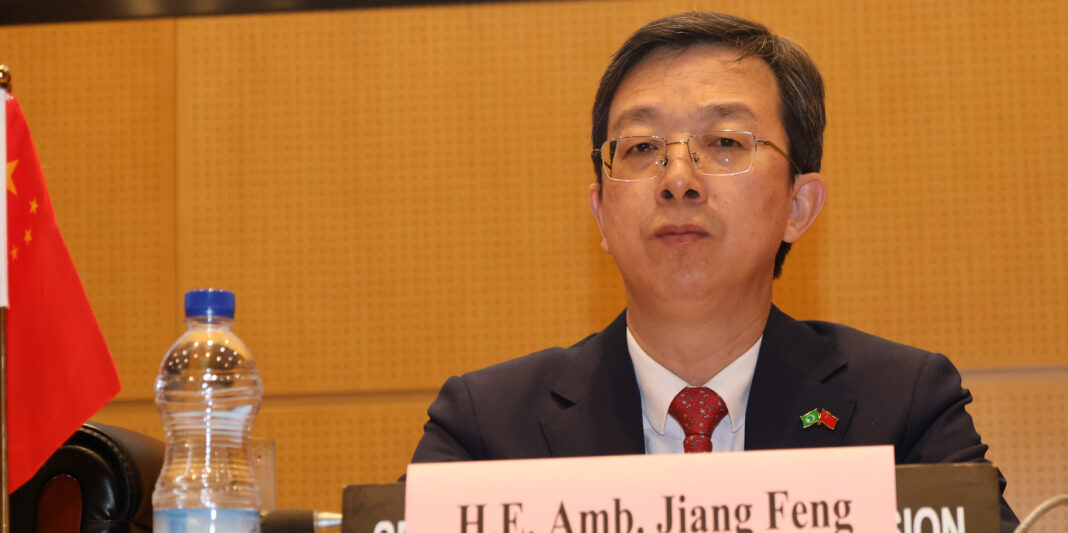
By Ambassador Jiang Feng
The Wall Street Journal recently commented that China had supported the global economy by reducing its oil imports, while Le Figaro maintained that, following the 2008 global financial crisis, China had once again “saved the world economy” at a critical moment. The wording used by the two Western media outlets may differ, but they point to the same reality: in a world fraught with risks, rising protectionism, and accelerating technological change, the Chinese economy has once again served as a stabilizing force for the global economy.
For many years, China’s contribution to global economic growth has remained at around 30%, making it the undisputed “number-one engine” of global growth. At another critical moment when the global economy faces mounting shocks, China is providing a stabilizing force for global markets, creating new development opportunities for countries around the world through continued expansion of opening-up, and enabling more countries to share in development opportunities by promoting greater openness in technology.
In response to current challenges, China has upheld its responsibility as a major power to maintain stability in the global economy. Since late February of this year, the U.S.-Israel-Iran conflict has disrupted traffic through the Strait of Hormuz, causing shortages of international crude oil and key raw materials, and presenting the global economy with new and severe challenges.
Leveraging its strong position in the new-energy sector, China has actively responded by reducing crude oil imports, thereby significantly alleviating upward pressure on international oil prices. China’s industrial sector has maintained efficient and stable production, helping offset supply gaps caused by production stoppages and logistics disruptions in some regions.
In recent years, China has accelerated its green transition across the economy and society, greatly enhancing the economy’s resilience and capacity for adjustment. Currently, nearly four out of every ten kilowatt-hours of electricity consumed across the country comes from green power, while the retail penetration rate of new energy vehicles has continued to rise, reaching a cumulative 54.1% in the first half of the year. China’s advanced and practical technologies—such as solar power, wind power, and energy storage—along with high-quality products such as electric vehicles, are turning the energy transition from a dream into reality for many developing countries. Distributed solar and microgrid projects implemented by Chinese companies in sub-Saharan Africa are steadily bringing light to more and more communities across the continent.
Committed to shared development, China is expanding opportunities for global growth through greater openness. In today’s world, markets have become one of the scarcest resources. With annual imports exceeding 20 trillion yuan, China is a major export destination for nearly 80 countries. At a time when some countries are turning toward protectionism, China has remained committed to expanding openness. By lowering import tariffs, hosting the China International Import Expo, and launching the “Export to China” series of events, China has continued to provide a vast market for goods and services from around the world.
Effective May 1st this year, China fully implemented zero tariffs on imports from 53 African countries with which it has diplomatic relations, without requiring reciprocal market access or attaching any conditions. In just over 100 days since the policy took effect, a growing range of African products has entered the Chinese market at an accelerated pace. Fresh apples and wines from South Africa, avocados from Kenya, oranges from Egypt, and blueberries from Zimbabwe have all begun making their way onto the dining tables of ordinary Chinese consumers.
From May to June, China’s imports from Africa rose by 23.5% year on year, while imports of African aquatic products and textile raw materials both recorded double-digit growth. African trading partners have welcomed those measures, noting that zero tariffs have not only expanded the scale of African exports to China, but also created more favorable market conditions for African countries to strengthen their processing capabilities, extend industrial value chains, and increase the value added of their products.
Looking toward the transformations of the future, China is promoting technological openness to prevent new historical injustices. At the opening ceremony of the 2026 World Artificial Intelligence Conference, Chinese President Xi Jinping emphasized that we must carry out extensive international cooperation and help Global South countries with capacity building to bridge the AI and digital divides, promote sustainable development, and prevent the creation of new historical injustices in AI. Africa is home to thousands of languages and faces distinctive needs in agriculture, education, healthcare, and public services that differ from those of other regions.
Against this backdrop, a growing number of African developers are turning to Chinese open-source AI models for customized development, enabling AI to better meet local needs. Technological openness lowers not only the cost of using AI, but also the barriers to participating in this technological revolution. It enables more developing countries with relatively limited financial and technological resources to avoid becoming completely dependent on the expensive, closed-source products offered by a handful of technology giants. More importantly, it gives them an opportunity to move beyond the role of perpetual consumers and passive recipients of technology and build the capacity to accelerate their progress in this technological revolution.
From addressing the oil crisis by proactive adjustment of demand, to actively expanding market openness, and to promoting open-source technology in the field of artificial intelligence, China’s contributions to the global economy are grounded in the present amid crises, serve the needs of development today, and look toward a shared future. The global economy has never been a zero-sum game. On the contrary, when a super-large economy is willing to use its own market to absorb more goods, adjust its own demand to stabilize global markets, and utilize its own technological capabilities to help more countries bridge the technological divide, what it creates is not merely wealth for itself, but can also become a source of additional growth for the shared development of the world economy. Through its actions, China is demonstrating that a super-large economy can indeed serve as a stabilizing force for the world economy, for openness in global development, and for inclusive scientific and technological progress.
Ambassador Jiang Feng is the Head of the Mission of the People’s Republic of China to the African Union