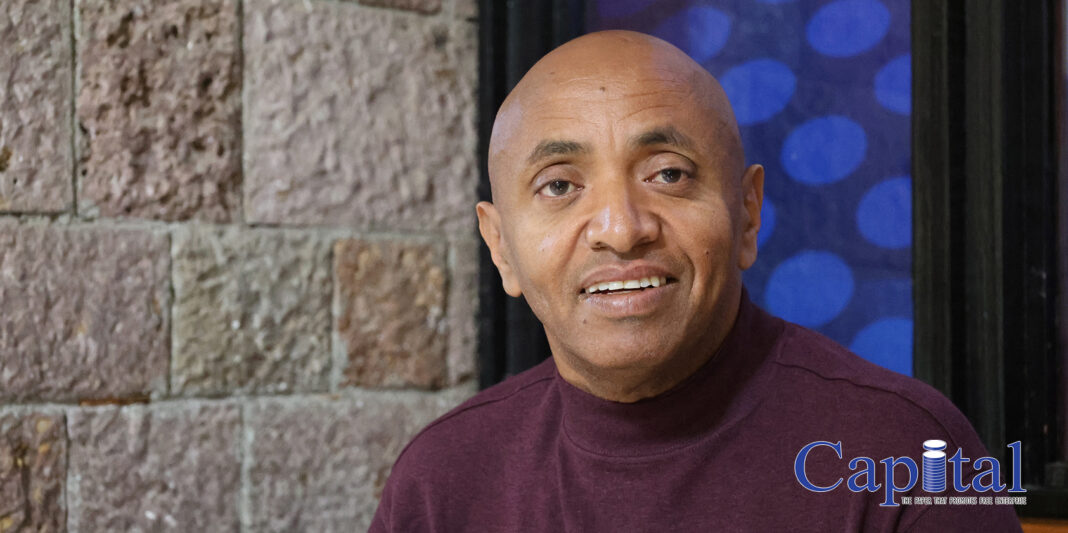
With the privilege of speaking with a remarkable figure whose journey embodies resilience, vision, and profound generosity, Lemma Getachew hails from the historic walled city of Harar, Ethiopia. Thirty-six years ago, a young Lemma fled conflict, found refuge in Somalia, then built a new life in the United States — from taxi driver to licensed pharmacist, business magnate and philanthropist. Now CEO of The Inspirion Group, the Ethiopian-American developer shares his inspiring story of turning adversity into achievement while uplifting his homeland. Excerpts;
Capital: Before we discuss your major business successes, let’s go back. It’s said you were involved in business as a child. What was it like when you came to Addis Ababa from Harar as a refugee during the Ethio-Somali War?
Lemma Getachew: It’s true; my business life started in early childhood. At that time, I was a fourth-grade student—around 11 or 12 years old. I would go around the Kazanches area in Addis Ababa selling gelato. We walked as far as Bambis, sold everything within an hour or two, and returned.
Capital: How did the opportunity to go to America come about?
Lemma: Yes, the story goes like this: I dropped out of university in the late 1980s. Then, along with my Somali friends, I went to Mogadishu and stayed there for about eight months. One day, while I was at the UNHCR to collect some money my brother—a medical doctor based in the U.S.—had sent me via Geneva, the UNHCR Director in Somalia and an immigration official from the U.S. Embassy happened to be there.
At that time, most refugees were coming from the Wollo famine and didn’t speak English. When they saw me, they asked, “Young man, what are you doing here?” I shared my story with them. They informed me they could facilitate my move to the U.S. if I had a sponsor there. Since my brother had already sent sponsorship papers, this opportunity allowed me to enter the U.S.
Capital: When you arrived in America, did you go straight into education? How did you complete your studies?
Lemma: Yes, I went directly to Howard Community College to study Pre-Pharmacy. Then I attended Long Island University and graduated as a pharmacist. I supported myself through school by driving a taxi, which provided quick cash. Although the government had given me a loan, driving the taxi allowed me to pay for my education and complete my studies within two to three years.
Capital: How did you transition to business after your pharmacy studies? Did you start as an employee?
Lemma: I worked 12 hours a day for a large corporation and was a loyal employee. On weekends, I would work from 7:00 AM to 11:00 PM. One day, without consulting me, they hired someone else for my position and transferred me elsewhere. They treated me with contempt, thinking, “This guy is a fool; he’ll work wherever we send him.” I was furious and decided to quit.
When I applied to another corporation, the Pharmacy Director wasn’t available, so I spoke with the Vice President instead. At that time, there was a shortage of pharmacists. During our conversation, I unexpectedly mentioned, “I have my own company.” He asked me to submit paperwork, and I used that one-month window to register and establish my company. I started working at $50 an hour and eventually began hiring my friends, growing my pharmacist staffing company.
Capital: When did you shift into “Home Care” and open your own pharmacy?
Lemma: Around the year 2000, a friend informed me he had opened a Home Care business in Minnesota. Other pharmacists advised against leaving a stable job for elderly care, but I didn’t heed their warnings. I hired a retired nurse and launched the business. Later, an elderly gentleman named Mr. Godan offered me a building to open my own pharmacy, so I purchased a closed-down pharmacy to start. That pharmacy became very successful.
Business significantly expanded when we began “Compounding”—preparing medications in ointment form. We became the number one compounding pharmacy in Ohio and ranked fourth across several states, with up to 300 sales representatives and many professionals.
Capital: As part of your large conglomerate, you have also ventured into real estate. How many apartments do you currently own? What are the “Addis View” and “Midtown” projects?
Lemma: I entered real estate by initially buying 40 units, and later expanded to 1,000 units. Currently, I am developing a significant project called “Addis View,” which will eventually be a 500-unit apartment complex. “Midtown” is a luxury apartment building located downtown.
Capital: How long did you remain in the pharmacy business before transitioning to real estate? What challenges did you encounter?
Lemma: I stayed in the pharmacy sector for three or four years. My biggest challenge was pharmacy benefits management, a large Fortune 500 company that controls both insurance and pharmacies. They had the right to audit the drugs sold through my pharmacy. I learned that the price of a drug called “Doxycycline” was set to increase from five cents to five dollars, so I bought it in bulk and stockpiled it. As a result, the company filed an audit claim to remove me from the market.
Capital: Isn’t it challenging to compete against such billionaire companies? How did you succeed?
Lemma: I outsmarted them. I hired expensive lawyers to buy time. While dragging the case through court and arbitration, I opened another pharmacy in my wife’s name in the same city. While they were occupied with the lawsuit, I generated millions of dollars at my main pharmacy. Ultimately, we settled with an agreement that I “wouldn’t open a pharmacy for three years.”
By then, I had made the money I wanted and transitioned all my customers to the pharmacy I opened in my wife’s name. I thank God for my journey from Ethiopia and my ability to compete with such large companies.
Capital: This tactic of exploiting legal loopholes is something President Trump also employs. As a businessman, how do you feel about using legal loopholes?
Lemma: While I’m not necessarily proud of it, it is a legal avenue allowed by the American system. For instance, when Trump claims, “I don’t pay taxes,” I can’t deny that I don’t pay taxes either. Why? Because there are lawful methods permitted by the government, such as “Depreciation” and other expenses. Under real estate law, you can reduce the value of a property each year for 30 years and avoid taxes. This is why two out of three millionaires in America have made their wealth through real estate. I paid significant taxes when I owned the pharmacy, but now that I understand the real estate system, I’ve legally minimized my tax burden.
Capital: In business, competitors or large corporations might resort to lawsuits. How can one navigate such pressures?
Lemma: The key is to understand the system. If the law provides a loophole, you should utilize it to protect your business. When I say I “outsmarted” them, I don’t mean I broke any laws; rather, I found a way to navigate the same legal framework they used to challenge me. A businessman shouldn’t give up in the face of challenges; instead, they should develop a strategy supported by experts. My experience with taught me valuable lessons.
Capital: How did you transition into the real estate business, given your background as a pharmacist?
Lemma: While working as a pharmacist, I purchased a 40-unit apartment building, and the profits were substantial. I began to question, “Why am I working so hard in pharmacy?” and ultimately decided to switch to real estate full-time. At one point, I managed a thousand units. There is no business as lucrative as real estate in America, and I encourage anyone who has the means to pursue it.
Capital: Is there a recommended starting point for individuals new to business?
Lemma: It depends on your circumstances. I began as a single-house landlord and expanded from there. The most important thing is simply to start.
Capital: What drives your tendency to hire highly knowledgeable experts for your projects?
Lemma: My understanding of the business has allowed me to “outsmart” the market. However, the real secret is hiring people who are smarter than you. For example, my wife and I brought on a Jewish professional named Mark Shelles, from whom we learned a great deal, particularly about securing business incentives from the U.S. government.
Capital: Can you explain the “Midtown” project that received government support?
Lemma: “Midtown” was an apartment building that had been closed since the 1970s due to asbestos contamination. After I renovated and reopened the building that the government had shut down, the city recognized its immense value. By introducing 80 luxury units, we attracted 80 affluent residents to the area, boosting local commerce. Consequently, the government provided not only financial support but also a 30-year tax abatement. The Mayor himself encouraged us to proceed because it was crucial for the city’s economic vitality.
Capital: Is your current focus on “Addis View” and new construction?
Lemma: Yes, I’ve shifted my focus from old buildings to new construction. “Addis View” is situated near University Circle, the cultural and educational district in Cleveland, Ohio. In the future, we plan to build up to 500 modern apartments there. New buildings are easier to manage, have lower operational costs, and attract professional tenants who pay their rent on time.
Capital: What did you learn from your experience with old apartments?
Lemma: While old apartments can be suitable for beginners, they often come with significant headaches. Buildings from the 1970s frequently have boiler and elevator issues that can lead to unexpected expenses, which can quickly erode your profit margins. For instance, my new 80-unit apartment downtown is more profitable and energy-efficient than my previous 400-unit property, “Shoregate Towers.”
Capital: You’ve also ventured into Japanese cuisine. As an immigrant from a small town in eastern Africa, how did you get involved in this business?
Lemma: It started when my family and I wanted to dine at a nearby Japanese restaurant but found ourselves facing a long wait. This made me realize the potential attractiveness and profitability of the business. I reached out to friends who knew a chef skilled in Japanese cuisine, and that led to the establishment of our restaurant. Honestly, I don’t run the business alone; our employees and management are integral to its success. What brings me more joy than money is hearing people in American cities say, “The Teriyaki is wonderful.” Knowing that I came from a distant land, that people trust me enough to enjoy my food, and that I’ve created jobs for the community makes me feel I’ve achieved something significant.
Capital: How many employees do you currently have, and how many of them are of Ethiopian origin?
Lemma: We currently employ over 550 people across both the restaurant and real estate sectors, many of whom are Ethiopians. I have trained and mentored numerous individuals, and many have gone on to achieve great success, becoming engineers, sociologists, and master’s degree holders. For example, I entrusted a young man named Wossen with managing hundreds of employees when he was just 18, and he is now thriving. Additionally, I have employed Palestinians and others who have become millionaires today. Their success is a source of great honor for me.
Capital: It is said you faced a health crisis a few years ago. How did that experience change your perspective on life?
Lemma: I was always busy and never took time to rest. My health issue made me truly understand the meaning of life. Helping others is part of my nature. My wife and I were among the first to sponsor those in need through “Mary Joy Ethiopia,” a humanitarian organization. However, after my illness, my outlook on life changed dramatically. I realized that life isn’t solely about making money.
I read a book featuring interviews with individuals in hospices nearing death. Many expressed regrets like, “I wish I had done more good” or “I wish I had spent more time with my family,” but no one said, “I wish I had made more money.” God has blessed me with more than I could ever need; now, the greatest purpose in my life is to bring a smile to someone’s face.
Capital: Your support in areas like Harar and Southern Ethiopia, including Arba Minch, is highly regarded. What motivates this?
Lemma: The joy I witnessed on the faces of children when I brought water to a kindergarten in Harar still resonates with me. Those children didn’t know me, yet they held my hand as if I were their father. Their smiles bring immense joy to me and my children. Our principle is to share what little we have. I believe current investors in Ethiopia have a long way to go in fulfilling their social responsibilities.
My neighbors in America don’t just give money; they teach skills that can change lives. I am confident that the computer donation we made in Harar will transform a student’s life and contribute to the nation’s development. As John F. Kennedy said, “Ask not what your country can do for you, ask what you can do for your country”—that is my motto. We have donated over 300 computers to the school in Harar.
Capital: It’s said you do charity work in various parts of Ethiopia?
Lemma: Yes, my wife and I strive to help to the best of our ability. For instance, when we learned about a water shortage in an area called Dawro in Southern Ethiopia, we arranged for a water well to be drilled. When the city elders found out, they traveled 250 kilometers to Addis Ababa to thank me; it deeply touched my heart. Additionally, we established a computer lab for students, donating 51 computers and a digital storage system containing 27,000 books. We plan to expand our efforts beyond Harar and Southern Ethiopia to other parts of the country.
Capital: How do you observe the current youth and the business environment in Ethiopia?
Lemma: I am very optimistic about the current generation. In our time, the youth focused primarily on politics. Now, they are brimming with business and technology ideas. I spoke to medical students in Arba Minch and was impressed by their questions and innovative thoughts. They aren’t waiting for the government to hire them; they are eager to create their own opportunities. This gives me great hope for the country. I want to inspire the youth by sharing my failures and successes. When I failed out of Addis Ababa University, I thought it was the end of the world, but I persevered and reached this point. Sharing this experience is my duty as a citizen.
Capital: Management is one of the key challenges for Ethiopian business owners. There is a problem where a businessman’s company dies with him. What is your advice on this?
Lemma: This is indeed a significant management challenge. I require my son to work as a regular employee in my company so he can learn the business from the ground up. Regardless of one’s opinion of Trump, his approach to raising his children is worth emulating. His children started by driving tractors. An investor should not spoil their child; instead, the child must be tested to become self-sufficient. The mindset of “I am rich because my father is rich” can ruin children. I tell my children that I was once a taxi driver, ensuring they understand that life is not easy and that they must work hard for what they achieve.