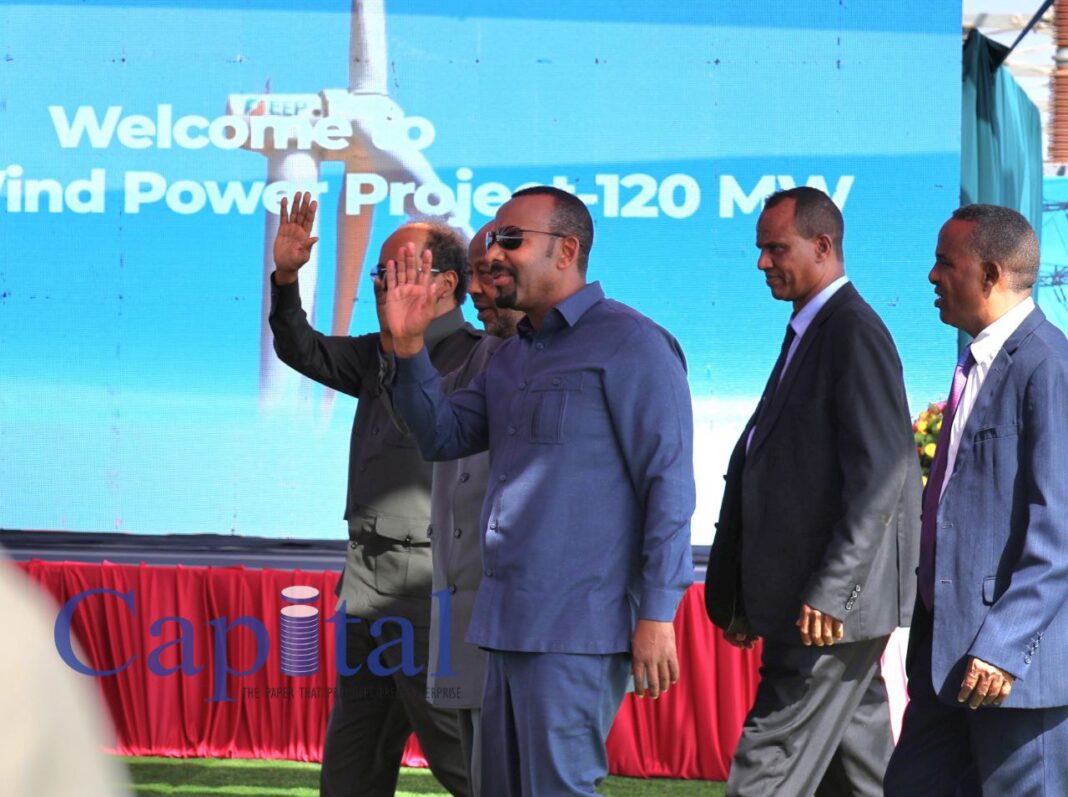
In a strategic move towards increased financial independence, Ethiopian Electric Power (EEP) has begun funding key energy projects with its own resources, thereby enhancing its profitability. This initiative was highlighted at a ceremony yesterday, where EEP announced the successful completion of the Aysha II Wind Farm project.
Initially financed by the Chinese Export-Import (Exim) Bank, the wind farm project was ultimately completed using EEP’s own funds after the bank withdrew its financial support. The Aysha II Wind Farm, located approximately 680 km east of Addis Ababa and 20 km west of the Djibouti border, is positioned near an existing international transmission line.
Recognized as a highly viable project for the international energy market, it has now been officially completed.The agreement for this project, signed nearly a decade ago, specified that the Chinese Exim Bank would cover 85% of the total cost, with the Ethiopian government responsible for the remaining 15%.However, Moges Mekonnen, Head of Corporate Communication at EEP, noted that only 40% of the pledged funds were disbursed by the bank.
Despite the funding challenges, the wind farm began generating electricity three years ago and has now been fully completed, with a total installed capacity of 120 MW.EEP’s leadership opted to use its own resources to finalize the remaining portion of the project, which is already producing positive results.The funding delay was largely due to an increase in Ethiopia’s external debt risk, which led the Chinese contractor, Dongfang Electric Corporation, to continue work on the project for years without sufficient financing.
Ultimately, EEP took the initiative to finance the completion independently.The project consists of 48 turbines, each with a capacity of 2.5 MW, and is estimated to have cost USD 257.3 million. Located in the Sity Zone of the Somali Region, about 180 km east of Dire Dawa, the wind farm has significant potential to generate foreign currency through energy exports to Djibouti, which already imports Ethiopian green energy.Dongfang Electric Corporation has considerable experience from previous work on various Ethiopian electromechanical projects, including hydropower developments.Meanwhile, EEP has maintained a stable financial position, partly due to the government’s absorption of its substantial domestic borrowing—over half a trillion birr—from the state-owned Commercial Bank of Ethiopia.
Moges emphasized that the profits earned by EEP are vital not only for improving public access to energy but also for enhancing the company’s ability to finance future projects independently. “Our profitability strengthens our confidence to take proactive steps in project financing like Aysha,” he stated.He also cited the Koysha Hydropower Project as another example of EEP’s leadership after SACE, the Italian insurance-financial group, suspended its financing. “EEP’s involvement in Koysha demonstrates how the company can manage projects independently as its profitability grows,” Moges explained to Capital.
The Ethiopian government continues to seek international financiers to complete the Koysha Hydropower Project, a major dam on the Omo River designed to generate 2,160 MW of electricity.Once finished, it will be Ethiopia’s second-largest hydropower plant after the Grand Ethiopian Renaissance Dam.Approximately USD 1 billion is needed to finalize Koysha, prompting the government to explore commercial loan options, a financing route it had largely paused since 2017 due to increased external debt risk.A week ago, Brook Taye, CEO of Ethiopian Investment Holdings, which owns EEP, reported that the electric generator earned 2.1 billion birr in profit during the first half of the current fiscal year, marking a shift from long-term heavy debt.