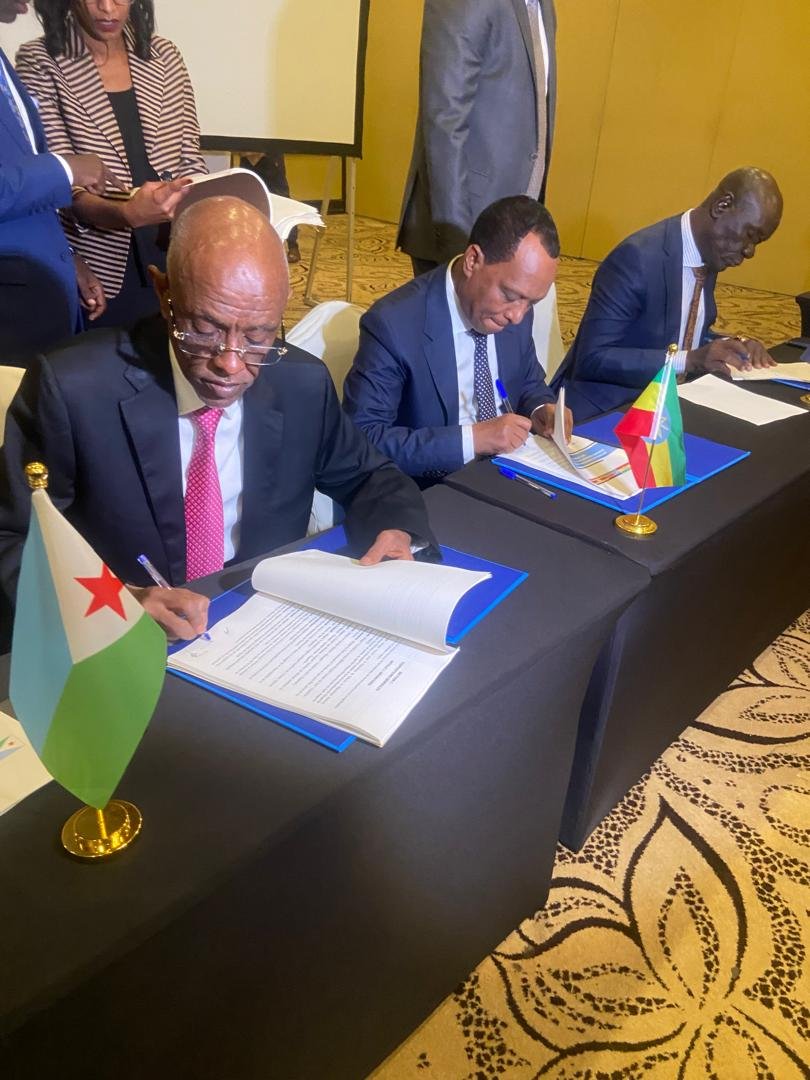
After a three-month delay, ministers from Djibouti, Ethiopia, South Sudan, and Uganda have officially signed an agreement to establish the Djibouti–Ethiopia–South Sudan–Uganda (DESSU) Corridor Authority, marking a major milestone in East African regional integration.
The signing ceremony, originally scheduled to take place in Ethiopia last November, was held on February 14 at the Palace Kempinski Hotel in Djibouti City. The event was attended by the transport ministers of the four member countries, along with diplomats and development partners.Sources close to the matter told Capital that the November meeting was abruptly canceled due to the unexpected absence of representatives from one of the four member nations.
The newly established authority formalizes the Memorandum of Understanding (MoU) signed last year, transforming the corridor vision into a tangible institution. Officials hailed the development as a strategic game-changer expected to deliver significant economic and logistical benefits by strengthening cross-border connectivity and trade facilitation.Speaking at the ceremony, Hassan Houmed, Djibouti’s Minister of Infrastructure and Equipment, emphasized that the initiative aligns with the goals of the African Continental Free Trade Area (AfCFTA) while reinforcing the bloc’s standing within regional bodies such as IGAD and COMESA.”We are not merely building roads; we are building peace through economic interdependence,” Houmed stated.
He reaffirmed his government’s full commitment to making the DESSU Corridor “a global success and a model of regional integration for the entire African continent.”Ethiopia’s Minister of Transport and Logistics, Alemu Sime, framed the corridor as a collective aspiration to build a seamless trade ecosystem across the Horn of Africa.“As a land-linked nation, Ethiopia embraces its role as a connector linking our neighbors, South Sudan and Uganda, to the sea through the ports of Djibouti,” Sime said.
Aboubaker Omar Hadi, Chairman of the Djibouti Ports and Free Zones Authority, provided a detailed vision of the project’s scope, describing the DESSU Corridor as an “integrated economic system” designed to open up landlocked countries to the Red Sea. He outlined a continuous logistics chain linking the Port of Djibouti to key inland cities, including Addis Ababa, Jimma, Boma, Kapoeta, Nimule, Gulu, and Kampala.Hadi stressed that the economic impact would be “direct and quantifiable,” predicting that the corridor will significantly reduce logistics costs, shorten transit times, and improve supply chain predictability.“These efficiencies will translate into stronger export competitiveness, increased trade volumes, industrial development, job creation, and sustained GDP growth across the four countries,” he added.