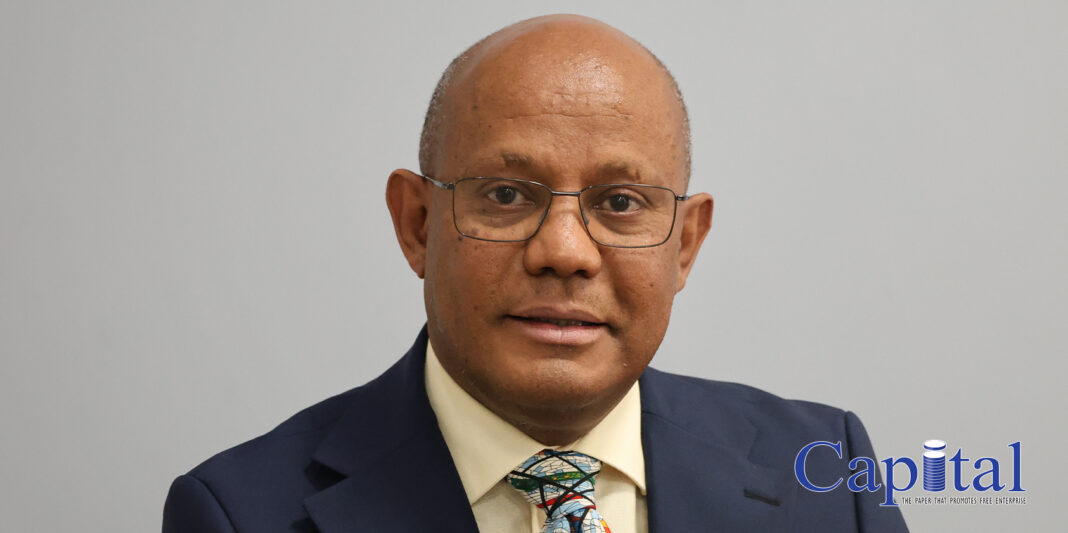
As Ethiopia stands on the threshold of a historic economic transformation with the launch of its first-ever capital market, attention is turning to the professionals tasked with shaping its foundation. In an exclusive interview with Capital, Million Kibret, Managing Partner at BDO Ethiopia, shares insights into the opportunities, challenges, and critical prerequisites for building a vibrant, transparent, and trustworthy financial ecosystem.
Armed with a newly secured license from the Ethiopian Capital Market Authority, BDO Ethiopia — a member firm of the global BDO network operating in 169 countries — is positioning itself to play a pivotal role in guiding businesses from private, family-dominated structures toward broader public participation.
In this wide-ranging conversation, Million explains how BDO is leveraging international expertise to strengthen local capacity, why restoring and safeguarding public trust is essential following past unregulated investment schemes, and why the most pressing challenge facing Ethiopian enterprises today is the absence of sustainable systems and corporate governance. Excerpts:
Capital: What unique professional support is BDO bringing to the newly launching Capital Market in Ethiopia?
Million Kibret : BDO in Ethiopia is a member firm of BDO International, an organization operating in 169 countries providing financial advisory, accounting, and audit services. As a member firm in Ethiopia, we have been advising organizations with international scale and quality, specifically in the financial management area.
Since 2013—meaning for the last 13 years—we have been providing consulting services in Ethiopia, particularly regarding investment and finance. Until now, we have been advising family-founded companies to help them grow.
Now, the license we received from the Capital Market Authority will enable us to assist these companies go beyond growing using their own resources; it allows them to seize the opportunity to raise the funds they need for growth from the public in addition to banks.
Capital: What specific strategies does BDO use to strengthen Ethiopia’s capital market and build public trust?
Million: Well, our local banks have tried their level best to the best of their capacities. However, their resources are limited. When enterprises need more money than local banks can provide, going public is a good alternative. However, as we witnessed in the recent past, innocent people have historically been taken advantage of by others saying, “We will do this for you, investing like this, get you this benefit…” The main reason for this was the absence of strict regulations.
The Ethiopian Capital Market Authority now responsibly oversees these strict regulations. Under it, licensed advisors and other service providers ensure that money collected from the public is managed according to applicable laws and regulations.
What makes BDO Ethiopia unique is that, as a member of BDO International, it brings the experience of 169 countries. Since Ethiopia is just starting its capital market, we bring people from other countries to train local professionals.
We learn from the mistakes of others while taking best practices, so that our professionals, working alongside international BDO experts, can strengthen the Ethiopian capital market ecosystem, to make it more credible and vibrant.
Often, as you know, the problem is that when an industry starts, people without much credibility or ethical, moral backgrounds grab for their short-term benefits, and the industry is cut short. Then that industry is labeled as “untrustworthy”.
Among our top priorities is to educate the public and people in business. We plan to be engaged in awareness creation with the public at large: “What does a capital market mean? How do you participate in the capital market?” Then, we help those who plan to participate in the market to do so, providing support and advice for them join the Ethiopian capital market.
Our biggest advantage is that we are able to pull resources and accumulated knowledge from many countries around the world, including those in Africa and others like the US and Europe that have been doing this for over a hundred or two hundred years, and we ensure Ethiopians learn from it as we should rely on our local resources.
Capital: During your 13-year stay in Ethiopia, what was the main challenge?
Million: The main problem we observe in most Ethiopian companies is a lack of sustainability. Since many organizations are founded at a family level, when the founder or owner encounters problems like illness or death, the organization often faces the fate of collapsing along with the founders.
Companies are national assets and pillars of the economy; therefore, when a company that delivered for 50 years collapses because of the owner’s absence, the national economy suffers as well.
The big problem we encountered is that companies are not operating based on well-established systems and procedures. Since most started in the aftermath of the fall of the Derg regime, the identity of the organization is closely tied to the personality of the owner.
Because of this, there was no such thing as “Corporate Governance.” Our biggest challenge was bringing companies into a standard operating system and ensuring their long-term sustainability. Additionally, growing without systems and rules is very difficult. One person’s capacity and knowledge can only grow a company to a certain level. For organizations to grow beyond that, operating systems and corporate governance is mandatory.
When companies come to us, the first thing we tell them is: “Even though you are comfortable operating currently, you need a system for your growth and to continue for the years to come.” For example, if we look at giant companies like Boeing, Airbus, or Apple, their creators are gone, but the organizations are still growing. Apple didn’t stop after Steve Jobs died; rather, it continued expanding.
This happened because they have strong systems and guidelines. Our major challenge was to detach companies from the identities of their owners and make them run using their systems.
Capital: The Ethiopian financial sector is in transition. With bank mergers and the entry of foreign banks expected, what is BDO doing in its advisory service?
Million: BDO works with banks, insurance, and financial institutions in many countries. Bringing that international experience to Ethiopia, we are planning to enhance our engagement with local banks helping to assist them strengthen themselves as the country opens the sector to foreign investment.
This can take two ways: one is providing advisory services to enable banks to increase their capacity by working together and merging, and the second is helping them modernize their systems.
Working with banks and similar institutions, we share international experiences and advise them on what they should do to withstand the competition.
Now that we have obtained a capital market advisory license, we will strive to help financial institutions to enhance their capabilities according to the license given to us. To make Ethiopian banks competitive, we are working to bring selected professionals from countries where the sector has flourished to a level becoming the pillar of economic growth and financial inclusion.
Capital: The late start of Ethiopia’s capital market can be seen as a good opportunity. As a professional, in which direction do you say the country should move to use this opportunity?
Million: Going forward, organizations that have been moving through private effort must grow and become larger by utilizing the benefits of the capital market following the law. Although Ethiopia is a large country, we do not have many large companies relative to the country’s size and level. For example, Ethiopian Airlines is a world-renowned institution we are proud of. However, we need many more companies as large as the airline to build the country’s economy. Such giant institutions cannot be built by the effort of one person or one family alone.
Therefore, organizations must strengthen their corporate governance, systems and structures, join the capital market, collect additional capital, and grow. This process has great benefits for the owners as well.
Mostly, when business organizations are established, the founder or owner must be there 24 hours a day and take all the suffering and worry. But when they join the capital market, because there is a clear operation system, and accountability, the owner doesn’t necessarily have to be there all the time. A successor can be assigned to take the institution forward. This creates great relief and opportunity for the founders to explore other opportunities and enjoy the dividends of their lifetime efforts.
Capital: What would you say was a major success story in your tenure?
Million: The stories of many strong traders can be mentioned as examples.
After working for 40 or 50 years on an enterprise, they come to us saying, “We are tired, what should we do?” We take time to build a business system, procedures, and corporate governance for them. This enables them to pass their organization to their children or have it led by a professional manager.
Because of this, many of our clients have informed us, “Until now, we were slaves in the organization we created ourselves; now you have set us free.” Although they initially feared, “What will happen to the organization without me?” once they set up the system and let it go, they find freedom.
This freedom, besides giving relief to the owner, allows the organization to grow beyond one person’s capacity and effort. Overall, seeing organizations that its owner said “we were tied up and couldn’t grow farther” fix the bottlenecks of their operations and reach a high level is our greatest success.
Capital: In addition to the points you mentioned, what do you say is the unique reason that family businesses fail to continue or remain a bottleneck?
Million: Recently, at the 3rd Ethiopian Family Business Forum organized by HST Consulting, Commander Haile Gebrselassie said: “From time to time I’m being engaged in mediating between successor children when company founders become absent. The problem aggravates to the extent of companies being closed by court orders. This problem stems from the company not having a succession plan and clear operating systems and procedures in advance.
To solve the problem, founders must answer the question “Who will replace me if I am not there?” and prepare their succession plan properly, so that, in cases of the founder departing from the company for various reasons, the appointed person can immediately take over and continue the operation of the company.
Capital: Do you believe the government should play a role in guiding family businesses toward more sustainable governance and operational structures?
Million: The relevant government bodies should collaborate with the family business community to establish frameworks that ensure the sustainable operation of family-owned enterprises, particularly when founders step down or are no longer able to lead. Company closures have far-reaching impacts—not just on the family, but also on employees, suppliers, customers, and the wider economy.
By working together, the government and business community can develop legal mechanisms to enable businesses to continue operating in the absence of founders, including appointing professional managers and family representatives to oversee succession and continuity.
Capital: Do you see scope for collaboration with peer institutions to initiate and advance policy reforms that strengthen the sustainability of family businesses in Ethiopia?
Million: Certainly! It is possible to prepare a draft document with service-providing institutions like HST and present it to the government. It is not always appropriate to just blame the government. Initiatives for new legal instruments can originate from the private sector, the professional associations and individuals. Therefore, BDO and others working in the local business environment can coordinate and provide advice and support to the government presenting draft policy documents for better results to emerge.