Senior Ethiopian officials have issued a grave warning over the rise of what they describe as “legal contraband” — an organized smuggling scheme that exploits investment and business licenses as cover for large-scale illicit trade.
Security and trade authorities say the practice is severely damaging the national economy, forcing legitimate manufacturers out of the market and channeling funds to anti-peace and terrorist groups.
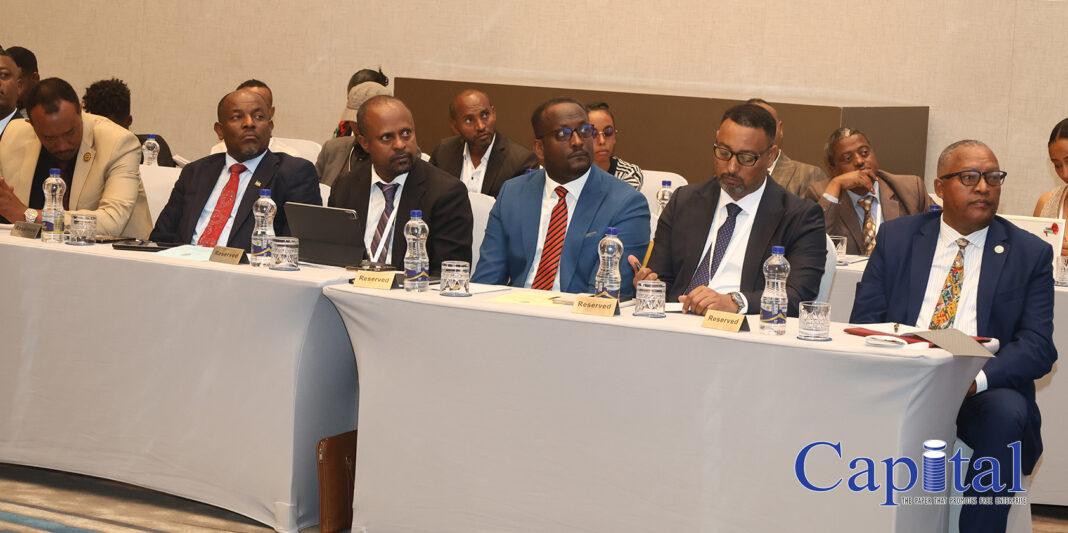
The warning came during a panel discussion at the 4th National Anti-Illicit Trade Conference organized by the Ethiopian Chamber of Commerce and Sectoral Associations. The session brought together senior representatives from the National Intelligence and Security Service (NISS), the Ministry of Trade and Regional Integration, the Ethiopian Customs Commission, the Ethiopian Federal Police, and the Information Network Security Administration (INSA).
A NISS representative disclosed that individuals are acquiring investment licenses not to operate legitimate businesses, but to access foreign exchange privileges and import rights that are then used to facilitate smuggling operations. Despite ongoing digital reforms, gaps in post-licensing monitoring have allowed such networks to expand.
Officials said domestic industries — particularly steel and corrugated iron manufacturers — are bearing the brunt of the impact. Criminal networks, operating under the guise of legality, import goods at predatory prices and flood the market, undercutting local producers and distorting competition.
In a striking admission, the NISS representative acknowledged that elements within government institutions tasked with prevention, including security bodies, have been implicated. “When we examine the data, the involvement of government bodies assigned to prevention is significant,” the official said.
The problem is compounded by deceptive practices in the marketplace. Smuggled goods are being repackaged with counterfeit “Made in Ethiopia” labels, misleading consumers and further eroding the competitiveness of genuine domestic products.
Authorities also warned that contraband networks are emerging as major sources of financing for anti-peace forces. While such groups have often been associated with diaspora funding, intelligence findings indicate growing self-financing through the smuggling of locally sourced gold, hashish, and fuel.
An INSA official cautioned that without stronger oversight mechanisms, digital trade systems could inadvertently become tools that facilitate — rather than prevent — contraband activities.
Law enforcement officials detailed increasingly sophisticated tactics by illicit traders. Aman Hoboro, Deputy Commander and head of the Tax and Customs Crimes Investigation Department at the Federal Police, said smugglers are storing goods in small consignments inside national parks, exploiting protected areas to evade detection.
“These activities are causing serious destruction to both natural ecosystems and public health,” he said, noting confirmed environmental damage and harmful health impacts linked to the operations.
Police investigations have also uncovered schemes in which brokers use the identities of homeless youth who have migrated from various regions to obtain business licenses. In many instances, the individuals named on the licenses are unaware that their identities are being used to facilitate illegal trade.
Data presented by the Ministry of Trade and Regional Integration underscored the scale of the challenge. Over the past year, authorities inspected approximately 3.12 million business entities. Of those, 482,092 — about 15.4 percent — were found to be in violation of legal procedures.
Product quality inspections revealed further concerns. Of 126 factories producing 26 categories of consumer goods, all were found to be operating below mandatory standards, prompting administrative action. Three factories are facing legal proceedings for manufacturing products deemed highly hazardous to human health.
Import controls have also intensified. Of more than 3.1 million metric tons of goods imported by over 15,000 traders last year, 1,504 metric tons failed to meet mandatory standards and were returned to their countries of origin.
The forum concluded with a consensus that contraband and illicit trade now constitute a multi-dimensional threat to national security, economic stability, environmental protection, and public health. Officials pledged to strengthen regulatory oversight and enforcement measures to dismantle the deeply entrenched criminal networks operating under the cover of legality.