Since the introduction of macroeconomic reform on July 29, 2024, the National Bank of Ethiopia (NBE) has rolled out a series of sweeping changes. Most notably, on February 11, the NBE took a bold step by easing foreign exchange directives, granting banks a more prominent role in forex management.
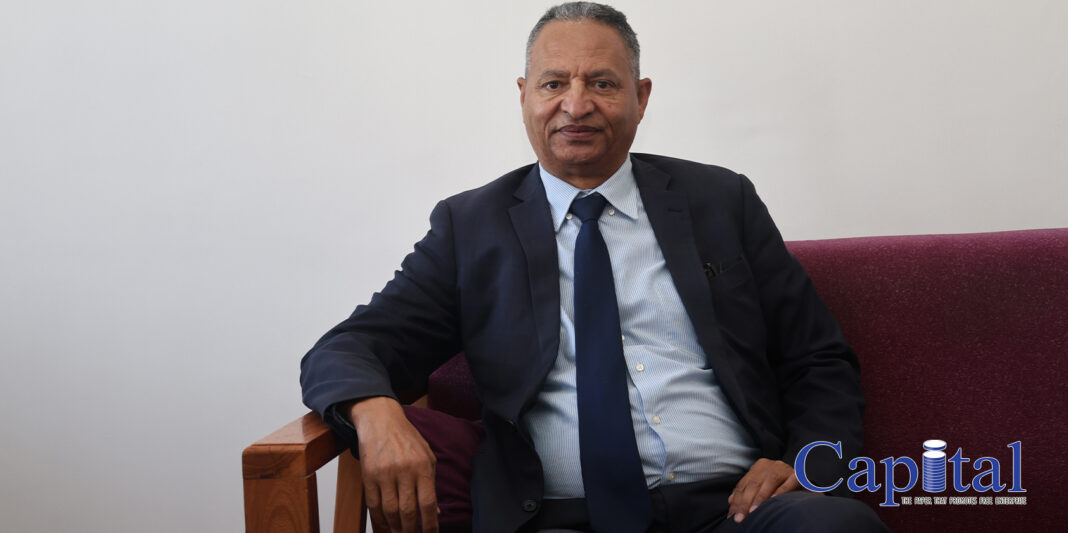
To assess the significance — and the risks —of these reforms, Capital sat down with veteran banker and economist Eshetu Fantaye, whose career spans more than three decades in Ethiopia’s financial sector.
Eshetu began his career after earning his degree in economics from Addis Ababa University. Like many of his peers, he joined the state-owned Commercial Bank of Ethiopia (CBE), rising through the ranks to become Vice President. After a brief stint with a California-based ICT firm, he returned to banking in 2006 as Vice President of Awash Bank. He later served as President of Bunna Bank and founding President of Ahadu Bank.
Currently, he works as a consultant for local and international institutions.
Capital: How do you view the new foreign exchange directives issued by the National Bank of Ethiopia? What is their significance for the economy?
Eshetu Fantaye: To be honest, these reforms are long overdue—but absolutely necessary. I recently worked on a report assessing their overall impact and how they compare with international experience.
It’s important to remember that the transfer of foreign exchange authority from the NBE to commercial banks is not entirely new. The first major shift occurred in 1998 under Directive No. FXD/07/1998. I was a member of the committee that drafted it. That directive marked the NBE’s transition from directly handling foreign exchange to regulating it.
However, political and security disruptions—including the Ethio–Eritrea war—diverted attention from implementation. As a result, the reform momentum stalled. Had those early reforms continued consistently, Ethiopia might not be facing today’s severe forex shortages.
What we are seeing now are “Second-Generation Reforms”—a continuation of a policy shift that began decades ago. These measures could significantly improve bank operations, reserve management, trade financing, and correspondent banking relationships. Above all, they send a strong signal to markets and international institutions: Ethiopia is moving forward.
Capital: What impact will these directives have on commercial banks and the broader financial system?
Eshetu: The impact is significant. Over the next 24 to 36 months, we can expect major structural adjustments within both the central bank and commercial banks. This transition is further complicated by the anticipated entry of foreign banks and the commencement of operations by Fintech firms and payment gateways.
These directives demonstrate the regulator’s (NBE) commitment. I see them as steps taken to solidify the reform measures initiated in July 2024. For instance, the introduction of forward foreign exchange contracts is a landmark change. Previously, Ethiopia lacked such instruments. Now, importers can hedge against currency volatility—an essential risk management tool in modern banking.
Capital: What is the benefit to the import community of allowing forex trading to be market-driven and permitting practices like forward dealing?
Eshetu: Under the old system, when an importer opened a Letter of Credit (LC) for $1,000, they would deposit 40% or even 100% of the value in birr at the prevailing exchange rate. However, by the time the goods arrived months later and the final payment was due, the purchasing power of the birr might have declined. The importer often suffered a hidden loss—forced to pay 20% or 25% more than originally planned. This instability erodes profit margins and fuels inflation.
With forward dealing, a bank can now tell a trader, “I will sell you these dollars 90 days from now at a specific fixed rate; in return, you pay me a small service fee.” This provides certainty to the trader. They can accurately price their goods from day one without fear of exchange rate hikes 90 days later.
However, there is a catch: our banks currently lack the sophisticated risk management and liquidity forecasting systems required for such operations. Without careful preparation, forward contracts could create liquidity stress.
Capital: Are Ethiopian banks ready for this? What concerns do you have regarding their ability to compete with foreign banks expected to enter the market?
Eshetu: This is where the biggest gap lies. Even major players like Awash, Dashen, the Commercial Bank of Ethiopia (CBE), and Abyssinia may not currently have the internal capacity to implement this. If I were a manager at one of these banks, my immediate focus would be on developing operational guidelines.
When foreign banks enter, they bring massive capital, modern systems, international networks, and deep expertise. Our banks, however, have relied almost exclusively on interest income. They must now shift their focus toward fee-based income.
Expertise is not acquired overnight. Banks must form alliances with international banks like Citibank or JP Morgan, recruit skilled professionals, and establish foreign exchange dealing rooms. They need to upgrade their systems through consultancy and training. To fast-track this, they should design and execute a project to be completed within a specific timeframe. Otherwise, when foreign banks arrive, they will severely hurt domestic banks, particularly in corporate lending and trade services.
Capital: The new directive allows banks to manage external loans and guarantees. What risks and opportunities does this present?
Eshetu: This carries significant risk! Until now, our banks have had zero experience in this area; the National Bank previously handled it. Now, the responsibility has been shifted to commercial banks. Managing this requires immense knowledge and caution.
If banks do not establish a strategic program office and complete their preparations within 120 to 180 days, the danger will be severe. The National Bank should also issue another strict guideline stating that “every bank must verify it has the systems in place to implement this directive.” Otherwise, foreign banks will enter while local banks are at their weakest and dominate the market.
Capital: What does the experience of other countries look like, and what can we learn from them?
Eshetu: If we look at countries like India and Vietnam, they began to see results within the second year of implementing such reforms. India completed its overall formalization process in the early 1990s, and our journey is clearly headed in that direction.
Vietnam began its reforms in 1989, and the transformation they have achieved since then is truly remarkable. They have successfully attracted major international companies. Interestingly, they don’t focus on complaining about their currency’s value dropping against hard currencies; instead, they prioritize embracing the reform and reaping its long-term benefits.
I would advise those involved in this process, and those closely following the reform, to observe the example of Vietnam. At the time of its reforms, Vietnam’s economy was below ours, yet their currency unification and foreign exchange policies have led to tremendous success.
Moreover, the fact that the NBE is demonstrating strong commitment and is not turning back sends a powerful signal that will encourage Foreign Direct Investment (FDI).
Capital: One of the most sensitive issues in the new directive concerns the repatriation of accumulated dividends. What pressure could this place on banks?
Eshetu: This is a critical point. To date, many companies have invested foreign currency and generated profits in Ethiopia but have been unable to repatriate their dividends due to the foreign exchange shortage.
For years, giant companies—such as international airlines, Chinese construction firms, Dangote, and Heineken—have accumulated profits in birr but were unable to repatriate them due to forex shortages.
The NBE must be very cautious here. If these companies suddenly bring their massive accumulated birr reserves to commercial banks all at once, banks will face a serious dilemma: allocate scarce forex to essential imports like life-saving medicine, or to dividend payments? If not handled carefully, this could create significant market distortion.
We need a dedicated “pipeline” or a tiered repayment strategy to address these old dividend obligations. We must not suddenly dump years of accumulated foreign exchange demand onto banks that still lack sufficient reserves.
Furthermore, the exact amount of money held as accumulated dividends needs to be clearly identified. The key question is: How will this money exit? If these requests are directed to commercial banks and the responsibility is shifted entirely onto them, we must remember that these banks already have very limited foreign exchange capacity.
While banks are currently struggling to pool currency for critical imports, being flooded with dividend requests will only increase their distress. Banks might be inclined to prioritize these payments because of the service fees they can collect, but that could hinder the importation of essential goods. Therefore, the implementation guidelines for this directive must be extremely meticulous.
Capital: What about the new $3,000 outward remittance allowance for individuals?
Eshetu: This can be viewed from two perspectives. On the one hand, it holds significant value in building public confidence. On the other, it is almost equivalent to opening a small-scale capital account. Just imagine if ten thousand people simultaneously decided to convert their birr and send dollars abroad—it’s easy to see how banks would struggle to accommodate such demand.
This is a major gamble. The biggest challenge lies in the banks’ capacity to implement it. If the directive exists on paper but banks tell customers “we don’t have it” when they visit, public trust will quickly erode. Furthermore, there remains a gap of at least 15% between the official exchange rate and the rates offered by forex bureaus, especially private ones. What happens if everyone tries to take advantage of this opportunity? Even if the purpose isn’t speculation, can banks handle thousands of people wanting to pay for education or other courses? These scenarios must be clearly addressed in the guidelines.
Capital: What about international commitments?
Eshetu: Yes, there are obligations—such as funds owed to international airlines like IATA—that are earned in birr and must be repatriated. Similarly, international organizations that previously couldn’t convert their holdings may now want to bring in foreign currency to purchase assets. All of these must be clearly reflected on the banks’ balance sheets. The central bank needs to have precise figures on these amounts.
Following that, there should be a “gentleman’s agreement” between the central bank and commercial banks. A clear framework is necessary: “I will assist with this much, but try to meet the rest through your own forex inflows.” Simply delegating responsibility without support won’t work. We must be careful not to “give the meat but withhold the knife.”
Capital: Some people, including you, argue these measures should have accompanied the July 2024 reform package. Why?
Eshetu: I believe that if this foreign exchange policy had accompanied the initial reforms, the roller coaster of price fluctuations we are seeing now could have been navigated more smoothly.
If the government doesn’t negotiate effectively with the IMF, they won’t allow you to do what needs to be done. For example, two billion dollars was released. Why wasn’t it given to us on Day One? Had we received it immediately, it would have helped curb speculative sentiment in the market.
Ethiopia needed an allocation closer to $4 billion. If that had happened, the value of the birr wouldn’t have jumped from 50 to 150, and capital flight could have been deterred. Confidence would have been built, preventing investors from selling local assets to move money abroad.
However, the IMF is releasing funds “drop by drop,” acting like a typical lender that won’t disburse without verifying strict compliance. This is where strong negotiation capacity becomes essential.
Capital: How do you assess the birr’s depreciation and its impact on living costs?
Eshetu: To be honest, it saddens me that the value of the birr has exceeded 75 or 80. This was something that could have been managed. If the situation had been handled properly from the start, it could have been prevented from going this far. This isn’t politics; it’s purely a matter of economic management.
Now, demands for wage increases will inevitably arise. But since 40–45% of our consumer goods—such as medicine, oil, fertilizer, and edible oil—are imported, costs rise significantly as the birr weakens.
While it’s good that the central bank eventually started forex auctions, it should be criticized for not starting sooner. This delay exposed the economy to high risk. At a time when it’s said Ethiopia is heading toward a 72% multidimensional poverty rate, such price volatility poses a threat to national security.
Capital: Finally, are Ethiopian banks ready? What must be done on capacity building?
Eshetu: This is a crucial point. For a generation that has lived in a closed economy for the last 50 years, this is completely new. Capacity must be built—from the Governor down to frontline bank staff. There is a major capacity gap, particularly in forward markets, forex dealing, and external loan analysis. We shouldn’t expect banks to close this gap in just a year or two.
The central bank should give commercial banks a short window—say, 180 days—to prepare. Banks, in turn, should use their financial resources to enter training agreements with reputable international banks from India, Europe, or the US. They must strengthen themselves in manual preparation, risk management, and technology. The central bank must also establish a system for data-driven monitoring. In short, the central bank and commercial banks must work in coordination, much like a Public-Private Partnership (PPP).
QUOTES
· “These reforms are long overdue—but absolutely necessary. What we are seeing now are ‘Second-Generation Reforms’ that send a strong signal that Ethiopia is moving forward.”
· “If banks do not establish a strategic program office and complete their preparations within 120 to 180 days, foreign banks will enter while local banks are at their weakest and dominate the market.”
· “We must not suddenly dump years of accumulated foreign exchange demand onto banks that still lack sufficient reserves.”