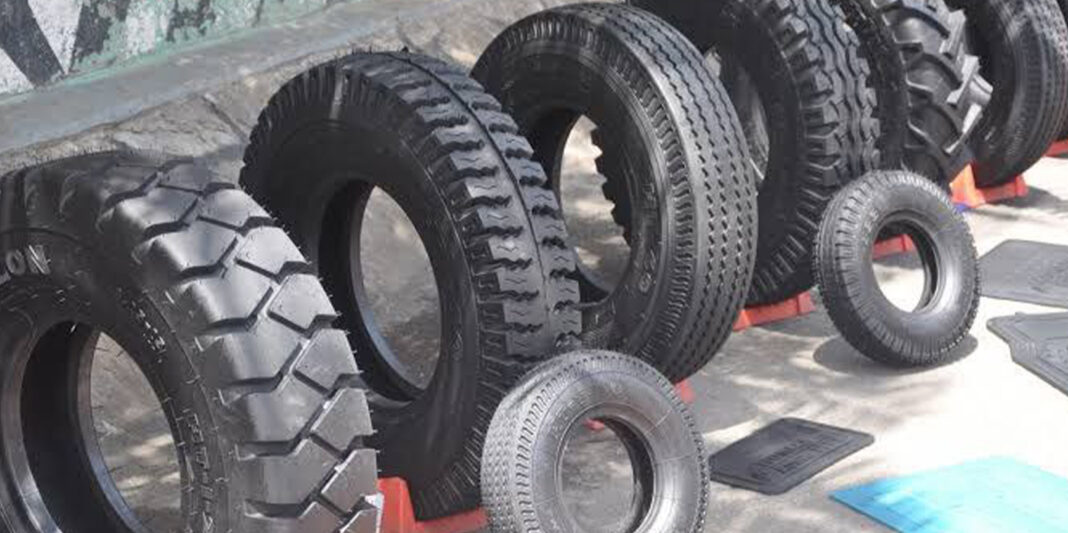
Horizon Addis Tyre Manufacturing (HATM), Ethiopia’s pioneer and sole tyre manufacturer and a key player in East Africa’s industrial landscape, has announced that its survival is under grave threat due to surging illegal tyre trade and the absence of mandatory quality standards.
Established in 1972 and currently under the MIDROC Investment Group, Horizon Addis has grown from producing four types of tyres to over 54 varieties, including specialized tyres for agriculture, industry, and military vehicles.
However, company leaders argue that these industrial achievements require urgent protection from an unregulated “shadow market” operating across Ethiopia’s borders and within its cities without accountability.
The company, which boasts over half a century of history, stated that it currently faces a high existential risk due to widespread contraband trade, the lack of mandatory national quality standards, and sophisticated tax evasion methods.
Elias Gebremichael, the Marketing Section Head at HATM, told Capital that while the factory has the capacity to cover 35% to 40% of the domestic market, its actual share in the formal market is being significantly eroded by illegal traders.
He emphasized that the survival of this massive institution now depends on the speed and effectiveness of government intervention. The manufacturer identified the primary obstacle as the lack of a mandatory national standard for tyres entering Ethiopia.
To date, the Ethiopian Conformity Assessment Enterprise has not implemented strict standards to prevent low-quality products from entering the market.
“Because there is no mandatory standard, the market is open to anyone,” Elias stated. “Whether the tyres enter legally or via contraband across borders, they are sold openly. The lack of criteria has allowed low-quality and often dangerous products to be viewed as equal to high-quality, locally produced tyres.”
The manufacturer also pointed out another widespread deception among importers: “Ply Rating” (PR) fraud. In the tyre industry, the ply rating determines the load-bearing capacity of the tyre.
“We have a ‘Capacity Analysis’ method where we cut and examine the internal components of the tyre,” Elias said. “We often find tyres labeled ’16 Ply’ for heavy trucks that don’t even meet an ‘8 Ply’ count when inspected.
“They look the same to the consumer, but they explode under pressure. This isn’t just unfair competition; it’s a public safety concern.”
Beyond quality issues, the factory is struggling against an illegal practice known locally as “yetregate Goma” (tyres fitted on vehicles). These are tyres brought into the country fitted to a vehicle to evade import taxes.
According to Elias, while the government does not charge duty on tyres fitted on imported vehicles, the scale of this activity suggests it is being used as a strategic contraband method to bring in new or slightly used tyres in bulk.
While Horizon Addis covers high manufacturing costs—including salaries for over 800 employees and tax obligations—contrabandists operate out of hidden warehouses with minimal overhead, he protested.
“It is estimated that the monthly tyre trade in Ethiopia exceeds 3 billion Birr,” Elias told Capital. Contrabandists focus on high-demand “work vehicle” tyres—specifically for Isuzu trucks, minibuses, and ‘Abadula’ (LGR) vans. Because these vehicles travel long distances, their tyres wear out quickly, making them the primary source of revenue for the sector. By controlling this segment illegally, smugglers are negatively impacting the local factory’s main revenue stream.
Regional traders often refuse to buy from the factory because Horizon Addis issues legal invoices, which leaves a paper trail for tax authorities. Instead, these traders prefer to buy from illegal wholesalers in suburban warehouses who sell without documentation.
“When we compare our prices to the market, we can’t even factor VAT into the competition because our competitors simply don’t pay the tax,” Elias said.
“We aren’t just talking about money; we are talking about our survival,” the marketing head emphasized. With over 800 employees working 24 hours a day across three shifts, the factory is the livelihood for thousands of families.
Although the Ministry of Industry and other relevant bodies are providing support, the pace of the solution does not match the scale of the problem.
The Horizon Addis Tyre Factory was inaugurated in 1972 by Emperor Haile Selassie and later operated as a joint venture with Slovakia’s MATADOR. Since 2013, it has been fully under Horizon Plantation (MIDROC) and has significantly modernized its production.
The company data indicates that the factory is a peerless institution in the sector, producing tyres suited for Ethiopia’s landscape, providing warranty services, and offering technical training.
However, the organization reiterated that unless decision-makers take immediate action regarding standard controls and anti-contraband measures, the future of the domestic tyre industry remains precarious.