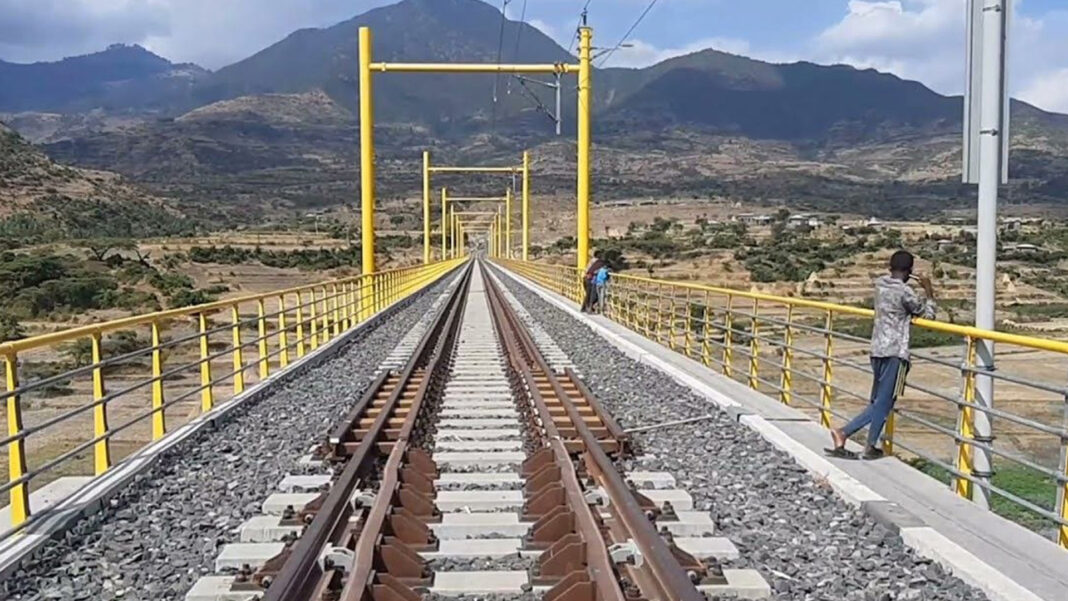
The Ethiopian Railway Corporation (ERC) plans to complete the remaining construction of the Awash–Kombolcha–Woldiya–Hara Gebeya railway project within two years. This follows the resolution of a compensation dispute with Turkish contractor Yapı Merkezi.
A senior ERC official, who wished to remain anonymous, informed Capital that the corporation has budgeted and made arrangements for the remaining work. However, the official declined to disclose the allocated amount or the company selected for the undertaking.
In addition to completing unfinished sections, the ERC is also focused on repairing railway infrastructure damaged by conflict in northern Ethiopia and by earthquakes. Construction activities are reportedly underway in Kombolcha and Dessie.
The 392-kilometer railway project was initially awarded to Yapı Merkezi in August 2015, under a contract valued at $1.7 billion. The dispute between the contractor and the Ethiopian government stemmed from disagreements over contract performance, construction delays, payment issues, and damage to the company’s assets during the war in northern Ethiopia.
According to the ERC official, the four-year arbitration dispute in London concluded on September 23, 2026.
The arbitration ruling ordered Ethiopia to pay Yapı Merkezi $213.7 million in damages, which includes nine percent interest, along with $29.1 million in advance payments, as reported by Capital.
These damages reportedly comprise $67.4 million in unpaid amounts owed by the corporation, $76.7 million for construction delays, and $89.2 million for damage to the company’s assets during the war in northern Ethiopia.
Yapı Merkezi had initially sought over $1 billion in compensation from the Ethiopian government, while Ethiopia filed a counterclaim for $400 million, according to the ERC.
Negotiations were also held in Istanbul and Addis Ababa to resolve the dispute. Yapı Merkezi reportedly offered to settle for a lump sum payment of $500 million, with interest calculated at commercial bank rates, but this proposal was rejected.
A 27-member Ethiopian team of legal, financial, and engineering experts, led by Addis Ababa University law professor Tilahun Teshome, represented the country during the arbitration proceedings.
Yapı Merkezi had also named the Ministry of Finance and the Ministry of Transport and Logistics in the case, in addition to the ERC. The tribunal reportedly dismissed the claims against these two ministries, a decision expected to reduce the risk of Ethiopian government assets abroad being used to enforce the award.
Furthermore, the tribunal ordered Yapı Merkezi to transfer project vehicles and machinery to the ERC.
In a separate statement, Yapı Merkezi announced that it had been awarded $307 million in compensation in its dispute with the ERC.
When asked about the discrepancy between the figures announced by the contractor and those reported by the corporation, the ERC attributed it to differences in the interest calculation periods, rather than a fundamental disagreement with the ruling itself.
Both parties reportedly have 28 days from the decision’s issuance to appeal. However, sources familiar with the case informed Capital that neither the ERC nor Yapı Merkezi currently intends to appeal.
The planned two-year completion period marks the next phase of work on this railway project, which has been significantly impacted by construction delays, payment disputes, and infrastructure damage.