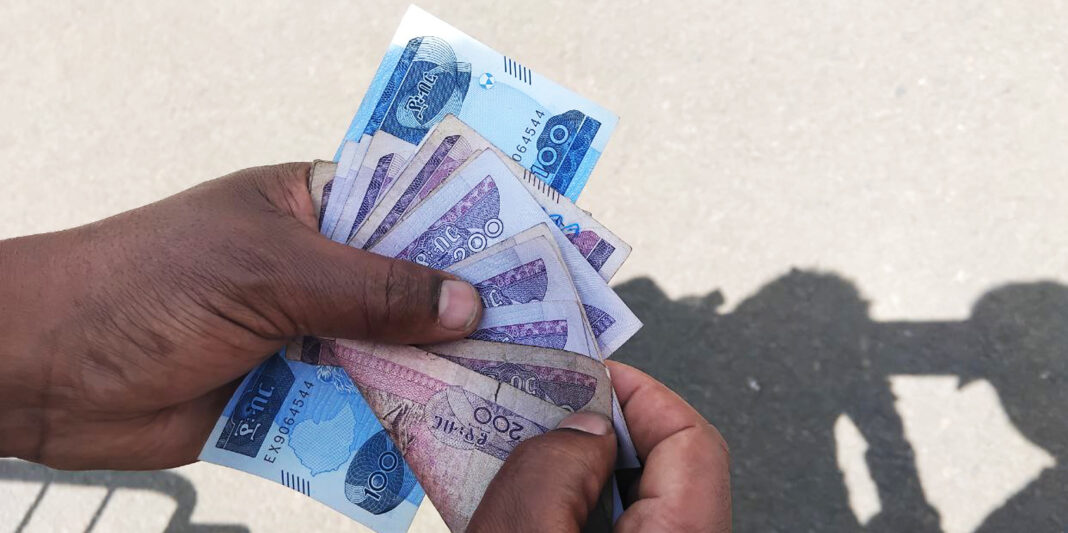
The Ethiopian birr has emerged among the weakest performing currencies in sub-Saharan Africa this year, depreciating by more than 10 percent against the U.S. dollar by the end of September 2025. The decline marks a significant setback for Ethiopia’s foreign exchange market, deepening challenges for businesses struggling to access hard currency and widening the premium in the parallel market.
Recent data show that the birr’s decline places it alongside the South Sudanese pound among the region’s poorest performing currencies of 2025. Analysts note that the ongoing volatility highlights persistent structural constraints in the country’s foreign exchange environment and underscores difficulties many businesses face in securing dollars through official channels.
A World Bank report released on October 8, 2025, revealed that the National Bank of Ethiopia (NBE) has implemented a string of corrective measures aimed at stabilizing the currency and narrowing the black market divergence. The measures include tightening regulations on banks’ foreign exchange transaction and service fees while restricting sales to priority sectors such as trade, personal travel, and essential goods.
The report also noted that despite escalating forex pressures, Ethiopia’s 2025 economic growth forecast has been revised upward by 0.7 percentage points, driven by resilient domestic activity and stronger performance in key industries. This gain, along with improvements in Nigeria and Côte d’Ivoire, has positioned Ethiopia among the few African economies with an upgraded growth outlook this year.
Over the long term, Ethiopia’s per capita income had grown at an average annual rate of 5.9 percent between 2000 and 2019, according to World Bank figures. However, recent data from global trading platform XS.com underscore the birr’s continued depreciation against major currencies. As of October 7, 2025, the exchange rate stood at approximately 144.50 birr per U.S. dollar, or $0.0069 per birr.
Economists attribute the weakening currency to multiple domestic pressures, including high inflation, a persistent trade deficit, and political instability that have collectively undermined investor confidence. While the government continues to pursue gradual foreign exchange liberalization, the birr remains under downward pressure, with its official rate still overvalued relative to parallel market rates.
The World Bank’s regional review placed the Ethiopian birr 18th among Africa’s 21 weakest currencies in 2025. A similar assessment by the XS.com Economic Institute ranked Ethiopia as the 26th poorest country globally, positioning its currency just below Yemen and slightly above Haiti in comparative strength.
The International Monetary Fund (IMF) has reiterated that exchange rate evaluations are based on official currency benchmarks against the U.S. dollar, reflecting each country’s macroeconomic fundamentals and market confidence. For Ethiopia, the current trend underscores the complex balance between market reforms and macroeconomic stability as the nation moves toward more liberalized foreign exchange management.