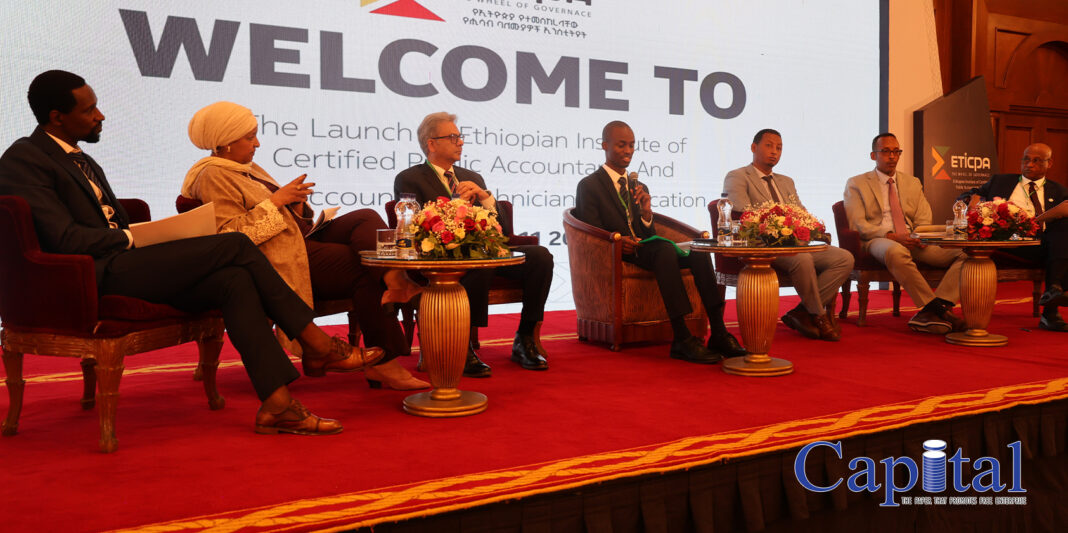
Ethiopia’s sweeping economic reform agenda is facing a critical bottleneck as a severe shortage of certified accountants hampers the ability of state-owned enterprises (SOEs) to produce audited financial statements on time. The shortage, officials warn, is undermining investor confidence and limiting transparency in both public and private sectors.
State Minister of Revenue Abdurham Eid Tahir said the shortage of qualified financial professionals has become a major national concern, directly affecting economic governance and tax compliance efforts. “Our tax-to-GDP ratio has dropped to just 6.5%, which is less than half the 15% minimum recommended by the World Bank and the IMF for low-income countries,” he noted. By comparison, neighboring Kenya’s ratio stands at 16%.
According to the minister, much of Ethiopia’s tax non-compliance stems from accounting capacity gaps. “In many cases, businesses fail to comply not out of intent, but because their financial reports are not properly prepared due to the shortage of trained accountants,” he said.
Recalling his time at Ethiopian Investment Holdings, Abdurham stated that at one point, there was “only one certified public accountant among the country’s largest state-owned development enterprises.” This lack of qualified professionals, he said, made it nearly impossible for these enterprises to submit timely audited financials—further complicating oversight and policy decisions.
The shortage has forced tax authorities to rely heavily on enforcement measures to collect revenue. “About 20% of Ethiopia’s total tax revenue now comes from enforcement actions,” Abdurham said. “In contrast, countries like Kenya collect the vast majority through voluntary compliance.”
He emphasized that the problem is not only quantitative but also qualitative. “A competent accountant must understand local tax laws, public accounting standards, and compliance expectations. Without that, even well-intentioned taxpayers can fall into non-compliance,” he added.
These remarks were made during the official launch of the Ethiopian Institute of Certified Public Accountants (ETiCPA), a long-awaited institution tasked with transforming the country’s accounting and audit profession.
For decades, Ethiopia depended on foreign credentialing systems—such as the ACCA in the UK or the American CPA—to train its accountants. While internationally respected, those programs are often disconnected from Ethiopia’s specific legal, fiscal, and regulatory environment. Dependence on external certifications also led to large foreign exchange outflows and limited accessibility for local professionals.
The government established ETiCPA in April 2025 under Proclamation No. 1372/2025 to address these long-standing challenges. Deputy Auditor General Abera Tadesse described the new institute as a “foundation for professional accounting that will significantly improve the quality of financial information.” He added that enforcing ethical standards will “reduce fraud, corruption, and systemic financial deterioration” while enhancing the reliability of audit reports.
Speaking at the event, Minister of Finance Ahmed Shide said ETiCPA will be central to Ethiopia’s ongoing financial liberalization, capital market development, and private sector expansion. “The institution will supply trained professionals who meet international standards and help create a credible, transparent financial system,” he said, pledging government support for seven years as the institute moves toward full professional autonomy.
Hikmet Abdella, CEO of FSD Ethiopia, stressed that the pace of reform “cannot continue without well-established professional accountants.” Transparent and timely financial statements, he said, will be vital as Ethiopia integrates into global markets and develops its capital and securities sectors.
Solomon Gizaw, Chairman and CEO of HST Consulting, called the creation of ETiCPA a milestone for the profession. “We, as professionals, have long struggled to establish credibility and structure. This institute now gives us a national platform—one that speaks with the unified voice of the profession,” he said.
Despite these advances, the shortage remains acute. As of late 2025, Ethiopia is estimated to have only 500 to 540 internationally recognized accountants, a strikingly low figure for a country with one of Africa’s fastest-growing economies.
Experts warn that unless this gap is urgently addressed, the country’s reform goals—ranging from expanding public enterprise efficiency to attracting global investment—may be delayed by chronic weaknesses in financial reporting and oversight.