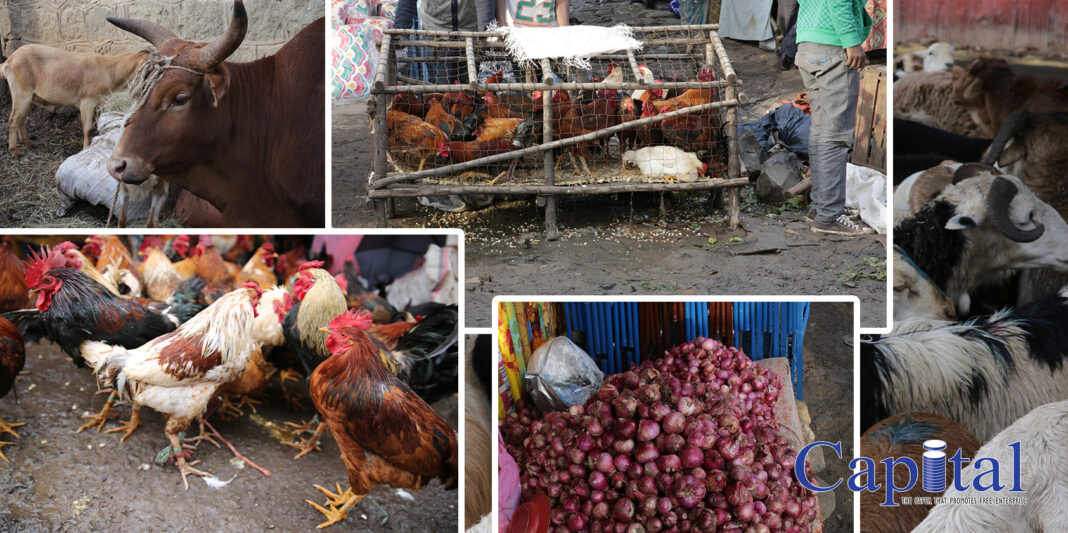
Just before dawn breaks over Akaki, the main livestock corridor leading into Addis Ababa, the fog mingles with the bleating of cattle and the shouts of brokers. The air is thick with the smell of dust, animals, and expectation. But this Christmas season, the energy that once filled Ethiopia’s largest livestock market feels subdued—muted by frustration and fatigue.
Behind that tense quiet are countless stories like those of friends Gizachew and Eshetu, both long-time residents of the capital who arrived before sunrise to buy an ox for Kircha—the cherished tradition of pooling money to share meat during Gena, the Ethiopian Christmas.
Standing near a pen of restless bulls, Eshetu points toward a mid-sized brown ox. “Last year, we bought one like this for around 50,000 Birr,” he says, shaking his head. “Now the dealer wants 150,000. If he doesn’t get that, he says he won’t sell.”
Gizachew sighs heavily as he looks around. “It’s not just the price—it’s the shortage. We used to buy two animals, but not this year. The cost of living has cast a shadow on our celebration.”
Their situation mirrors an all-too-familiar pattern across the markets of Addis Ababa this festive season. The spirit of Gena, usually a time of joy, community, and shared abundance, has collided with an unforgiving economy marked by inflation, supply bottlenecks, and corruption.
Festivity meets financial strain
Ethiopia’s Christmas, celebrated annually on January 7, is a communal holiday that brings families from city to countryside together. It’s both spiritual and social—a day when even the poorest make sure meat is served, symbolizing abundance and gratitude. But for 2018 E.C., that promise has come under pressure.
A mini-survey conducted by Capital across major marketplaces—Mercato, Qera, Shola, and Akaki—reveals that this year’s Gena economy is testing the limits of household budgets.
Even in the traditionally “affordable” sheep and goat markets, prices have spiraled. “This market has lost its taste,” says Teshome Kebede, a father of four, after a failed negotiation with a merchant from Arsi. “I expected prices to stabilize during the holiday since demand is high, but everything doubled. We used to buy good sheep for 12,000 to 15,000 Birr. Now, the same costs close to 30,000 birr.”
For many urban families, celebrating Gena this year requires trade-offs: skipping travel, buying smaller quantities, or settling for butchered meat instead of a live animal.
“It’s heartbreaking,” Teshome adds. “In my childhood, Gena meant slaughtering your own sheep. That sense of pride and family ritual is fading.”
The hidden cost of checkpoints
Traders, long accused of price gouging, counter that they too are victims—caught in an informal web of “roadside taxation.”
A livestock dealer from North Shoa, who requested anonymity, detailed the layers of illegal payments made on the road to Addis Ababa: “Between checkpoints, security posts, and brokers, we pay ‘fees’ that don’t exist on paper. Sometimes it’s 200 Birr, sometimes 1,000 birr—but at every stop, someone demands money. By the time a sheep reaches the city, its price has doubled.”
He continues, “People think traders are exploiting them. But how can we survive when we must pay bribes at every stage, when even fuel and animal feed cost more than ever before?”
This informal “tax” system, which traders say has worsened over the past two years, illustrates a deeper structural problem: the breakdown of supply-chain efficiency and regulatory oversight. It’s also a key factor driving price escalation in livestock markets, which traditionally supply Addis Ababa with hundreds of thousands of animals during the festive season.
The inflation spiral
Beyond checkpoints, larger economic forces are tightening the squeeze. Persistent inflation—hovering around 30 percent for food items by late 2025 according to government data—has eroded the purchasing power of ordinary citizens.
In the Akaki market, chickens—often a fallback for those unable to afford sheep or cattle—now sell for between 1,500 and 2,500 Birr. The price of eggs has reached 25 Birr each, a new high. At such rates, preparing Doro Wat, the iconic Ethiopian holiday dish, has become an expensive luxury.
“Let’s do the math,” says Wubet Ayele, a mother of three shopping in Shola Market. “Two chickens, twelve eggs, five kilos of onions, and a kilo of butter cost well over 7,000 Birr. That’s nearly half a month’s salary for many. The numbers simply don’t add up anymore.”
Her frustration is widely shared. Items once seen as holiday essentials—onions, oil, flour, teff—have all seen sharp increases. Edible oil, in particular, has become a focal point of consumer outrage, with prices jumping from 1,300 to 2,200 Birr per five-liter container over recent months.
Policy efforts and practical gaps
The Ethiopian government has made a series of promises aimed at stabilizing markets ahead of religious holidays. The Addis Ababa City Administration’s Revenue Bureau recently announced initiatives to ensure “sufficient supply” across the capital, emphasizing the distribution of affordable agricultural and manufactured goods through government-managed centers and Sunday markets.
Among its plans:
- Auctioning over 279,000 cattle and nearly 300,000 sheep and goats through official market gates.
- Delivering 633,400 chickens and 15 million eggs to weekend markets.
- Strengthening inspections against illegal stockpiling and artificial shortages.
Officials are also cracking down on illegal checkpoints after repeated complaints from livestock traders. Yet, despite these measures, change on the ground remains limited.
An official at the Ministry of Trade and Regional Integration, speaking on condition of anonymity, acknowledged the “implementation gap.” “Policies exist, but enforcement lags,” he said. “Many of these illegal barriers are local-level problems, sometimes tied to informal power structures. Addressing them requires coordination across multiple regions—a slow and sensitive process.”
Structural cracks in the economy
According to economists, Ethiopia’s recurring price shocks are not purely seasonal—they stem from deeper structural imbalances. Fekadu Lemma, an economic analyst based in Addis Ababa, attributes the crisis to a “threefold pressure” of currency depreciation, logistics inefficiencies, and regional insecurity.
“Our import dependency for fuel, cooking oil, and fertilizer makes us very vulnerable,” he explains. “When foreign exchange tightens, the supply of key goods is disrupted. At the same time, insecurity in some regions delays transportation and raises costs. The result is cumulative inflation that intensifies around holidays.”
Ethiopia’s edible oil industry exemplifies this fragility. The Ethiopian Edible Oil Producers & Manufacturers Association (EOPMA) notes that domestic production only meets 20–23 percent of national demand between November and May, dropping to single digits in other months. Despite over 100 large and small factories, shortfalls persist due to foreign currency constraints needed for raw material imports.
Fekadu adds, “Government programs to expand Sunday markets or cap prices are short-term reliefs. They do not tackle the core issue—productivity and regional equity. Until farmers, traders, and consumers are connected through transparent, efficient logistics, such crises will repeat.”
Household struggles behind the numbers
Back in Akaki, visibility improves as the morning fog lifts, but the prospects for traders remain bleak. Livestock that once moved swiftly now linger unsold. The noise of bargaining is replaced by murmurs of resignation.
“I don’t blame anyone,” says Tesfaye, a broker with two decades in the trade. “Farmers blame traders, traders blame taxes, and buyers blame everyone. But in truth, we’re all trapped in the same circle. Everything along the chain costs more—from transport to feed to labor.”
For middle-income families who once thrived on planned savings, Christmas preparation has turned into crisis management. Some households are skipping ceremonial slaughter altogether, diverting their limited funds for school fees, rent, or medical expenses instead.
Meanwhile, manufacturers of holiday essentials—teff flour, beverages, oil—report declining consumer volumes. “People are buying in smaller units,” says Bethlehem Mekuria, who manages a mini shop in Lideta. “We sell half-kilo bags now. No one wants bulk.”
The social implications are equally profound. Gena is more than a feast—it’s a symbol of community resilience and continuity. Shared meals, visits to relatives, and the ritual of slaughtering animals collectively reinforce bonds that have long sustained Ethiopian identity.
“The danger,” notes sociologist Asnake Hailemariam, “is not just economic fatigue but cultural erosion. When people can no longer afford to participate in traditional celebrations, community cohesion weakens. Inflation becomes more than a financial problem—it becomes a social one.”
Indeed, many worry that the growing gap between those who can afford full festivities and those who cannot will deepen inequality in urban life. For lower-income families, even the joy of giving—inviting neighbors, sharing food—is slipping away.
Glimpses of resilience
Despite the hardships, signs of resilience appear amid the frustration. In neighborhood markets from Akaki to Megenagna, cooperatives are organizing shared transport and direct sales from rural suppliers to avoid broker-induced markups.
In one such initiative, a group of residents from Kolfe Keranio pooled money and arranged a collective livestock purchase from North Shewa. “We saved about 20 percent compared to local market prices,” says the organizer, Samuel Bekele. “It may not solve everything, but it gives us some breathing room.”
Younger traders, too, are experimenting with digital platforms to connect urban consumers with rural producers, bypassing conventional markets. Although still small in scale, these grassroots efforts hint at an emerging adaptation strategy—one blending tradition with innovation.
With government agencies pledging tighter enforcement and economists calling for structural reform, hope lingers that Ethiopia’s markets can regain stability. But for now, consumers like Gizachew and Eshetu will head home this Christmas with smaller portions, heavier hearts, and lingering questions.
As the morning sun finally breaks through over Akaki, casting light on thousands of unsold oxen, the contrast could not be clearer: a nation rich in tradition and community, yet trapped in an economy that no longer supports its celebratory rhythms.
In their eyes, the market gridlock is more than a temporary slowdown—it’s a symbol of a society caught between old values and new realities, struggling to reconcile both on the eve of Gena.