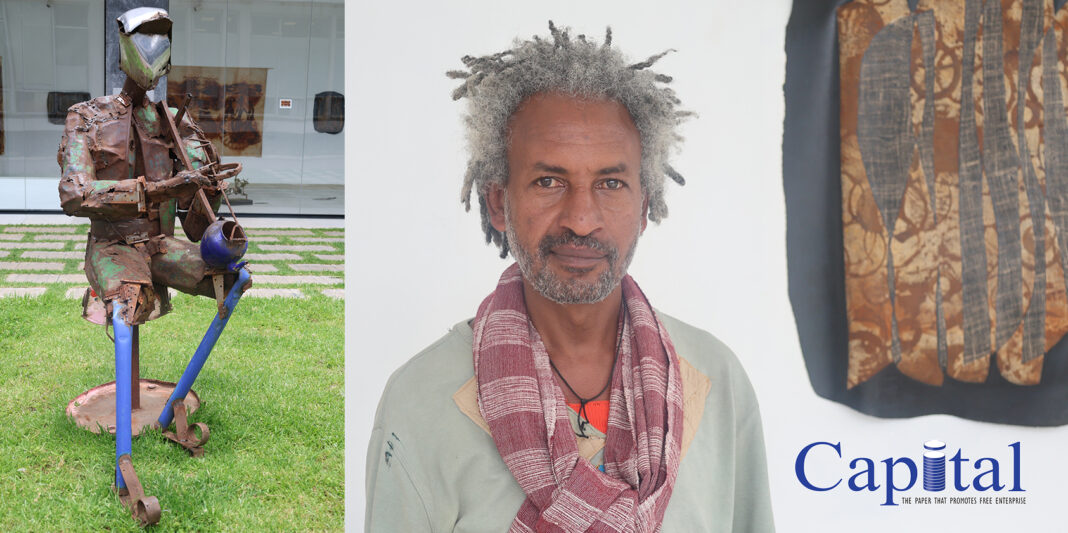
Tesfahun Kibru is an artist who embodies relentless creativity. He takes no breaks, whether in his choice of shoes, clothing, or his commitment to experimentation. Through his work, he seeks to reform or challenge existing cognitive and productive relationships, opening new pathways for the future of Ethiopian art. His latest exhibition at The Space Ethiopia gallery, curated by Dagim Abebe, is historically significant on multiple levels.
Firstly, Tesfahun is now represented by The Space Ethiopia gallery and its visionary leader, Frehiwot Demssie. This marks a crucial milestone in his career, establishing his presence in galleries and art fairs that began in Johannesburg and are rapidly expanding. Artists require professional representation, and for a free spirit like Tesfahun, maturing like fine wine, embracing such a partnership signifies a transformative new chapter.
Secondly, this exhibition continues the experimentation that began during his time at Dima NETSA in the Ethiopian Tire and Rubber Economy Plant, where Rubber Art and Zegetism first emerged. Professor Bekele Mekonnen has written about this evolution. Followers of Capital may remember Tesfahun’s show in April 2018, which celebrated Capital Newspaper’s 10th anniversary and featured Zegetism, Rubber Art, and sculptures. An article in the show’s catalogue discussed the genesis of Zegetism, Rubber Art, and synergy. Now, eight years later, the works have evolved significantly, showcasing a remarkable leap in creativity.
Zegetism stands as a unique fusion of science and art, inviting us to dive into the depths of experimentation and creativity. It represents a pivotal contribution of this generation to Ethiopian art, much like Maître Afwork Tekle’s innovative use of stained glass techniques in painting. What makes Zegetism extraordinary is its redefinition of painting, both in terms of its materials and outcomes. Following Professor Bekele’s insights, we can say that Tesfahun has revitalized the works of Skunder Boghossian, breathing new life into ancient scrolls through Zegetism, elevating Skunder’s painterly techniques to new heights.
The works of Zegetism are not only mind-blowing but also fertile ground for further experimentation.
Rubber Art is an act of creation resulting from the synergy of art and industry. While science divides and classifies, art unifies across labor divisions. The techniques involved in Rubber Art, utilizing industrial vulcanization machines and meticulously prepared textile collages, are a marvel to behold. This represents the manufacturing of art in an industrial age. Notably, Marx analyzed capitalist society by examining its basic commodity form, leading to his magnum opus, “Das Kapital,” which meticulously builds the organism from its cells. Tesfahun begins with the shape of the sole, observing how the harmonious movement of soles creates figures that resonate with the soul. This revolutionary movement in art positions Tesfahun as a vanguard of the avant-garde. We witness Tesfahun’s magnum opus in Zegetism unfolding in real time, where “sole” and “soul” become intertwined themes.
Tesfahun is a rigorous logician in his medium, championing his free spirit for all to see. You are warmly invited to the exhibition, which runs until April 29, 2026. In the meantime, join us for a lively discussion with the artist on the afternoon of April 25, 2026, at The Space Ethiopia Gallery, located at the Ethiopost Headquarters.