Austria, Vienna
At a time when Western green-tech and logistics companies are racing to secure positions within East Africa’s rapidly expanding economic corridors, deep-seated risk aversion within the European financial sector has become a major bottleneck for large-scale infrastructure investments.
According to officials, private commercial banks are increasingly hesitant to finance operations outside traditional European markets, which is hindering potentially lucrative business partnerships in emerging economies like Ethiopia.
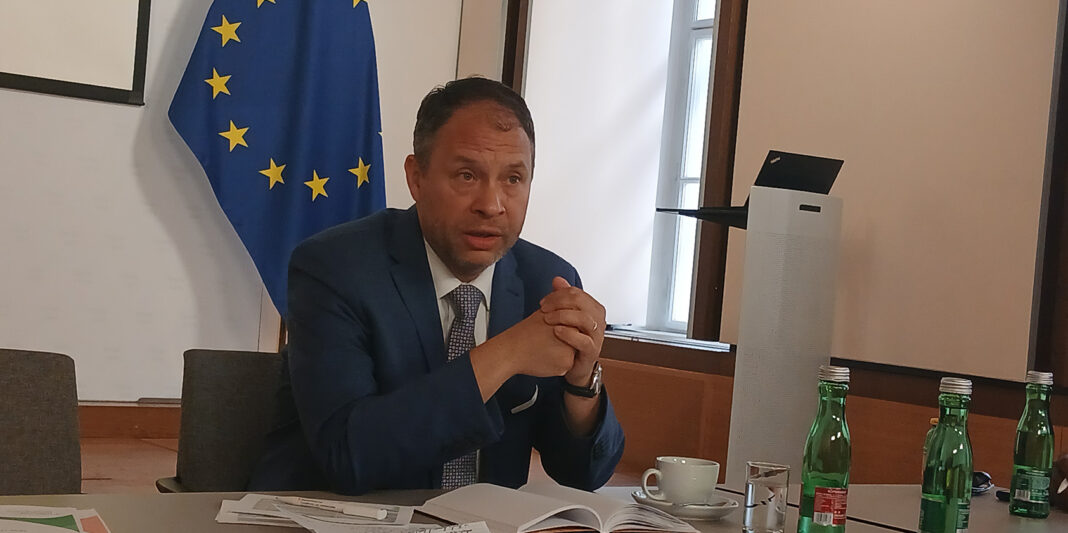
Roberto Thym, Deputy Director of the Business Services Department at the Austrian Ministry of Foreign Affairs, told Capital that it is becoming increasingly difficult for domestic companies to enter the Sub-Saharan African market on their own.
According to Thym, the solution lies in implementing sophisticated and multi-faceted financial instruments, as well as public-private “Package Deals” designed to shift and distribute risk away from risk-averse commercial lenders.
Through the framework of the African Continental Free Trade Area (AfCFTA), a major renewable energy and infrastructure boom has been created in East Africa. While Austrian logistics and green technology providers possess the high-level technical expertise required to strengthen supply chains and build sustainable networks, turning these projects into reality requires substantial capital—capital that European banks are currently holding onto with extreme caution.
“We know that the Austrian financial sector is a bit hesitant when it comes to financing extra-European markets where they don’t have much experience,” Thym said during an official statement on trade relations. “There appears to be a certain hesitation for any single actor to take on the entire risk alone.”
To break this financial deadlock, the Ministry of Foreign Affairs is encouraging project developers to move away from conventional, straightforward bank loans and instead design comprehensive financing plans that combine commercial finance with development assistance funds (concessional capital/low-interest loans).
At the core of this strategy is the involvement of Oesterreichische Kontrollbank (OeKB), the country’s main provider of export credits and international investment guarantees. By backing commercial bank loans with OeKB’s state guarantees, the overall risk profile of an East African business deal can be lowered to a level acceptable to conservative European banks.
Under this model, the Ministry of Foreign Affairs views its role not as a direct source of funding, but as an institutional matchmaker. “When we receive concrete requests, what we do as a networker is bring the relevant partners together and facilitate the creation of this kind of package deal,” Thym explained.
It was noted that the backbone of the Austrian export economy is built entirely on Small and Medium Enterprises (SMEs). Although these smaller entities are pioneers in green innovation, they have limited capacity to withstand the heavy administrative burdens associated with international project finance and regulatory compliance.
This structural vulnerability is currently facing a major test as the deadline for the European Union’s revised Deforestation Regulation (EUDR) approaches. Under this deadline, international exporters—including Ethiopia’s vital agricultural sector—must deploy strict digital traceability systems to prove that their products did not originate from deforested land.
Building and expanding such national tracking databases is extremely complex. Even though the EU allocates significant financial resources for such infrastructure through its Global Gateway initiative, Austrian SMEs are frequently locked out of these opportunities due to excessive bureaucracy.
“The backbone of the Austrian economy consists of small and medium-sized companies,” Thym explained to *Capital*. “Therefore, we face a slight challenge in connecting Austrian companies with EU fund opportunities because their sizes do not align. Austrian companies are too small to handle the comprehensive paperwork required behind it.”
To fill this structural gap and prevent innovative small companies from being excluded from international contracts, the official confirmed that the Austrian government has launched an institutional initiative called “Team Austria.”
This initiative brings independent domestic SMEs together into a single, coordinated consortia, providing them with the collective weight, administrative assistance, and legal resources required to participate in large EU infrastructure financing.
Meanwhile, following the EU Council’s decision to lift the restrictive Schengen visa measures previously imposed on Ethiopian citizens, it has been indicated that Austria is moving swiftly to capitalize on this regulatory reform.
This policy shift, unveiled this week, lifts the strict restrictions placed on short-term visas issued to Ethiopian citizens. Under the previous restrictive system—sparked by a diplomatic dispute regarding migrant readmission processes—the standard visa processing time had been extended to 45 days, additional fees were imposed, and multi-entry privileges were widely suspended.
Now, acknowledging that Addis Ababa has shown “substantial and sustained improvement” in identity verification and return logistics, the EU has reinstated the standard 15-day processing time and the basic €80 visa application fee across all member states.
Speaking to Capital, Roberto, the Deputy Head of the Ministry’s Business Services Department, emphasized the necessity of smooth trade exchanges between people and organizations. He noted that travel disruptions remain a global challenge and particularly impact exchanges with many African nations.
To forge robust economic ties, Roberto highlighted that ensuring the travel process is “as smooth as possible” is a key area from which both sides can mutually benefit.
To achieve this and facilitate convenient corporate travel for Ethiopian officials coming to Vienna, the Ministry of Foreign Affairs plans to work closely with the Federal Economic Chamber, which bears primary responsibility for managing these high-level business visits. He explained that by coordinating visa pathways and business logistics, Austria aims to transform these diplomatic relations into active and prosperous economic partnerships.