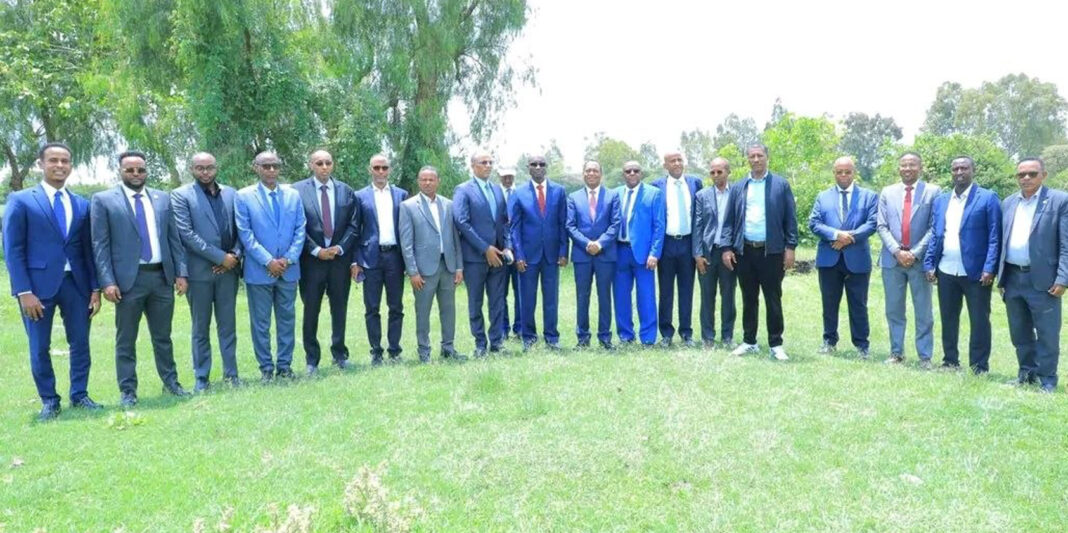
The Ethiopian government has handed over land in Mojo town to Djibouti for the construction of a dedicated heavy-vehicle parking terminal, clearing the way for a long-delayed logistics project that had stalled for nearly 25 years.
The handover marks a significant step in efforts by the two countries to modernize the Ethio-Djibouti transport corridor, which carries the bulk of Ethiopia’s international trade. Officials say the terminal is expected to ease congestion, improve freight movement and reduce delays along one of the region’s most critical trade routes.

The land transfer ceremony, held last week, brought together Ethiopia’s Minister of Transport and Logistics, Alemu Sime, Djibouti’s Minister of Infrastructure and Equipment, Said Nouh Hassan, the mayor of Mojo and other senior officials from both countries.
Alemu said the project reflects the “strong historical, economic and strategic relations” between Ethiopia and Djibouti. He said it would improve trade efficiency and service delivery while delivering mutual benefits to citizens of both countries.
The minister also credited Prime Minister Abiy Ahmed for helping resolve the long-running delay. He said the project had remained unresolved for 25 years, but progress was made following discussions during the prime minister’s previous visit to Djibouti.
For landlocked Ethiopia, the Djibouti corridor remains a vital economic lifeline. Mojo Dry Port handles much of the country’s trade volume and serves as a key entry point for imports and a major hub for exports.
But the corridor has long faced pressure from congestion, slow turnaround times and higher logistics costs for businesses. Industry observers have repeatedly warned that delays in freight movement increase the final cost of goods paid by consumers.
By creating a dedicated parking space for Djiboutian freight trucks, the new terminal is expected to streamline vehicle movement, reduce waiting times and improve the reliability of the transport system.
The project is part of a broader push to strengthen the Ethio-Djibouti transport corridor. The 752-kilometre electrified railway, built with Chinese investment, remains another central pillar of that strategy and has become an important freight artery since it began operations.
Plans are also under way to raise the railway’s annual freight capacity from two million tonnes to 6.2 million tonnes by 2027.
Officials say the Mojo terminal will do more than ease congestion. They describe it as a practical step toward deeper regional integration and shared prosperity between the two neighbors.

Alemu said the project would contribute to “boosting regional economic integration and shared prosperity.”
Ethiopia and Djibouti have described their relationship as exemplary, with recent high-level meetings focusing on joint projects and the efficiency of major infrastructure, including the Doraleh Multipurpose Port and the railway system.
The Mojo land handover now gives fresh momentum to a project seen as essential to improving logistics, supporting trade and strengthening one of East Africa’s most important cross-border economic partnerships.