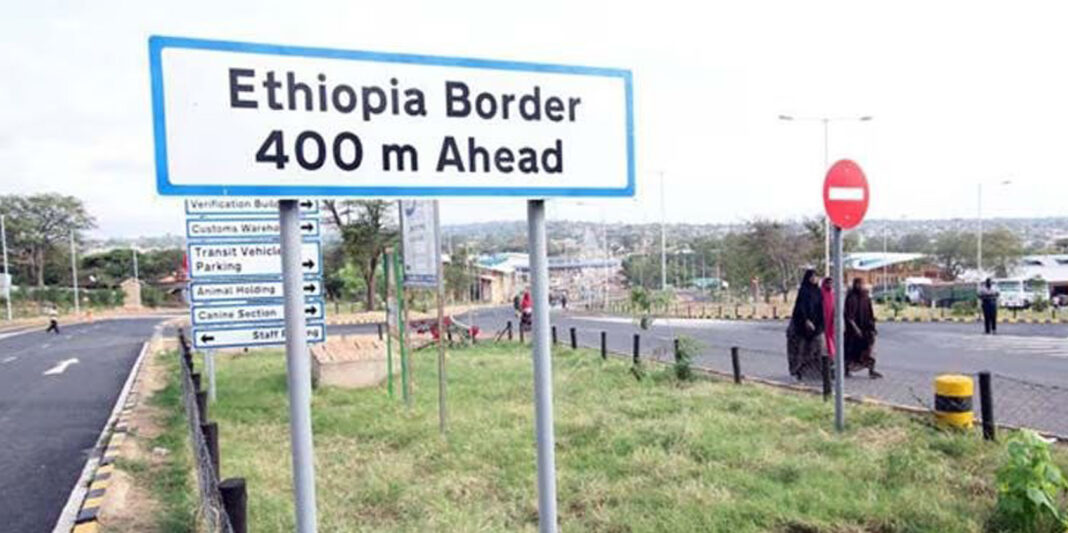
Ethiopia has solidified its position as the premier destination for Kenya’s informal cross-border trade, absorbing more than half of all unrecorded outbound goods across surveyed frontiers, according to newly released official statistics.
The 2025 Informal Cross Border Trade (ICBT) Survey Report, published by the Kenya National Bureau of Statistics (KNBS), reveals that Ethiopia captured a commanding 54% share of Kenya’s total unrecorded exports during the June 2025 observation cycle.
The joint study—conducted by the KNBS alongside the Central Bank of Kenya (CBK), the Kenya Revenue Authority (KRA), and the Ministry of Trade—monitored unrecorded goods flows at key border points during two 14-day sample periods in December 2024 and June 2025.
The findings emphasize that small-scale, unrecorded cross-border trade continues to serve as a vital support for food security, community livelihoods, and regional trade integration in the Horn of Africa.
Ethiopia was the main destination for Kenya’s informal exports across both survey cycles. During the 14-day monitoring period in December 2024, Kenya recorded a total informal export value of 159.7 million Kenyan Shillings (KES) across all its land borders. Of this total, exports to Ethiopia accounted for KES 74.5 million, or roughly 46.7%.
By June 2025, Ethiopia’s dominance as a trade destination expanded further. Out of the KES 124.0 million in total informal exports recorded during the 14-day period in June, shipments to Ethiopia reached KES 67.0 million—representing 54.0% of Kenya’s total informal exports.
Combined with Uganda (which received KES 36.2 million or 29.1% in June 2025), the two neighboring countries accounted for over 83% of Kenya’s unrecorded export trade.
Conversely, Kenya imported informal goods from Ethiopia valued at KES 50.4 million in December 2024 and KES 39.1 million in June 2025. During both periods, Kenya maintained a significant trade surplus in its informal trade with Ethiopia—rising from KES 24.2 million in December 2024 to KES 27.8 million in June 2025.
The Moyale border post emerged as the primary gateway facilitating informal trade between Kenya and Ethiopia, consistently outperforming all other surveyed border points in export value.
In December 2024, Moyale registered KES 63.8 million in informal exports and KES 8.2 million in imports, yielding a trade surplus of KES 55.6 million.
In June 2025, Moyale recorded KES 51.9 million in exports and KES 19.1 million in imports, maintaining a trade surplus of KES 32.8 million.
According to the study released on August 21, 2026, key routes serving the Ethiopia-Kenya border also include Mandera (Ethiopia side) and Ramu. In December 2024, Mandera handled KES 10.8 million in exports and KES 8.8 million in imports, followed by KES 11.2 million in exports and KES 11.1 million in imports in June 2025.
On the other hand, Ramu shifted from being heavily import-dependent in December 2024 (KES 33.4 million in imports against KES 2.4 million in exports) to recording KES 4.1 million in exports and KES 8.9 million in imports in June 2025.
The three state agencies explained that in December 2024, exports passing through Moyale and Mandera mainly consisted of inedible crude materials (excluding fuel), representing 42.1% (KES 67.2 million) of Kenya’s total informal exports. Food and live animals accounted for 28.3% (KES 45.3 million). During this cycle, unprocessed agricultural materials and food items constituted 63.7% and 17.1%, respectively, of direct exports to Ethiopia.
By June 2025, food and live animals became the leading export category across all borders, accounting for 37.9% (KES 47.0 million) of total informal exports, followed by crude materials at 24.0% (KES 29.8 million), officials reported.
Recognizing the scale and economic importance of this informal trade, both governments have taken steps toward formalization.
In December 2025, Kenya and Ethiopia signed a bilateral agreement in Moyale to establish a Simplified Trade Regime (STR) aimed at facilitating trade by streamlining procedures and reducing administrative hurdles.
Under the new framework, eligible traders must reside within a 50-kilometer radius of the authorized border crossing on the Ethiopian side and within a 100-kilometer radius on the Kenyan side. Licensed traders are permitted to trade goods valued up to $1,000 per month under simplified customs procedures, with border crossings restricted to once a week.
The system covers locally produced goods, including livestock, agricultural produce, food items, and other approved commodities. While it does not exempt participants from customs duties, qualifying goods receive a 10% bilateral tariff discount under COMESA Rules of Origin.
However, trade policy experts have raised concerns that the system’s limitations—including travel frequency caps, geographical restrictions, and administrative requirements—might inadvertently discourage traders from choosing formal channels.
An article published on the World Bank website suggests that allowing more frequent crossings, raising value thresholds, and expanding the operational radius would make formal trade more competitive and better reflect the daily reality of local traders.
This critical study highlights that total regional informal trade across Kenya’s borders declined by 16.7%—dropping from KES 299.0 million in December 2024 to KES 249.1 million in June 2025. This overall decline shifted Kenya’s overall informal trade balance from a surplus of KES 20.4 million in December 2024 to a slight deficit of KES 1.1 million in June 2025, driven primarily by an increase in informal imports from Tanzania.
Statistical authorities noted that recording these unrecorded flows is essential for improving national accounts, the balance of payments (BOP), and international merchandise trade statistics (IMTS).