As artificial intelligence accelerates across global markets, developing nations find themselves caught in a complex struggle between adopting breakthrough technologies and preserving legacy legal frameworks. In Ethiopia, this tension is acutely visible across intellectual property (IP), data governance, and national development strategies.
Experts caution that the widespread deployment of advanced AI systems directly challenges long-established legal principles, threatens traditional protections for creators, and exposes deep structural gaps in domestic data infrastructure.
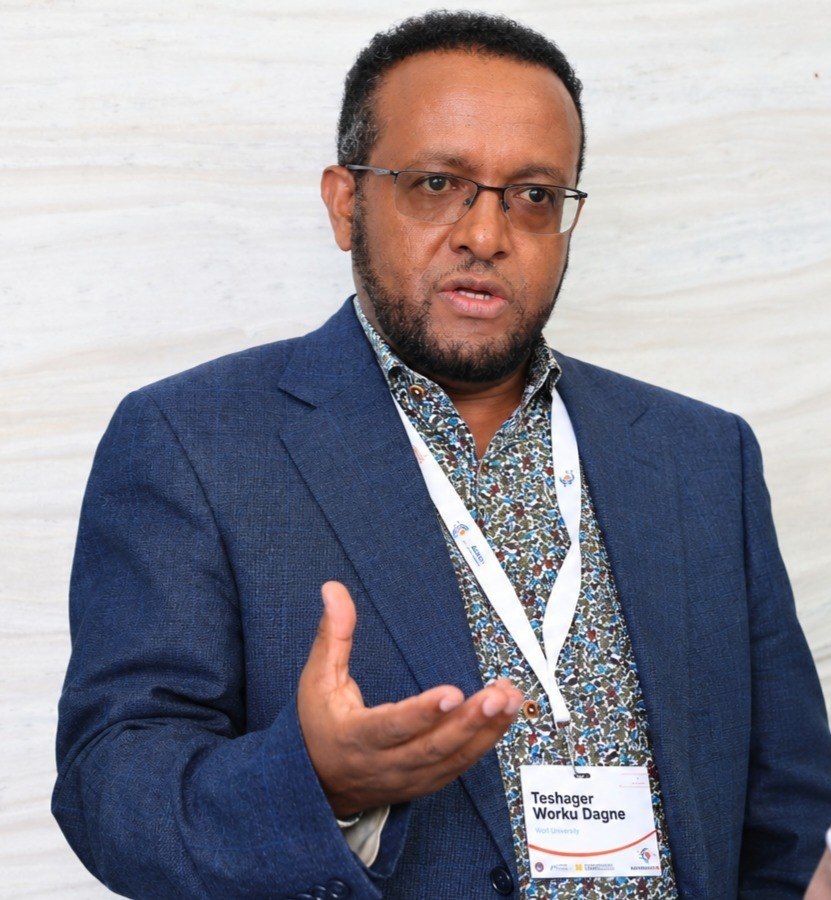
Teshager Dagne, an Associate Professor and the Ontario Research Chair in Governing Artificial Intelligence at York University in Canada, told Capital that modern AI architecture fundamentally threatens the foundation of copyright, patents, and trademarks.
“Throughout the history of technology, how society controlled and steered new technologies determined their utility and direction,” he noted. “Today, AI is challenging established legal frameworks. Copyright and patent laws are being dismantled by artificial intelligence.”
Elaborating on the issue, he explained that an author publishing a book today might find that work ingested into AI training datasets without permission, attribution, or compensation. The system can then generate content mirroring the original work, rendering the author’s copyright ineffective. A similar dynamic applies to patented innovations and trademarks, creating a legal gap where creators and innovators have limited recourse.
As the global AI race accelerates, African nations, particularly Ethiopia, face distinct structural hurdles. According to Teshager, the “data deficit” stands out as the most urgent challenge. While public sector institutions, hospitals, schools, and government agencies hold substantial volumes of valuable data, researchers and domestic AI developers struggle to access it.
“There is plenty of data in the public sector, but there is an infrastructural challenge and no direct pathway for researchers to utilize it,” he explained. “Legally speaking, older statutes remain tied to legacy technologies. When approached, institutions often claim exclusive copyright over public records, which unintentionally curtails and constrains the growth of artificial intelligence.”
This barrier is compounded by the fact that most commercial AI systems are trained primarily on foreign data. When Ethiopian users rely on these tools, the outputs reflect external knowledge frameworks that lack local context, cultural nuances, and linguistic accuracy. Teshager warned that relying excessively on foreign AI outputs rather than localized sources risks eroding credibility and information integrity.
“At the policy and strategy level, the country has an AI roadmap aimed at leveraging technology to solve societal problems at a micro level,” the professor said. “However, realizing this vision requires investing heavily in compute infrastructure and reforming bottleneck laws across intellectual property, data access, and technological development.”
Furthermore, AI development demands significant computing capacity, including specialized Graphics Processing Units (GPUs), secure data storage, and scalable cloud systems—resources that remain financially out of reach for many independent Ethiopian researchers. This constraint extends across the continent, where technological talent is often limited not by skill, but by insufficient access to high-performance computing environments.
While cloud infrastructure is expanding within Ethiopia, broader regional accessibility remains a work in progress. Nevertheless, the country has made tangible investments in foundational infrastructure.
In February 2026, the Ethiopian Artificial Intelligence Institute, in partnership with the UNDP and Addis Ababa University, inaugurated the AI UniPod—a modern facility equipped with specialized laboratories, robotics equipment, high-performance computing systems, and collaborative learning spaces designed to accelerate Ethiopia’s digital transition.
“You cannot isolate AI as a single technology,” Teshager noted. “It relies on an entire ecosystem of information infrastructure, storage, GPUs, and raw computing power. Because these assets are capital-intensive, they remain difficult to access for the majority of local researchers.”
Technological infrastructure alone is insufficient, according to Teshager. Ethiopia must actively cultivate a specialized workforce capable of building models, conducting advanced research, driving commercial applications, and establishing regulatory guardrails. This requires embedding foundational digital literacy and AI concepts throughout the educational system, from primary schooling through university curricula.
Drawing international comparisons, Teshager pointed to Canada, which launched the world’s first national AI strategy in 2017. Canada’s policy emphasizes proactive workforce transition, supporting industry adoption, and mitigating labor displacement through structured retraining programs.
However, international experience shows that commercial integration takes time. By 2024, only 4.7 percent of Canadian enterprises had formally adopted AI technologies, reflecting broader global challenges surrounding specialized talent shortages and implementation costs.
“If there is viable commercial demand, businesses will adapt,” the researcher stated. “When governments invest in developing a highly skilled technical workforce, enterprises are better positioned to integrate AI productively rather than resorting to workforce reductions. Strategic government direction is essential.”
Assessing Ethiopia’s broader readiness, Teshager noted that while a complete evaluation requires continuous benchmarking, regional technology indices consistently highlight areas for improvement. Regional indices such as the Africa Technology Index place Ethiopia behind continental leaders like Egypt, South Africa, Kenya, and Nigeria in digital infrastructure and readiness.
In government AI readiness assessments across the region, Egypt ranks among the leading African nations (51st globally in Oxford Insights’ 2025 index with a score of 57.5), followed by Kenya (65th), South Africa (67th), Mauritius (71st), and Nigeria (72nd). Overall, Sub-Saharan Africa continues to navigate infrastructural bottlenecks alongside steady digital expansion.
“Ultimately, the pace of technology adoption is directly determined by domestic infrastructural capacity,” Teshager concluded.