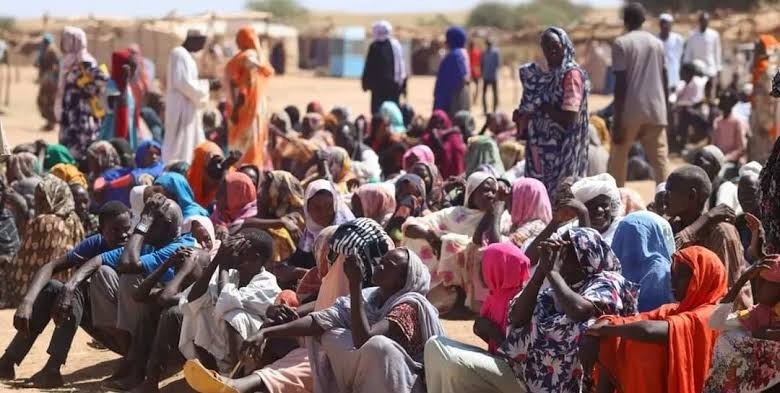
The International Organization for Migration (IOM) has issued an urgent warning that Sudan’s emergency humanitarian relief system could collapse within weeks due to a severe funding deficit, leaving millions of displaced people vulnerable to ongoing conflict, heavy rains, and acute shelter shortages.
“We simply cannot turn our back on the people of Sudan when they need us most amid raging conflict, increased displacement, and the impact of heavy rains,” said Amy Pope, IOM Director General. “The entire humanitarian system could collapse within weeks if we don’t act now. Without new funding, we won’t be able to get help where it’s needed most.”
According to the IOM’s Displacement Tracking Matrix, the crisis has left 8.6 million people internally displaced across the country, alongside 4.9 million recorded returnees. Nearly 70 percent of those displaced are currently living with host families or in informal settlements.
Ongoing violence, severe floods, and torrential rains continue to batter makeshift shelters, forcing vulnerable families into repeated cycles of displacement.
At the center of the unfolding crisis is the IOM-managed Common Humanitarian Pipeline, a shared logistics framework that enables the United Nations and more than 100 partner organizations to dispatch emergency relief items efficiently. While the pipeline has reached 2.84 million people since July 2023, its operational capacity has steadily dwindled. More than one million people were assisted through the pipeline in 2024, falling to 804,000 in 2025, with only 330,000 people supported so far in 2026.
Without immediate donor intervention, current stocks of emergency shelter, sanitation supplies, and household relief items are expected to be completely depleted by the end of September 2026. Furthermore, the warehousing and operational infrastructure sustaining the pipeline can only be maintained through December 2026.
IOM officials stress that disrupting the pipeline would severely cripple the broader humanitarian response, noting that rebuilding supply chain networks and coordination structures from scratch would be complex, costly, and time-consuming.
To sustain operations, the agency requires USD 15 million to maintain the pipeline at its 2026 minimum capacity for 12 months, supporting 305,000 people. Restoring assistance to 2025 levels for 570,000 people requires USD 27 million, while a broader scale-up to support up to one million people would demand USD 42 million.