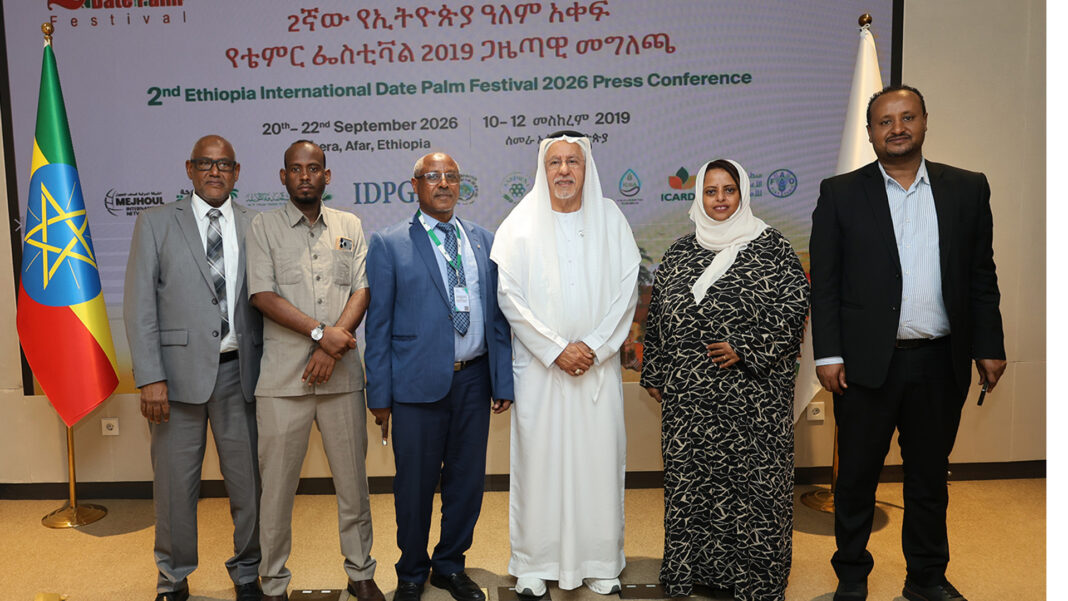
Ethiopia is orchestrating a structural transformation across its agricultural sector to eliminate fragmented farming practices, reverse historical trade deficits, and unlock the economic potential of its arid lowlands. As part of this push, the Ministry of Agriculture has rolled out a comprehensive 10-year Research and Development Master Plan, with its primary strategic focus centered on the modern commercialization of the date palm industry.
According to Ali Mohammed, Senior Advisor to the State Minister of Agriculture, the newly enacted master plan is designed to modernize production, significantly increase domestic supply, and transition Ethiopia from a net importer into a competitive global exporter. Data from the ministry indicates that the country possesses between 500,000 and 700,000 hectares of land well suited for date palm cultivation, though historically only 1.2 percent of this potential has been utilized.
This underutilization has previously weighed on foreign exchange reserves. Five years ago, Ethiopia’s annual date import bill stood near $9.8 million. Targeted agronomic interventions and localized production helped reduce that figure to approximately $650,000 last year, and the new 10-year roadmap aims to eliminate imports entirely while generating commercial surpluses for regional and international markets.
These strategic developments took center stage at the Second International Date Festival in Semera, the capital of the Afar National Regional State. The event convened policymakers, international agricultural bodies, and private investors to operationalize the new sector roadmap.
For more than two and a half centuries, Afar has served as Ethiopia’s traditional date-producing heartland. Harun Ali, Deputy Head of the Afar Region Agriculture and Natural Resources Bureau, noted that date palms provide essential household sustenance and livestock feed, remaining closely interwoven with local pastoral livelihoods. Beyond Afar, prime agro-ecological zones for expanded cultivation include the Somali Region, Gambela, Benishangul-Gumuz, Dire Dawa, and the Borana and Guji zones of Oromia.
To overcome historical productivity bottlenecks—such as shortages of certified planting materials, limited extension services, and weak post-harvest storage—the master plan draws on domestic genetic research. A landmark doctoral study at Addis Ababa University utilized molecular markers to evaluate 124 date palm genetic variations, revealing that 51 percent of total genetic variance exists among distinct populations. This points to a resilient reservoir of native traits across 314 cataloged varieties, including 166 male and 148 female accessions, within Ethiopia’s germplasm collections.
Building on this genetic baseline, the national initiative prioritizes elite varietal selection, tissue culture mass propagation, and integrated pest management across priority lowland areas.
Ethiopia’s date palm development is supported by strategic international partnerships, notably with the United Arab Emirates through the Khalifa International Award for Date Palm and Agricultural Innovation, alongside technical collaboration with the Food and Agriculture Organization (FAO), the International Center for Agricultural Research in the Dry Areas (ICARDA), and the Arab Organization for Agricultural Development (AOAD).
The Ministry of Agriculture has structured the master plan into three clear programmatic phases. The initial Preparatory Phase across the first two years focuses on institutional capacity building, land-use mapping, cooperative establishment, and initial technology transfer. The subsequent Execution Phase covering years three through five centers on large-scale seedling multiplication, deployment of water-efficient drip-irrigation systems, and the construction of regional processing hubs. The final Consolidation Phase from years six to ten targets full-scale commercial exports, international quality certification, and industrial value addition.
Under this roadmap, land allocated to strategic date production is slated to expand from an initial 6,000 hectares to 25,000 hectares, utilizing advanced domestic tissue culture laboratories to mass-produce and distribute disease-free, high-yielding saplings.
Beyond import substitution and foreign exchange savings, commercial date farming provides vital rural employment. The crop’s labor-intensive lifecycle—encompassing manual pollination, harvesting, grading, and packaging—creates steady off-farm and on-farm jobs, particularly for women and youth in pastoral lowland communities.
The initiative also complements Ethiopia’s broader Green Legacy Initiative and climate adaptation goals. A mature date palm tree can sequester up to 360 kilograms of carbon dioxide annually, providing an effective barrier against desertification and soil erosion in climate-vulnerable drylands.