A Life Devoted to Ethiopia’s Christian Heritage
In Memoriam — 1 October 2026
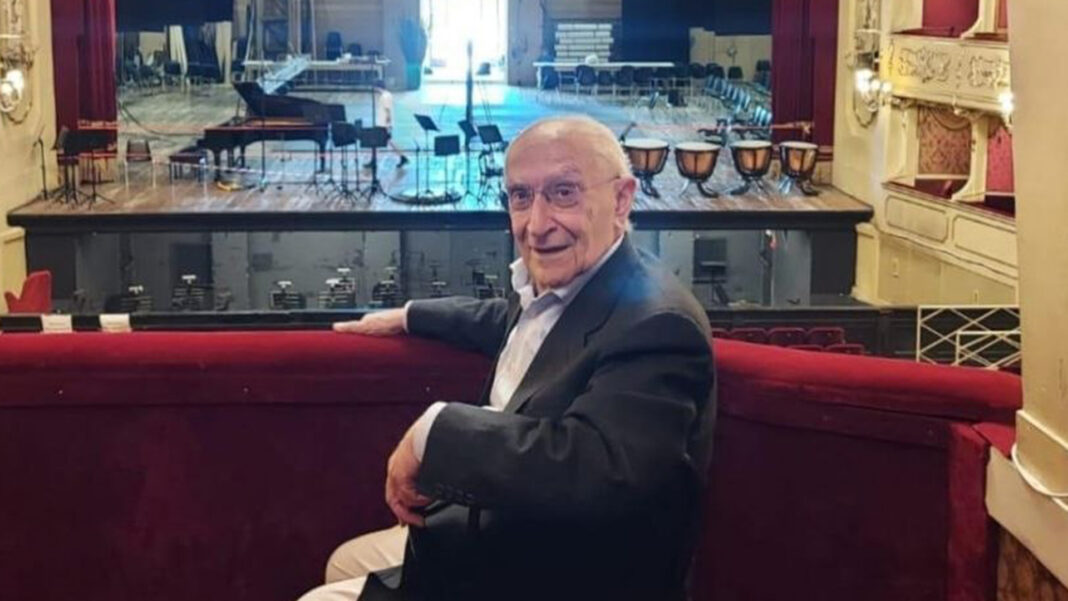
The passing of Italian architect and scholar Mario Di Salvo on 1 October 2026 is also a moment for Ethiopians to recognize a remarkable body of work devoted to documenting, studying and making better known an important part of Ethiopia’s cultural and Christian heritage.
Di Salvo was an architect and urbanist by profession, but his relationship with Ethiopia went considerably beyond architecture. Over many years, he brought the architect’s eye — careful observation of form, proportion, structure and continuity — to some of Ethiopia’s most distinctive cultural treasures: its churches, monasteries, basilicas, paintings and, perhaps most memorably, its crosses.
His work was patient and exacting. He measured, photographed, classified, compared, drew, researched and published. In doing so, he helped preserve a record of buildings and objects whose importance extends far beyond architecture. They are expressions of Ethiopia’s history, faith, craftsmanship and cultural imagination.
Narga Sellase: Architecture, Painting and Faith
One of Di Salvo’s first major Ethiopia-focused works was Churches of Ethiopia: The Monastery of Narga Sellase, published by Skira in 1999 in association with the Fondazione Carlo Leone Montandon, with contributions by the distinguished Ethiopian scholars Stanislaw Chojnacki and Osvaldo Raineri.
The study was devoted to the remarkable monastery of Narga Sellase on Lake Tana. Di Salvo did not treat the church merely as an isolated building. He placed it within the wider development of Ethiopian church architecture and examined its structure, artistic form and extraordinary cycle of paintings. The result brought architecture, painting, faith, history and landscape together as parts of a single cultural world.
The Crosses of Ethiopia
Di Salvo pursued this engagement even more extensively in Crosses of Ethiopia: The Sign of Faith — Evolution and Form, published by Skira in 2006. It became one of his most distinctive contributions to Ethiopian studies.
There is perhaps no symbol more immediately associated with Ethiopian Christianity than the cross, and yet the diversity of Ethiopian crosses is extraordinary. Across centuries, regions and uses, Ethiopian craftsmen developed a remarkable vocabulary of forms. Di Salvo spent years documenting these crosses, including work in museums in Addis Ababa, Aksum and Mekelle and in churches and monasteries. He studied their morphology, evolution and symbolism, and the relationships among different forms — from crosses appearing on Aksumite coins and in manuscripts to processional, hand and pectoral crosses.
His work helped demonstrate something that can easily be taken for granted: the Ethiopian cross is not simply a religious object. It is also an extraordinary record of indigenous design, craftsmanship, historical continuity and imagination.
The Basilicas of Ethiopia
His later major work, The Basilicas of Ethiopia: An Architectural History, published by I.B. Tauris in 2016–2017, widened the lens further. Di Salvo traced the development of Ethiopian Christian architecture from the ancient Aksumite basilicas through the post-Aksumite period, subterranean and semi-monolithic churches, cave churches, the extraordinary monolithic architecture of Lalibela and later Ethiopian basilicas.
Richly illustrated, the book was not simply a catalogue of buildings. It was an attempt to understand the continuity and transformation of an architectural tradition over many centuries. Significantly, Di Salvo dedicated the volume to the memory of his friend Mariena Mondelli Montandon and acknowledged the generous support of the Fondation Carlo Leone et Mariena Montandon in bringing the publication to fruition.
A Body of Work
The principal Ethiopia-focused books associated with Mario Di Salvo are:
- Churches of Ethiopia: The Monastery of Narga Sellase — 1999
- Crosses of Ethiopia: The Sign of Faith — Evolution and Form — 2006
- The Basilicas of Ethiopia: An Architectural History — 2016–2017
Beyond these books, biographical sources credit him with additional essays and research in Ethiopian studies. He was also among the curators of the 2008 Venice exhibition Nigra sum sed formosa: Sacro e bellezza dell’Etiopia cristiana, which brought the sacred art and beauty of Christian Ethiopia to a wider international audience.
Mariena Mondelli Montandon and the Foundation
Any recognition of Di Salvo’s Ethiopian work should also remember Mariena Mondelli Montandon, President of the Carlo Leone Montandon Foundation, whose support was closely connected to this body of scholarship.
Behind serious scholarship there is often someone willing to believe in work whose value may become fully apparent only years later. Mariena Mondelli Montandon played that role. The Foundation financed Di Salvo’s work on Ethiopian crosses, and his study of Narga Sellase was likewise published in association with the Foundation. In her foreword to the work on crosses, she expressed the hope that it would serve as a scientific reference for identifying and dating Ethiopian crosses.
Following her death, Di Salvo became Director of the Foundation, subsequently known as the Fondation Carlo Leone et Mariena Montandon. Their relationship therefore went beyond that of a scholar and a benefactor. Together, they helped preserve, study and communicate an important part of Ethiopia’s heritage to an international audience.
Documentation as Preservation
This work has acquired greater importance with time. Buildings deteriorate. Paintings fade. Objects can disappear into private collections. Churches and monuments can be damaged by neglect, environmental change, inappropriate restoration or conflict. Memory itself can disappear.
Careful documentation therefore becomes a form of preservation. Di Salvo’s photographs, drawings, classifications, architectural observations and publications created a record that remains available when the physical object itself may change or become inaccessible.
His work also carried another quiet but important message: Ethiopian Christian architecture and art should not be viewed simply as peripheral variations of traditions developed elsewhere. They constitute a distinctive historical, artistic and architectural tradition worthy of being studied on its own terms.
Remembering Mario Di Salvo
For Ethiopia, the passing of Mario Di Salvo should not go unnoticed. He was an Italian architect, but a significant part of his intellectual life was devoted to recording, understanding and sharing Ethiopia’s heritage. His work leaves behind not only beautiful books, but also an important documentary record for future generations.
At this moment, our thoughts are also with his wife, Clara, and their two daughters, Elena and Eloisa, who have lost a husband and a father. Behind a lifetime of research, travel and painstaking documentation is also the family that accompanied and supported that journey. To them, we extend our deepest sympathy and our gratitude for the life and work they shared with him.
Alongside Mario, we should also remember Mariena Mondelli Montandon and the Foundation whose support made much of this patient scholarship possible. Their collaboration reminds us that preserving cultural heritage depends not only on scholars, but also on those who recognize the importance of the work and are prepared to sustain it.
Preserving a country’s heritage is not only about protecting monuments. It is also about studying them, recording them, publishing them and passing knowledge of them from one generation to the next.
Mario Di Salvo helped Ethiopia do precisely that. For this, Ethiopia owes him a debt of gratitude.