Ethiopia could lose up to $453 million in coffee export revenue as strict European Union (EU) environmental rules threaten shipments failing to meet traceability, geolocation, and legal compliance standards, according to a new study by ODI Global.
The report, titled The Case of EUDR in Ethiopia: How to Secure Climate, Trade and Development Goals, and Overcome Risks of Market Exclusion, warns that the EU Deforestation Regulation (EUDR) poses severe risks to Ethiopia’s coffee sector, with far-reaching consequences for rural livelihoods, foreign exchange earnings, and overall economic stability.
According to the study, potential export losses could range from $160 million—if 20% of EU-bound shipments are excluded—to $453 million in a worst-case scenario involving a 57% market cutoff. Even if affected coffee is redirected to alternative buyers, Ethiopia stands to lose between $42 million and $118 million due to lower market prices compared to premium European rates.
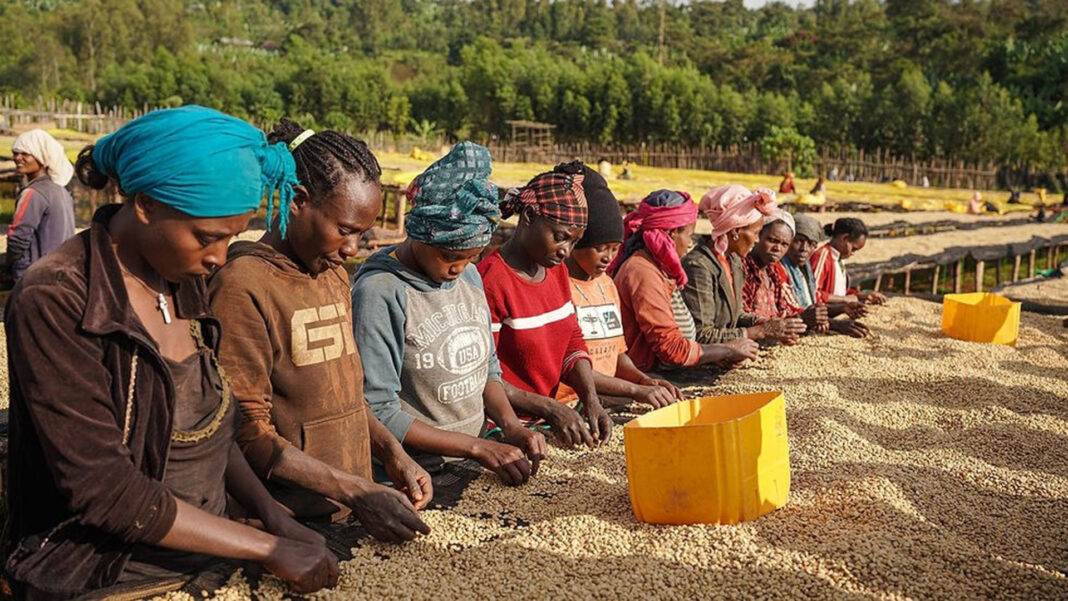
The study stresses that compliance demands impose disproportionate financial burdens on developing nations reliant on smallholders. Ethiopia is particularly vulnerable because around four million small-scale farmers account for 95% of its coffee production, mostly operating on plots under one hectare.
The EU represents approximately 30% of Ethiopia’s coffee export market. Across the country, an estimated 15 million people depend on the coffee value chain, while nearly a quarter of the population relies on the sector directly or indirectly.
The report outlines three major compliance obstacles: incomplete geolocation data, supply-chain traceability gaps, and legal verification hurdles.
EUDR requires precise geographical coordinates for every production plot. However, mapping individual farms costs between $4 and $7 per plot, with verification adding another $5 to $12. Applied across millions of fragmented farms, these costs create a heavy burden. Consequently, exporters are prioritizing pre-certified farmers, leaving up to 20% of smallholders at risk of market exclusion.
Local collectors and informal traders handle 57.4% of marketed coffee. While these intermediaries complicate documentation, excluding them without workable alternatives could disrupt traditional trade networks and harm farmers reliant on rapid cash payments.
To address these vulnerabilities, the Ethiopian Coffee and Tea Authority (ECTA), alongside the Ministry of Finance and the Ministry of Agriculture, has launched a three-year national action plan. Key initiatives include farm data collection, digital supply-chain tracking, and upgrading the Coffee Market Information Management System into the Ethiopian Coffee Traceability Management System (ECTMS).
However, ECTMS is not yet fully operational, and geolocation coverage remains limited. By July 2024, only 200,000 hectares had been mapped out of an estimated 860,000 hectares under cultivation—roughly 23%. Land documentation gaps also persist, alongside uncertainties regarding how the EU classifies Ethiopia’s traditional forest and semi-forest coffee systems.
The study show that, disruptions in coffee exports could worsen Ethiopia’s foreign currency shortages. Coffee generates roughly 35% of national merchandise export earnings, with 11% tied directly to EU sales. Export declines could reduce total national foreign exchange earnings by up to 8.5%, pressuring the birr and driving domestic inflation.
Financial institutions also face major credit risks. Exporters and cooperatives may struggle to service seasonal procurement loans if denied access to premium EU markets.
To mitigate these threats, ODI Global urges flexible bilateral engagement with EU authorities, technical support for smallholders, expanded environmental financing mechanisms, and fairer price-premium distribution across the coffee supply chain.