Africa arrives at the road to COP32 with a familiar frustration: the climate crisis is not a future risk but a present emergency. Droughts, floods, food insecurity, heat stress and rising debt are already reshaping livelihoods across the continent. Yet the finance needed to protect communities remains too small, too slow and too often delivered as loans rather than grants.
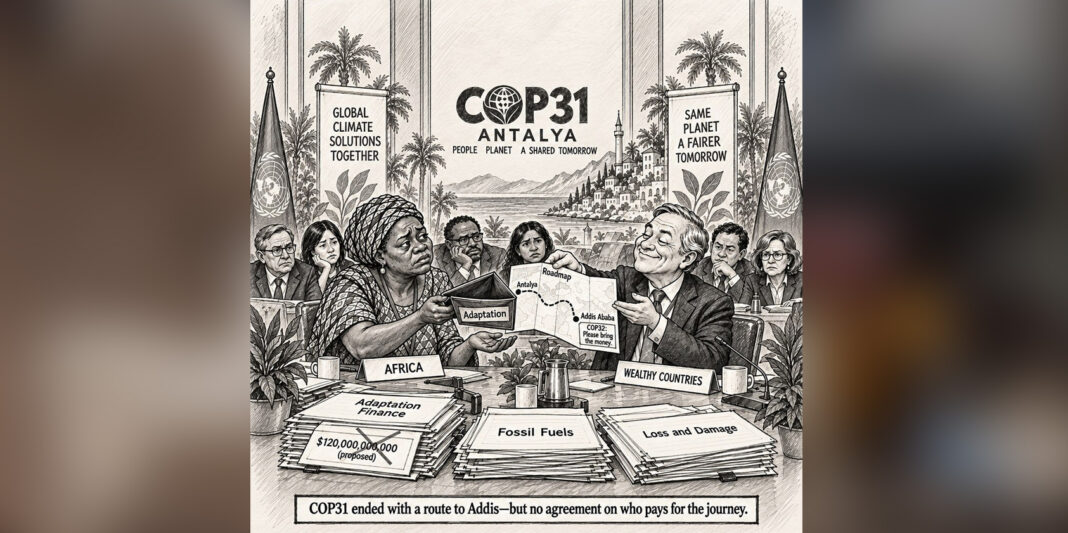
COP31 in Antalya produced an important step: the launch of the Antalya-to-Addis Ababa Roadmap on Adaptation and Resilience Finance, which is intended to identify predictable and scaled-up public sources of finance for adaptation and loss and damage, including innovative sources and mechanisms for access. The COP31 presidency decision also calls for a report on the roadmap’s conclusions to be considered at COP32 in 2027.
That is progress. But Africa cannot treat a roadmap as a substitute for money.
The most important outcome for Africa is political recognition that adaptation finance must become more predictable and accessible. The decision acknowledges the need to mobilise public, private, bilateral, multilateral and alternative sources of climate finance for developing countries.
It also preserves the connection between Antalya and Addis Ababa. COP32 will be hosted by Ethiopia in Addis Ababa in November 2027, giving Africa an unusual opportunity to place its priorities at the centre of global climate diplomacy.
African negotiators went into COP31 with clear demands: grant-based and concessional finance rather than debt-creating loans; a credible pathway to triple adaptation finance by 2035; stronger implementation of the Global Goal on Adaptation; and support for loss and damage.
The African Group of Negotiators also sought a clearer financing baseline and referred to a proposed level of 120 billion dollars annually for adaptation programmes and instruments. However, the amount and terms of delivery remained under negotiation, and reports indicated that the final cover decision did not include a concrete financial commitment or a specified 120-billion-dollar target.
That omission matters. A promise to “triple” adaptation finance is meaningless without agreement on the baseline, contributors, timetable and instruments through which the money will reach countries.
Africa’s case is not rhetorical. The United Nations Economic Commission for Africa has estimated that the continent received about 52 billion dollars a year in climate finance in 2022, against needs estimated at 190 billion dollars—barely 27 percent of what it requires.
The adaptation gap is especially severe. UNEP estimates that adaptation alone will cost developing countries about 305 billion dollars a year by 2035, more than the entire 300-billion-dollar climate finance goal agreed in Baku, which must also cover emissions reductions.
For African governments, this is not simply a question of climate ambition. It is a question of whether a farmer can irrigate during drought, whether a city can protect residents from flooding, whether health systems can respond to heatwaves and whether families can rebuild after disasters without falling deeper into debt.
COP31’s roadmap is therefore welcome, but its value will be judged by whether it produces finance that is additional, predictable, accessible and predominantly grant-based. Africa cannot be asked to borrow its way out of a crisis it did little to cause.
COP32 in Addis Ababa should be judged against a simple test: did it make climate finance more usable for African communities?
First, the Antalya-to-Addis Ababa roadmap must produce a concrete finance package. It should identify a baseline, define contributors, set annual milestones and specify how much support will reach adaptation and loss and damage. It should also distinguish grants from loans and ensure that funding reaches local governments, women’s organisations, farmers and frontline communities rather than remaining trapped in international intermediaries.
Second, COP32 should operationalise the commitment to triple adaptation finance by 2035. The target must be transparent, measurable and anchored in a credible baseline. African countries should insist on a reporting system that tracks not only pledges but disbursements, access times, concessionality and the share reaching the most vulnerable countries.
Third, the Global Goal on Adaptation needs a practical framework. Indicators are useful only if they are linked to implementation support. African negotiators have rightly argued that measuring adaptation progress must be connected to the means of delivering it: finance, technology, capacity and institutional support.
Fourth, loss and damage must move beyond a symbolic agenda item. The Fund should be adequately capitalised, with simplified access procedures for countries facing repeated climate shocks. Africa should also press for direct access modalities so that affected communities do not wait years for approval while disasters unfold.
Fifth, COP32 must address debt. Climate finance that arrives as high-interest loans can deepen fiscal pressure and undermine the very resilience it is meant to build. Grant-based support, debt relief linked to climate investment and reform of international financial institutions should be part of the agenda.
Ethiopia’s presidency offers more than symbolism. Addis Ababa can become the place where Africa sets a common standard for climate implementation: finance that reaches people, technology that is transferred rather than merely promised, and adaptation that strengthens food systems, water security, health and local economies.
The African Group has already shown that it can negotiate with a unified voice. UNEP commended African countries for presenting a common, clear and consistent position at COP31 and stressed that decisions in Antalya would shape the road to Addis Ababa.
That unity must now be converted into negotiating leverage.
Africa should enter COP32 with a clear demand: no more vague roadmaps without delivery schedules; no more adaptation pledges without baselines; no more climate finance that increases debt; and no more decisions that leave the continent to manage escalating losses with inadequate support.
COP31 gave Africa a route from Antalya to Addis. COP32 must give Africa the resources to walk it.