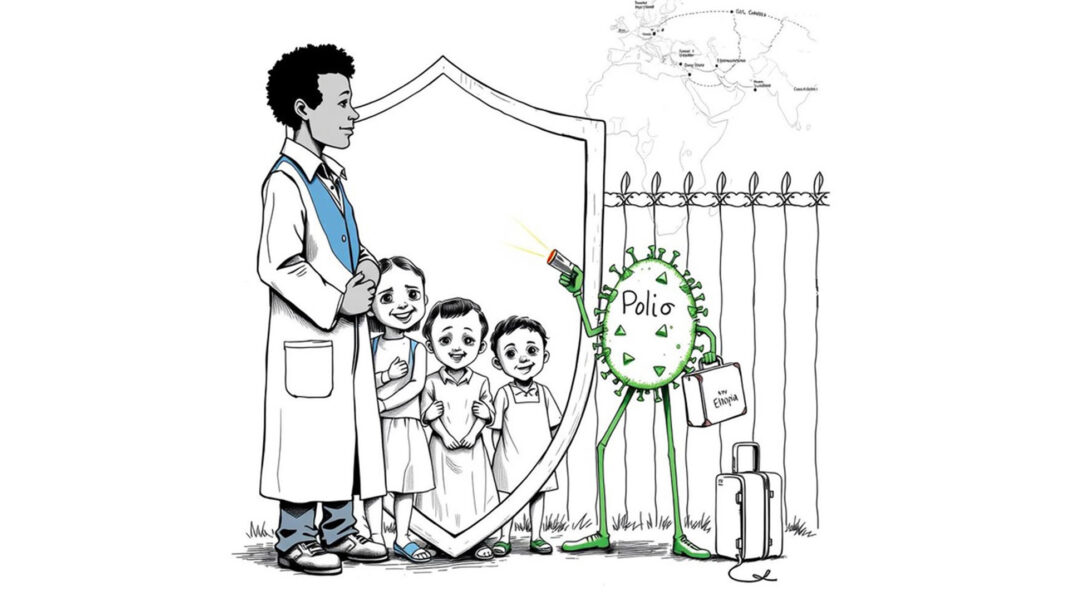
World Polio Day is a moment to celebrate one of the greatest achievements in public health: the dramatic reduction of a disease that once paralysed hundreds of thousands of children every year. It is also a reminder that the fight against polio is not over.
For Ethiopia, the day carries particular significance. The country was certified free of wild poliovirus in 2017, following the interruption of indigenous wild poliovirus transmission and the last reported imported case in 2014. These achievements reflect decades of commitment by the government, health workers, communities and international partners.
But certification is not the end of the story. It is the beginning of a long-term responsibility to keep Ethiopia polio-free.
Polio is dangerous precisely because it can spread without being noticed. Most people infected with poliovirus do not develop paralysis. Many show no symptoms at all, yet they can still shed the virus and infect others.
This means that the absence of reported cases does not necessarily mean the virus has disappeared. Poliovirus can circulate silently in communities, especially where immunisation coverage is low, surveillance is weak or populations are difficult to reach.
Vaccination remains the most important tool for protecting children. But vaccination alone is not enough. Strong surveillance is needed to detect the virus before it spreads, identify gaps in immunity and guide rapid responses.
The global polio eradication effort relies on three key systems: acute flaccid paralysis (AFP) surveillance, environmental surveillance and laboratory testing.
AFP surveillance helps health workers identify and investigate sudden paralysis in children under 15. Prompt investigation and the collection of adequate stool specimens allow laboratories to determine whether poliovirus is responsible.
Environmental surveillance adds another layer of protection. By testing wastewater, health authorities can detect poliovirus shed by infected people, including those without symptoms. This can reveal transmission even when no paralytic cases have been reported.
Laboratory testing and genetic sequencing then help identify the virus, trace its origin and understand how it is spreading. This information allows health authorities to target vaccination campaigns and respond quickly.
For Ethiopia, surveillance must reach every community: children in remote rural areas, mobile and pastoralist populations, underserved urban communities and border regions. No child or community should be beyond the reach of the system designed to detect and stop poliovirus.
Ethiopia’s polio-free status is a major public health achievement, but it must not create complacency.
As cases become rarer, there is a risk that funding, staffing and attention to surveillance may decline. That would be a serious mistake. The final stages of eradication are often the most difficult, because the remaining chains of transmission can be hard to detect.
The world also remains interconnected. As long as poliovirus circulates anywhere, every country must be prepared to detect imported viruses and emerging variant polioviruses before they establish transmission.
Ethiopia’s progress must therefore be protected through sustained political commitment, adequate financing, trained health workers, functioning laboratories and effective coordination between national institutions and global partners.
The value of polio surveillance extends beyond one disease. The laboratories, trained personnel, specimen transport networks, reporting systems and data platforms built through the polio programme can also strengthen Ethiopia’s ability to detect and respond to other health threats, including measles, cholera, Ebola and COVID-19.
Preserving these systems is an investment in the country’s broader health security. As new and re-emerging diseases continue to threaten communities, strong surveillance helps countries identify risks early, respond quickly and limit the impact of outbreaks.
The goal should therefore be twofold: eradicate polio and preserve the public health infrastructure developed in pursuit of that goal.
Polio eradication is not the responsibility of the Ministry of Health alone. It requires cooperation among government institutions, the World Health Organization, UNICEF, Rotary International, the Global Polio Eradication Initiative, health workers, parents and communities.
Health workers must be able to identify and report suspected cases. Parents must ensure their children receive all recommended vaccine doses. Communities must understand the importance of reporting sudden paralysis and cooperating with public health teams.
On this World Polio Day, Ethiopia should renew its commitment to vaccination, surveillance and partnership. The country’s polio-free status is a hard-won achievement, but it will remain secure only through continued vigilance.
The final case of polio will not, by itself, prove that the world is polio-free. That achievement will depend on strong surveillance, rapid response and the determination to ensure the virus never returns.
Ethiopia has come a long way. Now is not the time to look away.