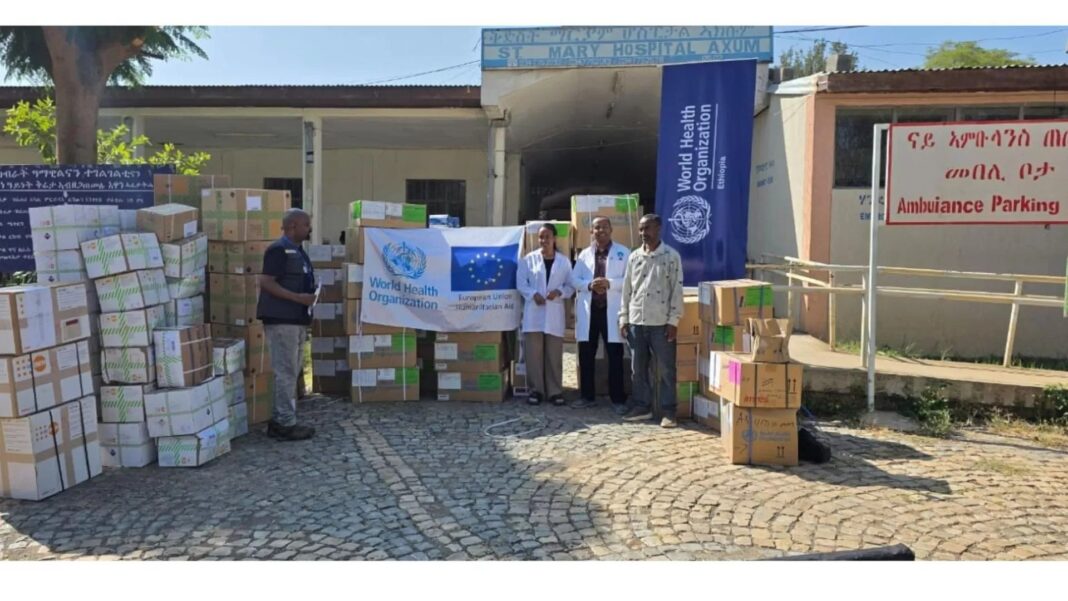
The World Health Organization (WHO) has delivered more than 71 metric tonnes of essential medical supplies to conflict-affected areas of Tigray, Amhara and Afar, as it scales up emergency health operations to address growing humanitarian needs caused by ongoing hostilities.
WHO said it was working with national and regional health authorities and humanitarian partners to maintain essential health services, strengthen disease surveillance and expand emergency medical assistance in areas affected by insecurity and displacement.
The medical shipments include emergency health kits, cholera response materials, reproductive health kits and medicines for noncommunicable diseases.
WHO has also strengthened emergency coordination mechanisms, deployed technical teams and expanded operational support across the three regions. Its activities include disease surveillance, outbreak investigations, vaccine distribution, emergency preparedness and coordination of public health interventions.
The organization said it was working with United Nations agencies, including the UN Office for the Coordination of Humanitarian Affairs (UNOCHA), UNAIDS, the International Organization for Migration (IOM), the UN Refugee Agency (UNHCR), UNICEF and the UN Population Fund (UNFPA), alongside government institutions and other humanitarian partners.
The coordinated response aims to improve the delivery of essential health services and medical supplies to communities whose access to healthcare has been disrupted by conflict and displacement.
Through support for mobile health and nutrition teams and existing health facilities, WHO and its partners are helping communities access primary healthcare, maternal and reproductive health services, disease prevention and treatment for communicable and noncommunicable diseases.
The organization is also supporting emergency referrals and strengthening outbreak response capacity and public health monitoring systems in areas where insecurity continues to affect healthcare delivery.
WHO’s emergency response is supported by contributions from donors, including the United Nations Central Emergency Response Fund (CERF) and the European Union through its European Civil Protection and Humanitarian Aid Operations (ECHO).
According to WHO, the funding has enabled the delivery of essential medicines and medical supplies, strengthened disease surveillance systems, supported mobile health and nutrition teams and helped sustain critical services for conflict-affected and displaced populations.