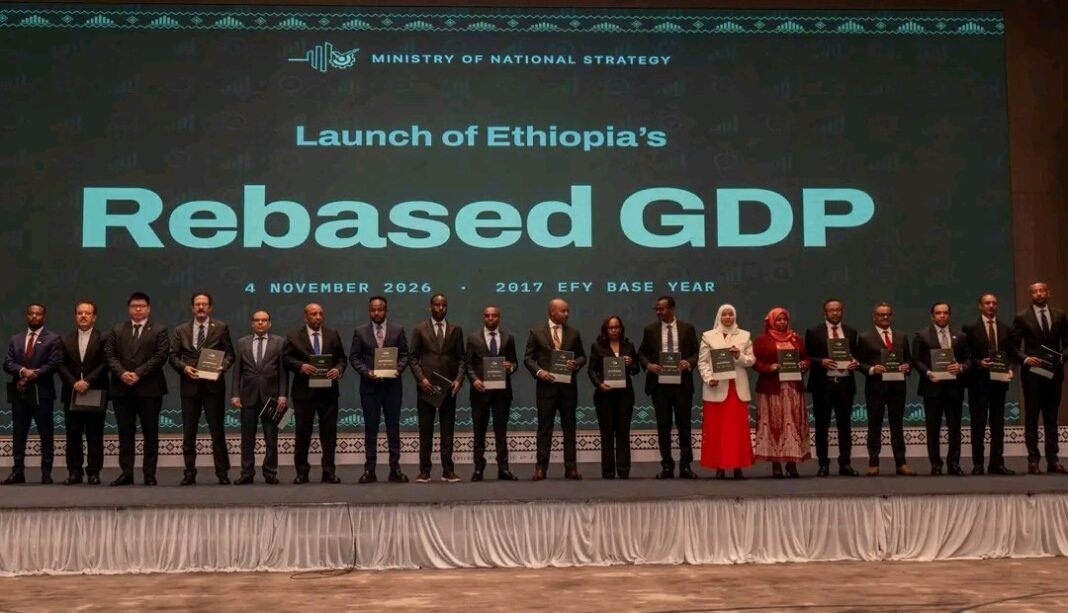
Ethiopia is preparing to introduce quarterly Gross Domestic Product (GDP) reporting as part of a comprehensive effort to modernize its national economic statistical system, improve fiscal transparency, and strengthen evidence-based policymaking following the country’s recently completed GDP rebasing exercise.
The planned transition from annual to quarterly GDP reporting will require significant improvements in the collection, classification, and management of economic and financial data across federal and regional government institutions.
The initiative is also expected to modernize Government Finance Statistics (GFS), update revenue and expenditure records, and align national accounting practices with internationally recognized statistical standards.
Fitsum Assefa Minister of Finace,
said the government would build on the reforms introduced through the GDP rebasing process to improve the quality and consistency of economic and public finance information.
She said one of the priorities would be to strengthen Government Finance Statistics by revising historical records and ensuring that future data are produced under an updated and standardized framework.

The exercise will cover both federal and regional administrations, extending improvements beyond the central government’s financial accounts to establish a more comprehensive national statistical system.
The government also plans to improve the classification of public revenues, expenditures, assets, and liabilities to ensure that financial information corresponds with the revised national accounting framework.
A major component of the reform is the adoption of the International Standard Industrial Classification of All Economic Activities (ISIC), which provides a common system for categorizing economic activities. The classification is expected to improve the level of detail available on government spending and the contribution of different economic sectors to national output.
According to Fitsum, the Ministry of Finance will work with the Ministry of Planning and Development and other relevant institutions to ensure that financial records are properly classified and integrated into the national economic accounts.
The improvements are particularly important for the planned introduction of quarterly GDP estimates, which require more frequent and detailed information than the annual reporting system traditionally used by the country.
The government is therefore working to synchronize data collection across revenue authorities, sector ministries, and national planning institutions to ensure that the information needed for quarterly economic measurement is available on time.
The statistical overhaul follows Ethiopia’s decision to adopt the 2024/25 fiscal year as its new GDP base year, replacing the previous reference framework to reflect structural changes in the economy.
Under the revised framework, Ethiopia’s GDP was estimated at 24.03 trillion birr, equivalent to 201.42 billion dollars, in the 2024/25 fiscal year. The economy subsequently expanded to 31.86 trillion birr, or 210.70 billion dollars, in the 2025/26 fiscal year.
Speaking at the official launch of the revised GDP figures, Fitsum said the rebasing exercise would improve national economic planning, strengthen fiscal and monetary policymaking, and enhance domestic revenue mobilization.

She emphasized that more accurate economic data would enable the government to assess sectoral performance more effectively and formulate policies based on the country’s actual economic conditions.
Feleke Demissie, Executive Director of National Economic Accounts Statistics at the Ministry of Planning and Development, said GDP rebasing was necessary because the structure of an economy changes over time, making periodic adjustments to the statistical baseline essential.
He explained that international statistical guidelines generally recommend updating the GDP base year every five years to ensure that economic measurements reflect current production patterns, emerging industries, and changes in economic activities.
”Over a five-year period, new economic activities and emerging sectors integrate into the national economy. Continuing to measure output against an outdated baseline distorts our true economic position,” Feleke said.
He noted that bringing the reference year closer to current economic conditions enables statisticians to incorporate previously underrepresented activities and reassess the contribution of different sectors to the economy.