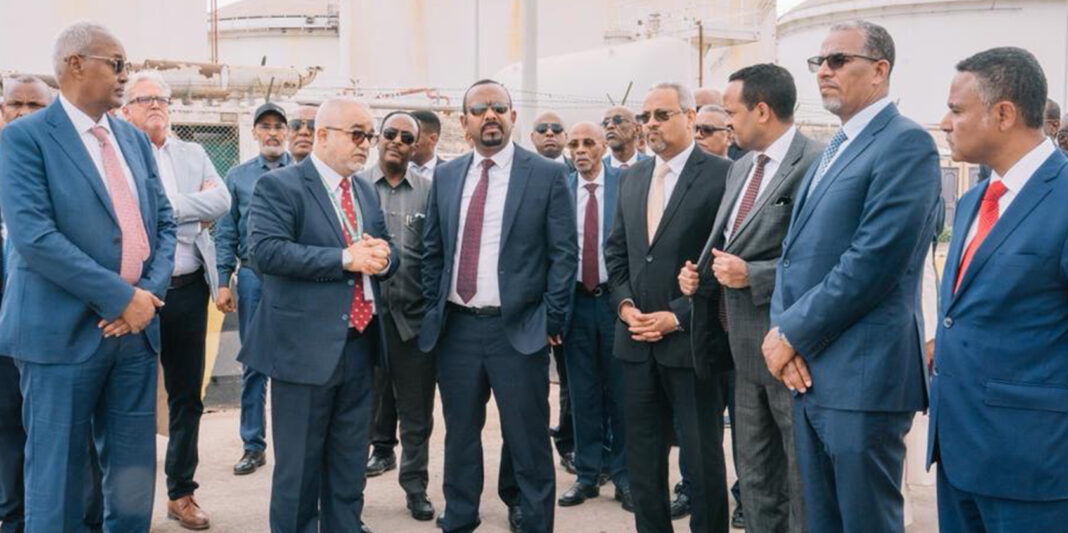
In a surprising move for private sector stakeholders, Prime Minister Abiy Ahmed visited Djibouti at the end of the week, where he met with President Ismail Omar Guelleh and toured two key ports in Doraleh.
Regional experts told Capital that the visit primarily aimed to further the Ethiopian government’s goal of enhancing cargo transportation via the Ethio-Djibouti Railway (EDR), alongside discussing important political issues and recent developments in the region.
The brief Sunday meeting between the two leaders reportedly focused on the latest geopolitical and regional topics. However, it was also anticipated to tackle the operational challenges faced by Ethiopian companies, particularly in multimodal logistics.
While experts confirmed that the Ethiopian government prioritized discussions regarding the state-owned EDR, private logistics operators expressed concerns that their challenges were not sufficiently addressed.
Dawit Woubishet, President of the Ethiopian Freight Forwarders and Shipping Agents Association, noted the unexpected nature of the Prime Minister’s visit and highlighted the inadequate representation of the private sector.
Experts, speaking on condition of anonymity, pointed out an unresolved issue: Djibouti’s delay in granting operational approval to six newly licensed Ethiopian logistics companies.
They emphasized that resolving such bottlenecks typically requires high-level government intervention, making it a likely topic of discussion.
According to these experts, the Ethiopian side is focusing on expanding the EDR’s role in transporting strategic commodities such as petroleum and fertilizer.
During his tour, Abiy visited the Horizon Djibouti Terminals Limited (HDTL) oil terminal and the Doraleh Multipurpose Port (DMP), both located about 15 km west of Djibouti city.
Sources indicate that the government aims to accelerate rail-based transport of petroleum and fertilizer. Currently, only the SGTD container terminal at Doraleh is directly connected to the EDR line.
Experts told Capital that while DMP handles Ethiopia’s strategic fertilizer imports, it requires a 1.9 km first-mile truck operation to reach the railway, costing an estimated $10 million annually. They noted that “the Ethiopian government is eager to swiftly establish a direct rail link for this port.”
Similarly, the Prime Minister showed interest in connecting the HDTL oil terminal, operated by the UAE’s ENOC, to the railway.
Sources clarified that while the EDR would construct the approximately 3 km rail line, the port operator is responsible for the necessary loading facility or jetty.
Overall, sources indicated that the government’s focus remains firmly on the EDR rather than on private logistics operators, with the Ministry of Transport and Logistics expected to lead efforts in addressing the multimodal challenges arising from Djibouti.
This visit also occurred against the backdrop of recent diplomatic engagement between Djibouti and Egypt, including an agreement for potential port development supported by Egyptian investment.
Experts suggest that this development is likely unwelcome to Ethiopia, which views Egypt as a geopolitical rival and intervening in its internal affairs.
They argue that while a Memorandum of Understanding has been signed, the realization of an Egyptian-built port is uncertain, risking displeasure from Ethiopia—the primary user of Djibouti’s ports and a major source of its revenue.
Analysts regard the Egypt-Djibouti agreement as more of a political gesture than a solid reality, especially given Ethiopia’s keen interest under Abiy’s administration in securing port access through various arrangements.