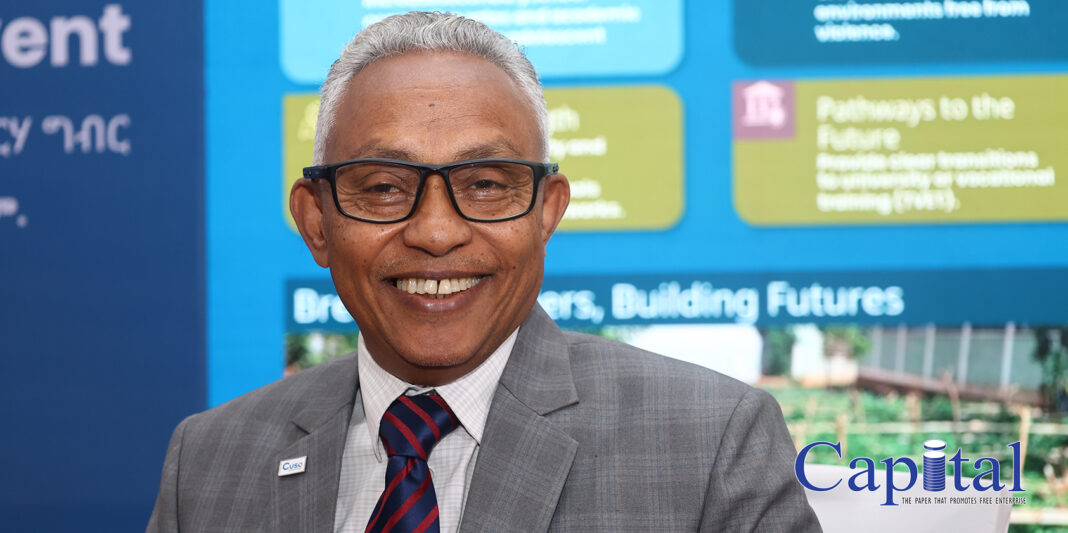
Wendwossen Kebede, a senior development leader with over 31 years of experience in international development, has dedicated his career to advancing education, public health, economic development, gender equality, and youth empowerment. Since 2015, he has served as Country Representative for Cuso International in Ethiopia, leading programs that transform communities through education and empowerment.
In this interview with Capital, Wendwossen shares insights on the recently concluded U-GIRLS 2 Project, a flagship initiative that has redefined girls’ education in the historically marginalized Benishangul-Gumuz region.
Capital: The project reports an 88.4% transition rate to higher education. How does this compare to the situation six years ago?
Wendwossen Kebede: Our baseline assessment in 2018/19 revealed an extremely challenging educational environment for girls in Benishangul-Gumuz. The barriers were multifaceted and deeply entrenched. They included traditional gender roles that imposed heavy domestic responsibilities, leading to chronic absenteeism and dropouts; cultural taboos and economic constraints that prioritized boys’ education when families had limited resources; a scarcity of female role models, exacerbated by a shortage of well-trained female teachers and a lack of women in leadership positions; pervasive safety concerns, including gender-based violence, harassment, and assault; and inadequate school infrastructure that failed to meet the specific needs of female students, particularly regarding sanitation.
In response, and in collaboration with our technical partner, the Institute of International Education (IIE), the U-GIRLS 2 project was designed to dismantle these barriers through a three-pronged strategy: first, by enhancing girls’ academic performance and leadership capabilities to foster greater autonomy; second, by raising community awareness about the critical importance of girls’ education and the gendered obstacles they face; and third, by strengthening governance at regional, zonal, and woreda levels to ensure a more equitable and effective education system.
The project’s launch in June 2020, however, coincided with unprecedented strain on educational systems due to COVID-19-related school closures, followed by the disruptive impact of conflict and a rise in internally displaced persons. The national crisis in secondary education was starkly illustrated by the 2022 Ethiopian Secondary School Leaving Certificate Examination, in which only 3.3% of candidates achieved passing scores. In this volatile context, we worked closely with local partners and Interpeace to design research-based interventions tailored to the rapidly evolving situation.
Today, the transformation in project-supported schools is profound. Nearly 99.5% of the girls in our program completed secondary education, and 88.4% achieved the passing grades required for admission to universities and vocational institutions. These outcomes dramatically surpass those in comparison areas, where only about half of students achieved similar results. The reported 88.4% transition rate to higher education is therefore not merely an impressive statistic; it signifies a fundamental shift in opportunity for girls in one of Ethiopia’s most underserved regions.
Capital: With CAD 14.9 million in support from the Government of Canada, what are the tangible returns on this investment?
Wendwossen: First and foremost, we sincerely acknowledge the financial support of the Government of Canada through Global Affairs Canada. On behalf of Cuso International and all U-GIRLS 2 Project partners, I extend our deepest gratitude for their steadfast commitment to advancing girls’ education and the trust they have placed in our partnership.
This investment has generated measurable and lasting returns across three key areas: educational outcomes, community transformation, and institutional capacity. Key legacy achievements include outstanding educational results: 99.5% of supported girls completed secondary school, 99.1% gained admission to university or TVET institutions, and 98.4% reported improved academic performance.
In terms of empowerment, 97.5% of girls noted increased confidence and leadership abilities, along with significant gains in life-skills knowledge, including sexual and reproductive health. Community transformation is evident, with 93% of parents and community members now actively supporting girls in pursuing higher education.
The project reached over 28,000 direct beneficiaries and approximately 700,000 indirect beneficiaries through schools and communities. Tangible in-kind support provided to project partners included 4,519 combined desks, 1,000 blackboards, 1,000 whiteboards, 140 desktop computers, solar panel systems installed in seven target schools, 100 science kits for secondary schools and 500 for primary schools, eight sound systems for school media clubs, 24,200 reference books for secondary schools and 30,000 for primary schools, 158,000 sanitary pads, 500 teacher’s gowns, more than 85,000 exercise books for conflict-affected schools, and WASH construction projects at Menge Secondary School and Komoshiga Birhan Secondary School, including deep well drilling.
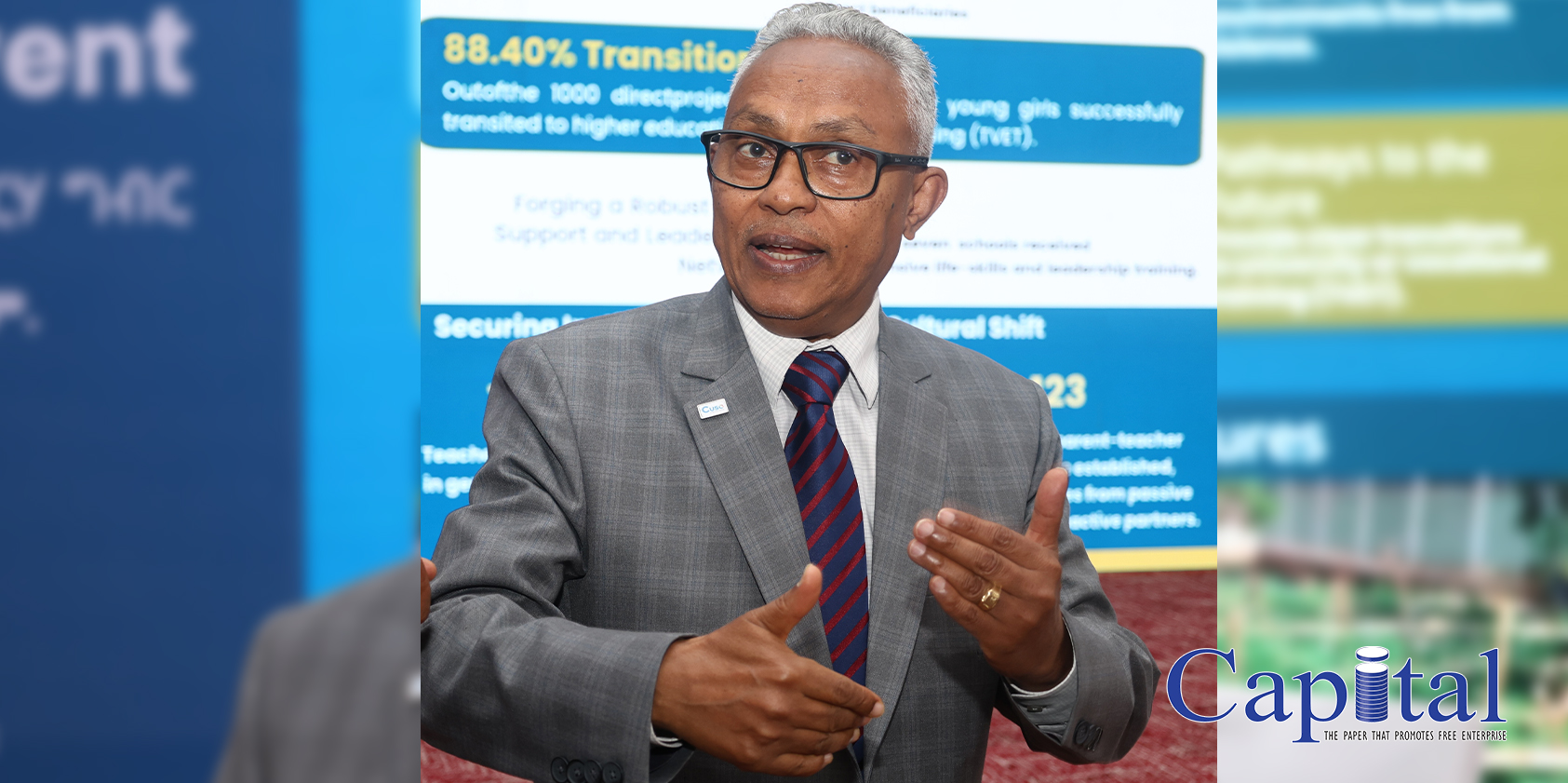
In short, the investment did more than support individual students—it transformed educational ecosystems and cultivated a generation of empowered young women.
Capital: Beyond numbers, what does success look like for a girl in this program?
Wendwossen: Success is most powerfully reflected in the personal transformation of girls who, once feeling invisible or confined by traditional expectations, now recognize themselves as leaders and agents of change. Participants in the U-GIRLS 2 program often describe a profound shift from fear and silence to confidence and agency. Through mentorship, leadership training, and peer support networks, these girls develop the courage to voice their opinions in class, pursue leadership roles in school, and advocate for their right to education within their families. Educators observe that students who previously hesitated to ask questions are now leading classroom discussions, mentoring younger peers, and actively participating in gender clubs that foster equality and mutual respect. Ultimately, success for these girls transcends university admission—it lies in discovering their voice and redefining what is possible for the next generation.
Capital: How do interventions like “Positive Masculinity” and “Multi-Family Healing Spaces” dismantle barriers such as early marriage or gender-based violence?
Wendwossen: These approaches address gender inequality at its roots by transforming relationships and power dynamics within families and communities. Positive Masculinity engages men and boys as allies by challenging harmful stereotypes through transformative techniques such as reverse role-play. This builds deep empathy, allowing men to experience firsthand the pressures girls and women face.
As male leaders and family heads critically examine the socially constructed meanings attached to gender roles, they begin actively removing obstacles that block opportunities for their daughters and sisters, leading to immediate behavioral shifts and a strong commitment to advocating for gender equality.
Multi-Family Healing Spaces operate through a structured four-part process that includes family healing sessions to build empathy and address conflict; parent-only sessions to practice democratic and nurturing parenting; youth-only sessions to strengthen self-expression and life skills for children over twelve; and intergenerational spaces where the whole family gathers on equal footing to bridge gaps and plan futures together, with every voice heard.
These structured dialogues allow girls to share their aspirations directly with parents, while families gain a deeper understanding of the challenges girls face balancing domestic work and school. The result is a tangible reduction in domestic workloads, delayed discussions of early marriage, and strengthened family support for girls’ continued education.
Capital: How were “soft outcomes” such as confidence measured?
Wendwossen: The project employed a robust mixed-methods evaluation approach, integrating quantitative surveys, comparison groups, and qualitative assessments. The results demonstrated measurable gains in personal development. Notably, 97.5% of participants reported enhanced confidence and leadership abilities. Furthermore, soft-skills scores showed significant improvement among intervention participants relative to those in non-intervention groups. These competencies directly contributed to educational advancement.
Capital: What role did local partnerships play?
Wendwossen: Local partnerships were absolutely central to the project’s success. We worked closely with regional education bureaus, women’s and social affairs bureaus, and all relevant sector offices, alongside school administrations, teachers, community leaders, Assosa University, and regional colleges. These collaborations ensured that all interventions were aligned with national policies and grounded in culturally relevant practices. Capacity-building interventions were designed and delivered collectively, based on jointly identified technical gaps.
Teacher training programs, for instance, were strengthened to incorporate gender-responsive pedagogy. Collaboration with government structures also ensured that strategies such as gender clubs, mentoring systems, and community dialogues were embedded within existing education systems, rather than functioning as temporary project activities.
The project recognized that lasting success requires active contribution from parents and the wider community. To this end, it built the capacity of Parent-Teacher-Student Associations (PTSAs), empowering them to take a leading role in promoting quality education and fostering an enabling teaching and learning environment. By facilitating stronger communication, collaboration, and innovation among stakeholders across the education ecosystem—from policymakers to practitioners—the project enabled locally owned interventions. This systemic engagement stands as one of the project’s most remarkable achievements.
Capital: What was the biggest operational challenge?
Wendwossen: The most significant operational challenge was implementing the project within a fragile, conflict-affected environment, compounded by the simultaneous pressures of the COVID-19 pandemic and economic instability. Frequent school closures, internal displacement, road blockages, and persistent security risks severely disrupted program activities and restricted access to affected communities. In response, the project adopted a highly adaptive management approach—adjusting timelines, integrating psychosocial support for displaced populations, and collaborating closely with local partners to ensure continuity of operations under extremely difficult circumstances.
Capital: What is the project’s exit strategy?
Wendwossen: The project’s exit strategy centered on deep institutionalization to ensure progress endures beyond its closure. Throughout implementation, U-GIRLS 2 introduced management innovations designed not as parallel systems, but as mechanisms to reinforce existing institutions, enhance efficiency, and secure long-term continuity. A key innovation was the strategic deployment of national volunteers—particularly female graduates—as school-based focal persons. These individuals served as vital liaisons between students, school leadership, and project teams, enabling consistent follow-up on attendance, academic performance, and protection concerns, while simultaneously building local capacity by providing young professionals with practical experience. Concurrently, the project deliberately shifted emphasis toward government capacity building by engaging technical advisors to train and mentor staff from regional bureaus, woreda education offices, and school leadership, thereby transferring expertise into permanent structures. To cement these gains, the project trained over 1,600 teachers in gender-responsive methods, established gender clubs and mentorship systems within schools, strengthened parental and community support networks, and successfully integrated its approaches into education bureau policies and school management frameworks.
Capital: What advice would you give to others seeking similar success?
Wendwossen: Based on our experience, three key principles are essential. First, adopt a holistic approach that addresses academic, economic, social, and psychological barriers simultaneously. Second, actively engage families and communities, as sustainable change is driven when parents and local leaders become champions of girls’ education. Third, invest in girls’ leadership, as empowered young women have a ripple effect, influencing their peers, families, and entire communities. The success of U-GIRLS 2 demonstrates that integrating these elements can yield truly transformative results.
Capital: What is the biggest threat to the progress made?
Wendwossen: The greatest threat is the convergence of economic vulnerability, conflict, and persistent gender norms. These factors can quickly reverse educational gains when support systems weaken. Economic shocks often pressure families into resorting to early marriage or child labor, while insecurity disrupts schooling and restricts girls’ mobility.
In this context, the international community has a crucial role to play. Sustaining progress requires continued investment in girls’ education, strengthening education systems in fragile regions, and supporting programs that empower girls as leaders of development. While there are undoubtedly many competing global interests, education remains a key foundation for lasting progress, making it essential to strategically maintain the momentum we have built.
As the proverb reminds us, “When you educate a girl, you educate a nation.” To achieve this, we must strengthen families, transform schools, and reshape socio-cultural norms across communities—a process that demands long-term, uninterrupted support. With the March 8, 2026, theme being “Give to Gain,” my humble message to all is to keep giving in order to sustain our gains.