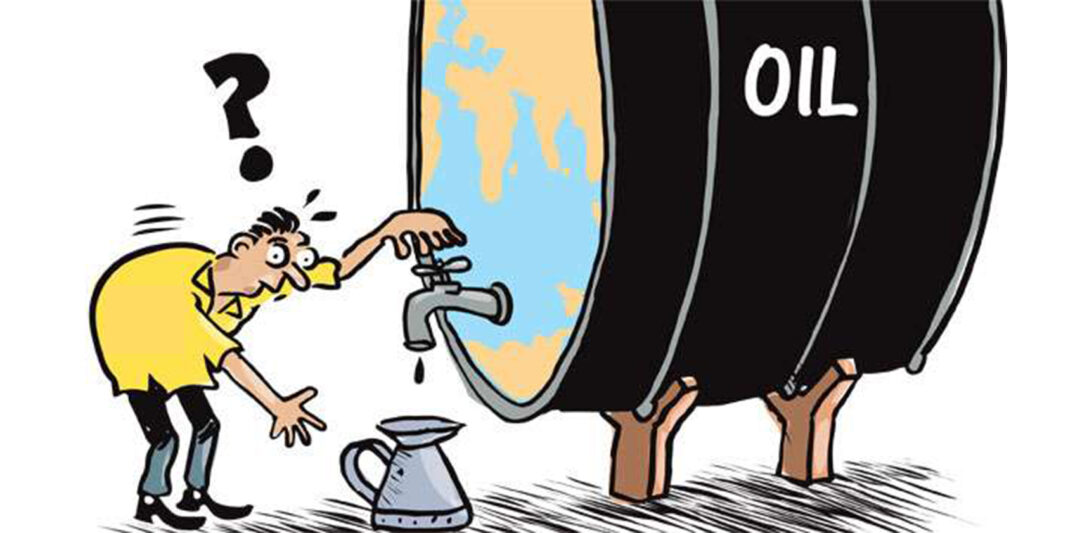
Consultants like to say: a crisis is just a system revealing itself.
Ethiopia’s fuel shortage is doing exactly that.
The war in Iran has triggered what energy analysts are calling one of the largest global supply shocks in decades, with as much as 20% of global oil flows disrupted and prices surging past $100 per barrel.
In some moments, prices have even approached levels not seen since previous global crises.
For countries that produce oil, this is a windfall. For countries like Ethiopia, it is a stress test.
The problem is not just price… It is access.
Most commentary focuses on rising prices. That is only half the story. The more immediate issue is supply.
The closure and disruption of key shipping routes like the Strait of Hormuz, through which a fifth of global oil normally passes, has tightened not just crude supply, but refined fuel markets as well.
That is why queues are forming. That is why deliveries are delayed. That is why fuel, even when paid for, does not always arrive on time.
This is not inflation. This is scarcity.
Clearly, Africa as a whole is highly exposed to this kind of shock because it imports most of its fuel. Ethiopia is even more exposed: It imports virtually all refined petroleum, it depends heavily on a single logistics corridor, it already faces foreign exchange constraints.
So when oil rises above USD100, the effect is not linear. It compounds. More dollars are needed.
Shipping costs increase. Insurance premiums rise. Delivery slows. And suddenly, the issue is not affordability alone, it is availability.
In a way, fuel is not just fuel. It is the operating system of the economy. When supply tightens, transport slows, prices rise, production costs increase, food supply chains weaken.
Fertilizer, heavily tied to energy markets, is also affected, pushing up agricultural costs and threatening future harvests. The result is predictable: today’s fuel shortage becomes tomorrow’s food inflation.
There is, however, one decision that now looks prescient.
The government’s push toward electric vehicles. At the time, it may have seemed ambitious. Today, it looks strategic. Countries with electric mobility, renewable energy, and reduced oil dependence are already showing greater resilience in this crisis.
Ethiopia, with its largely renewable electricity base, has an advantage many do not. Every electric vehicle on the road today is one less vehicle queuing for imported fuel tomorrow.
This policy should not slow down. It should accelerate.
Now, if oil remains above USD100, and early indicators suggest it may, Ethiopia cannot afford to respond passively. The response must be immediate, disciplined, and practical. First, demand must be managed.
Around the world, governments are already encouraging reduced fuel consumption, cutting non-essential travel, prioritizing logistics, and managing distribution tightly. Ethiopia will need to do the same, whether explicitly or indirectly.
Second, allocation must become strategic. Fuel should flow first to: Food supply chains, public transport, and essential services. Not all consumption is equal in a shortage.
Third, communication must improve. Uncertainty fuels panic. Panic fuels hoarding. Hoarding worsens shortages. Clarity matters.
If disruption continues into the coming weeks, the question shifts from management to adaptation. At that point, governments elsewhere have already begun enforcing energy conservation, rationing critical supplies, and prioritizing sectors. Some countries have even reduced working days or restricted energy-intensive activities. These are not extreme measures. They are pragmatic ones. Ethiopia may need to consider them.
Communities, of course, will not wait for policy. They will adapt instinctively. People will, combine trips, shift to public transport, reduce discretionary movement, share transport where possible.
We are already seeing this globally, where households are cutting fuel use, limiting travel, and adjusting daily routines.
The informal economy adjusts faster than policy ever can. The question is whether policy keeps up.
This crisis is not new. It is simply familiar in a sharper form. It reveals a simple truth:
Dependence on imported fuel is not just an economic issue. It is a structural vulnerability. Every external shock becomes an internal crisis. Which is why the long-term response cannot be temporary measures alone. It must include: Accelerated electrification, diversified logistics and reduced oil dependency.
Not as environmental ambition, but as economic necessity.
The Bottom Line is that if oil stays above USD100, Ethiopia’s fuel shortage is not a temporary inconvenience.It is a preview of what happens when global shocks meet structural dependence.
The queues at fuel stations are not just lines. They are signals that the system is tightening.
Signals that adjustment is already underway. And signals that the real question is no longer whether Ethiopia will feel the shock, but how quickly it can adapt before the shock becomes the new normal.