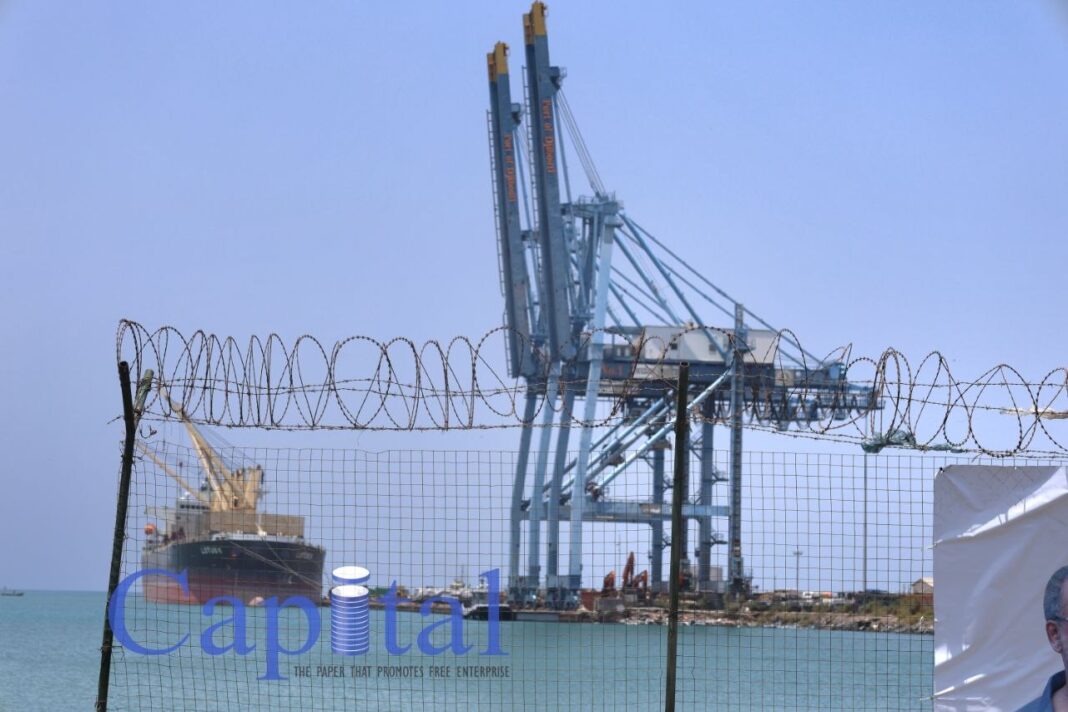
The Djibouti Ports and Free Zones Authority (DPFZA) has announced that despite a surge in incoming vessels driven by the ongoing conflict in the Persian Gulf, priority will be given to cargo destined for Ethiopia.
The chairman of DPFZA, Aboubaker Omar Hadi, stated that the situation in the Strait of Hormuz has led to an increased number of vessel calls at Djibouti’s ports.
Speaking to Capital, he confirmed that some ships originally bound for Jebel Ali have been diverted to Djibouti.
However, Hadi noted that the Persian Gulf conflict has not significantly affected Djibouti, as the country lies outside the affected shipping lanes. “We are on the Bab el Mandeb, and Hormuz is too far. Djibouti is open to the Indian Ocean,” he explained. “All the goods that transit through our ports come essentially from Asia and Europe. So for the moment, the Bab el Mandeb and the Suez Canal are not much affected.”
He added that Djibouti has even seen a recovery in traffic flows. “We have recovered a little flow for the countries of the region,” he said.
Addressing concerns over potential congestion due to the rising number of vessels, the chairman emphasised that Djibouti possesses ample infrastructure to handle the influx. “We have around six deep-sea ports in Djibouti, so we are not going to face any congestion,” he said.
The only possible bottleneck, he acknowledged, could arise from inland transport—namely rail and road networks. “But what we are going to do is handle the cargo discharged in Djibouti ports as transshipment: ship to ship. So there will be no congestion issue,” he clarified.
When asked about potential challenges for Ethiopia—Djibouti’s largest port user, which relies heavily on the facility for its imports and exports—Hadi was unequivocal. “We are not the one who created this problem. So for Ethiopia, we are going to give priority to all Ethiopian cargo destined for Ethiopia,” he said, adding that priority would apply especially to fertiliser shipments.
Regarding the opportunity to promote Djibouti as a key transshipment hub in global logistics, the chairman struck a cautious tone, declining to make bold promotional moves. “We are visible enough. We don’t want to be more visible,” he said. “It’s very dangerous to be more visible.”
On the subject of security, Hadi expressed no concern about potential attacks from Ansarullah forces in Yemen. “I don’t think they will target Djibouti,” he stated.
He noted that Djibouti’s ports are located at the southern entrance of the Red Sea, south of Bab el Mandeb, and therefore remain unaffected by any unrest in that narrow strait. “All our ports are south of it—the southern entrance of the Red Sea,” he reiterated.