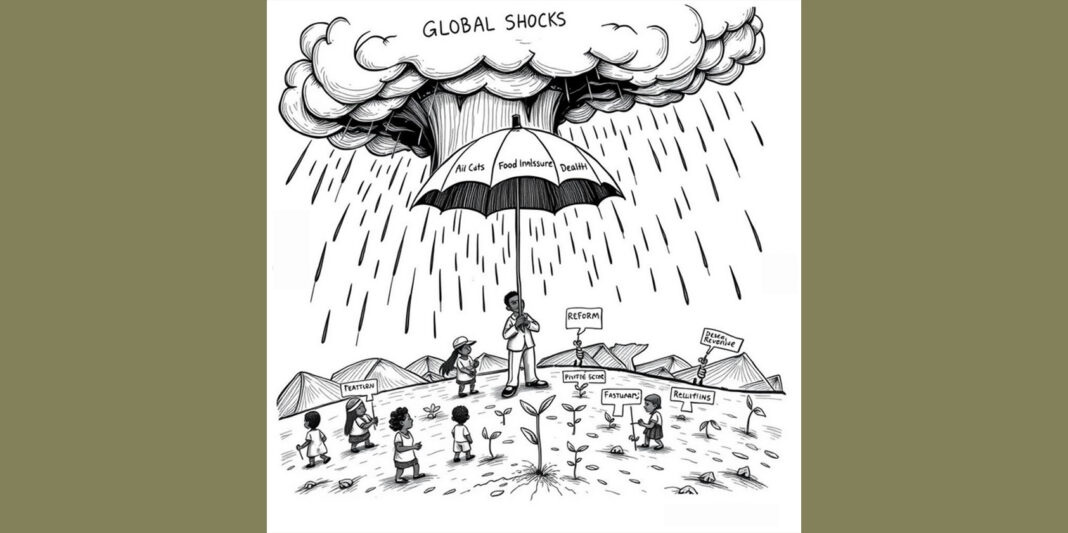
Sub-Saharan Africa is entering a harder economic era. After a relatively strong 2025, the region is now facing the combined pressure of war-driven commodity shocks, tighter financing conditions, and steep cuts in official development assistance. The IMF’s April 2026 Regional Economic Outlook is clear: the old model of relying on external support, public spending, and repeated stabilization cycles is no longer enough.
This is not a call for pessimism. It is a warning that hard-won gains can quickly erode if policymakers respond to today’s crisis with delay, fragmentation, or business as usual. The region still has room to act, but the response must be sharper, more coordinated, and more focused on building resilience from within.
The first priority is to protect price stability and the poorest households. The IMF notes that food, fuel, and fertilizer shocks are already feeding inflation and threatening food security, while aid cuts are hitting health, education, and humanitarian programs hardest. Governments should therefore avoid broad, untargeted subsidies and instead use temporary, well-designed support for the most vulnerable, while keeping monetary policy focused on anchoring inflation expectations.
The second priority is fiscal discipline with purpose. For many countries, the temptation will be to borrow more, postpone reforms, or cut public investment to plug the gap left by aid. That would be the wrong lesson. The IMF warns that many states already face high debt risks and limited fiscal space, so governments need to protect essential social spending, improve public financial management, and strengthen revenue mobilization rather than simply searching for new debt.
Domestic revenue reform is no longer optional. The region has the lowest tax-to-GDP ratio in the world, and aid dependence has made many budgets more vulnerable than they should be. Tax administration, customs modernization, reduced leakages, and better compliance can raise revenues without crushing growth, but these reforms require political will and public trust.
The third priority is to shift decisively toward private-sector-led growth. The IMF argues that sub-Saharan Africa’s growth has often depended too heavily on commodity booms or public investment, neither of which has delivered durable convergence with richer economies. The next phase must focus on governance, simpler business regulation, stronger external-sector policies, and a better investment climate that can crowd in private capital and create jobs.
That means governments should make it easier to do business, not harder. They should reduce bureaucratic bottlenecks, strengthen contract enforcement, improve state-owned enterprise performance, and open more space for competition. These are not abstract reforms; they are the foundations of productivity, export growth, and investment confidence.
Regional integration also has to move from slogan to strategy. In a world of higher shipping costs, trade disruptions, and volatile geopolitical conditions, African economies need bigger regional markets, more reliable logistics, and deeper financial systems. The African Continental Free Trade Area can only deliver if countries lower barriers in practice, modernize customs, and align rules that currently keep goods, capital, and ideas from moving efficiently across borders.
At the same time, policymakers should rethink how they finance development. The IMF rightly points to blended finance as one of the few scalable tools available in a constrained global environment, especially for projects that can attract private investment if risk is reduced. But blended finance will only work if countries improve project preparation, transparency, governance, and macroeconomic credibility.
There is also a digital opportunity hiding inside the crisis. The IMF notes that artificial intelligence could boost productivity, but only if countries invest in electricity, broadband, data governance, and skills. For many economies, this is a chance to leapfrog some stages of development—but only if digital policy is treated as core economic policy, not a side issue.
Aid cuts make the case for domestic resilience even stronger. External partners still matter, especially for humanitarian support and fragile states, but sub-Saharan Africa can no longer afford to build public services on a fragile external foundation. The task now is to protect the most essential programs, diversify financing, and build institutions that can deliver services even when donor priorities change.
The region has been through repeated shocks over the past six years. That history should not produce fatalism; it should produce urgency. The countries that emerge strongest from this period will be those that use the crisis to reform faster, govern better, and invest in the systems that make growth broad-based and durable.
Sub-Saharan Africa does not need a new diagnosis. It needs execution. The choice is whether this moment becomes another lost decade of adjustment—or the start of a more resilient economic model built on domestic reform, regional integration, and private-sector dynamism.