Ethiopia’s economy continues to grapple with chronic price instability, a problem rooted in deep-seated shortcomings in macroeconomic policy coordination and a persistent lack of structural separation between fiscal and monetary authorities. The severity of the crisis is underscored by recent data from the Ethiopian Statistical Service (ESS), which reveals that annual headline inflation has surged to 15.3 percent. This sharp acceleration marks a significant climb from 13.9 percent the previous month and starkly reverses the short-term reprieve of single-digit inflation—recorded at 9.7 percent—achieved just months earlier.
At the heart of this inflationary surge is skyrocketing food inflation, which climbed to 15.7 percent. While government officials frequently attribute these pressures to imported global commodity price shocks and transitional economic adjustments, independent experts and leading macroeconomists argue that this phenomenon is symptomatic of long-term structural mismanagement rather than temporary anomalies.
The core of the crisis lies in an institutional lack of firewalls between fiscal and monetary authorities. This structural defect perpetually fuels currency depreciation, imported inflation, and exacts a devastating toll on the country’s most vulnerable populations. Dismissing these recurring spikes as short-term adjustments ignores deeply rooted governance breakdowns that have persisted for generations.
Price instability is not a new challenge for the Ethiopian economy. Over the past six decades, inflation has repeatedly flared up, proving resilient to temporary policy fixes.
Yisehak Teka Nibere, a banking, finance, and macroeconomics expert with over two decades of experience in Ethiopia’s financial sector, told Capital that soaring price levels have remained the singular, unbroken macroeconomic challenge since the era of the Ethiopian People’s Revolutionary Democratic Front (EPRDF) and beyond.
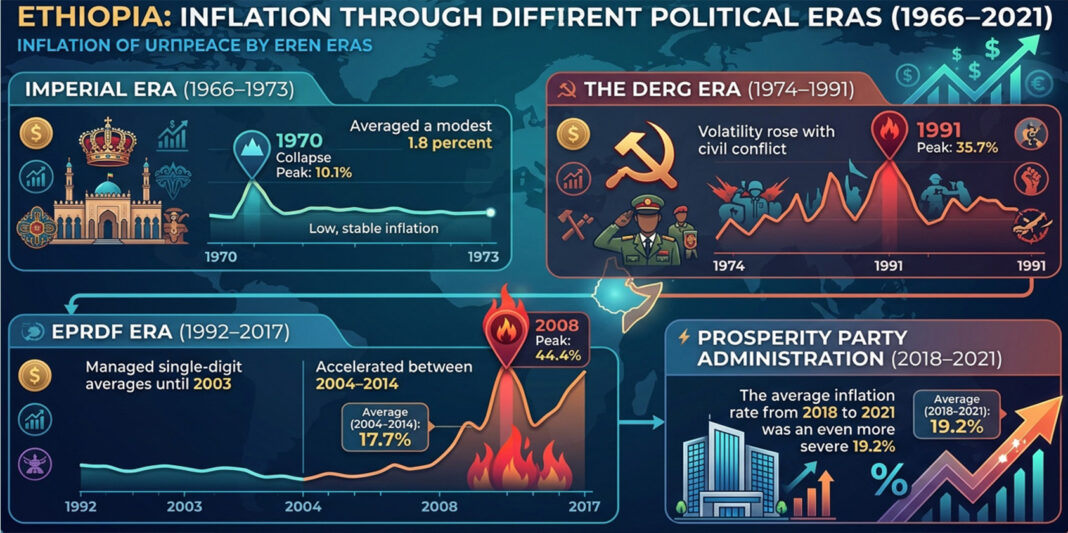
Recent academic research contextualizes this trajectory. Citing World Bank data, historical assessments show that prior to 2003, outside of severe supply shortages and wartime anomalies, Ethiopia largely maintained single-digit inflation. During the final eight years of the imperial regime (1966 to 1973), the average inflation rate hovered at a modest 1.8 percent, with a peak of 10.1 percent recorded only as the regime faced imminent collapse in 1970. Under the military government of the Derg, price volatility shifted alongside intensifying civil conflict, culminating in a high of 35.7 percent in 1991 as the civil war reached its zenith.
During the EPRDF era, spanning from 1992 to 2017, average inflation until 2003 remained manageable at 9.4 percent. However, the period between 2004 and 2014 witnessed rapid acceleration, with average inflation rising to 17.7 percent and peaking at 44.4 percent in 2008. This upward trajectory continued into the Prosperity Party administration, where average inflation climbed to 19.2 percent, reaching a peak of 26.8 percent. Economists argue that these recurring spikes underscore the necessity of adopting a modern, targeted inflation policy—typically benchmarked globally between 2 and 3 percent—to insulate the public from high inflation, which acts essentially as a regressive indirect tax on ordinary citizens.
The root cause of Ethiopia’s enduring inflation cycle, analysts emphasize, is the historical subordination of monetary policy to fiscal imperatives. In an institutional framework where the National Bank of Ethiopia (NBE) lacks complete autonomy from the Ministry of Finance, the central bank’s ability to act as a guardian of price stability is fundamentally compromised. As prominent analysts frequently observe, the institutional overlap between the entity managing government expenditure and the entity regulating money supply creates a severe structural conflict.
When the government heavily spends on public projects and fiscal operations, a massive amount of liquidity is injected into the economy. In a functioning independent framework, the central bank is mandated to use various monetary instruments to absorb this excess liquidity, thereby balancing the money supply with the aggregate supply of goods and services.
Two years ago, the Ethiopian parliament passed a landmark central bank proclamation designed to alter this dynamic. The legislation significantly expanded the National Bank of Ethiopia’s (NBE) operational capacity and legally restricted direct monetary financing of the government. This provided the statutory autonomy needed to combat inflation without political interference. Yisehak emphasizes that restoring this equilibrium is non-negotiable, as prices inevitably spiral upward when the money supply decouples from physical economic output. The current system, which allows the executive branch to unilaterally dictate fiscal priorities, effectively dismantles critical checks and balances. This phenomenon, known as fiscal dominance, strips the central bank of its role as an independent guardian of monetary stability.
In 2024, Ethiopia embarked on an ambitious macroeconomic overhaul supported by the International Monetary Fund (IMF), highlighted by the historic decision to float the Ethiopian birr. While transitioning to a market-determined exchange rate was presented as an essential step toward modernization, the immediate aftermath saw a depreciation exceeding 160 percent. The direct consequence has been intense exchange-rate pass-through inflation, magnifying the vulnerability of an import-dependent economy to external shocks. Throughout this rollout, the IMF has repeatedly insisted that tight monetary discipline and absolute central bank independence are non-negotiable pillars for success.
Recent empirical analyses of monetary transmission mechanisms in developing markets emphasize that central banks require robust institutional and financial independence to effectively steer market interest rates. Without adequate capitalization and operational autonomy, central banks often need state bailouts to absorb losses from sterilization or currency interventions. Such financial dependency erodes institutional credibility, exposing monetary policy to direct political and fiscal coercion. Consequently, commercial banks and the public discount policy tightening signals, neutralizing the central bank’s ability to anchor inflation expectations or influence lending rates. Beyond domestic monetary expansion, Ethiopia’s vulnerability exposes a deeper structural flaw: an over-reliance on import-driven supply chains.
While public discourse often focuses on how inflation devastates household purchasing power, analysts warn of a more profound institutional threat: unchecked inflation compromises the operational capacity of the state itself. As financial experts frequently note, inflation in the country’s economy primarily harms the government. Rampant price growth systematically erodes the real value of public budgets, paralyzing planned capital expenditures and making the procurement of basic public goods and services untenable. Regional and woreda administrations operating on fixed birr allocations find themselves unable to purchase essential operational supplies as market prices outpace budget cycles. This dynamic degrades public service delivery across every tier of government.
Furthermore, because a substantial portion of Ethiopia’s sovereign debt is denominated in foreign currency while state revenues are collected in depreciating local currency, inflation generates an unsustainable fiscal squeeze. Servicing identical dollar-denominated liabilities requires exponentially larger volumes of local currency. This structural bind is intensified by the rigorous austerity measures mandated by the IMF to restore macroeconomic equilibrium.
The Fund has persistently advocated for contractionary monetary policies and aggressive domestic revenue mobilization drives to ensure fiscal sustainability. These recommendations have pressured the administration to aggressively scale up tax collection, pushing to reverse a dip in the tax-to-GDP ratio that had languished around 7.1 percent during the 2023/24 fiscal year.
In the first half of the previous fiscal year, the National Bank aggressively used liquidity auctions, absorbing hundreds of billions of birr and raising its policy rate to 16 percent. These strong measures were central to a deliberate strategy to separate central bank financing from the federal treasury—a reform widely praised by international observers. The initial results were clear: by December 2025, annualized inflation dropped to a promising 9.7 percent. In recent Article IV consultations and program reviews, IMF leadership has continued to emphasize the urgency of solidifying central bank independence and improving policy transparency.
Ultimately, economic consensus suggests that chronic inflation will persist until Ethiopia establishes a truly independent central bank with statutory authority, operational autonomy, and immunity from political interference. Furthermore, domestic price stability will remain vulnerable to external shocks until structural reforms successfully diversify the economy and eliminate its dangerous dependence on foreign imports.