Thursday, April 9, 2026
Home Blog Page 1925

ESL sets sail toward expansion with new ultramax vessels

0

The Ethiopian Shipping and Logistics (ESL) has renewed hopes for building two additional ships at the Chinese shipyard after the relevant authority approved the initial investment.

The procedure has taken longer, even though the National Bank of Ethiopia (NBE) approved the request to get foreign currency in order to purchase two enormous, brand-new vessels.

The company, which presently operates nine bulk carriers in addition to a recently acquired used ultramax, a midsize vessel, has been working on a proposal to purchase two vessels in order to increase the scope of its maritime freight business.

The state-owned logistics behemoth, ESL, has been expanding its fleet of ultramax ships.

In an effort to grow its maritime industry, which includes the profitable cross-trade service, a crucial market niche for producing hard currency, ESL has made the decision to add more ships to its fleet, which was previously mostly made up of handysize ships.

According to the plan, the state firm is expected to purchase two ultramax ships with a gross weight exceeding 63,000 in the near future.

An international bid was put out in the previous fiscal year, and it was won by Xiangyu, a company from China that currently dominates the global shipbuilding market.

ESL and the firm have finalized the framework agreement for the project’s execution; the specifics will be decided upon when the financial matter is resolved.

However, because of the foreign exchange difficulty, the procedure would not proceed. The logistics company is currently among the largest public enterprises that produce hard currency, but in order to get there, it had to go through additional requirements.

The central bank requested the company to provide its clarification over the procurement project last year.


The financial allocation from the publicly owned financial behemoth Commercial Bank of Ethiopia (CBE), which is anticipated to unleash the foreign currency, directly impacts the case.

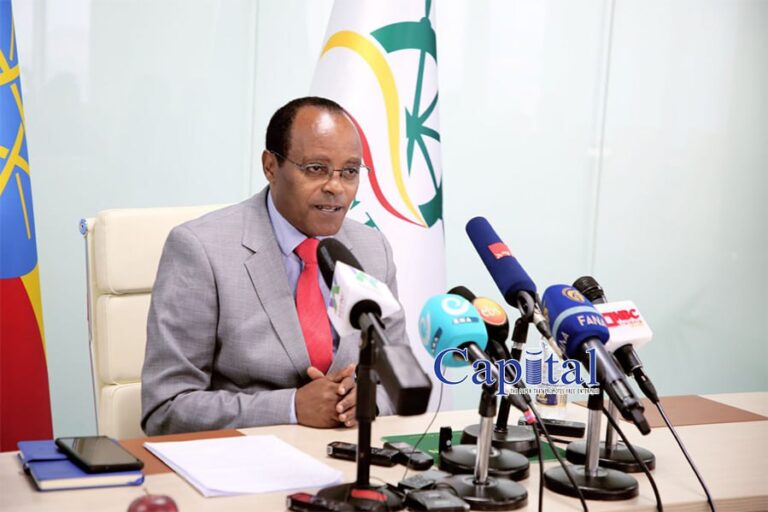
The CEO of ESL, Berisso Amallo, told Capital that NBE has been persuaded to purchase additional vessels by his company, even if the matter is still at CBE. He said that his organization is aware of the current correlation between the issue and the hard currency shortage the nation is experiencing.

“But they do give us hope that the first payment will be released by July, which is the start of the next budget year,” he stated.

He stated that he anticipated receiving the first payment in the upcoming months, which would enable the builder to start building right away.

Even though construction is anticipated to take longer than two years, he also stated his wish to board the ship as soon as possible. According to the agreement, ESL will cover thirty percent, and CBE will arrange the remaining seventy percent of the funds needed for the purchase of the two vessels, a process that is expected to take more than two years.The money will be paid in five equal installments of twenty percent each. The framework agreement states that the first payment will be made upon contract signature, with the remaining amount to be paid for steel cutting, keel laying, launching, and delivery.

Wondimu Denbu, Deputy CEO for Corporate Service at ESL, recently told Capital, “We need the foreign currency on five payment schedules that we clearly explained to NBE in filing.”

According to industry experts, purchasing a brand-new ship takes more than two years since shipbuilding is similar to obtaining building construction.

The new ships will be dry carriers with an ultramax type carrying capacity of more than 63,000 DWT, per the deal. At the moment, ESL has nine ‘handysize’ dry carriers with a DWT of around 28,000 each.

Recall that approximately 12 years prior, the prosperous logistics company set out to buy nine vessels, including two tankers, for a total of USD 293.5 million.

This was made possible by a loan guarantee from the Export Import (EXIM) Bank of China, which brought the total number of vessels acquired to 11, until recently.

A year ago, ESL swapped in its first-ever 42,000 DWT tankers, Bahir Dar and Hawassa, for the ultramax dry bulk carrier MV Abbay II. This is also the company’s first midsize vessel.

A delegation headed by the CEO visited China a week ago to talk about acquiring new ships in order to expand its fleet of marine assets.

The CEO, however, is hesitant to divulge the details because it is still in the early stages.
EEU to enhance services for its prepaid electricity users

0

The Ethiopian Electric Utility (EEU) is set to revolutionize the experience for nearly 900,000 prepaid electricity customers with the development of a new $48 million technology center. Slated for completion by year-end, this initiative aims to streamline operations and significantly improve customer satisfaction.

The new technology excellence center, located in Kotebe, Addis Ababa, will address frequent complaints from prepaid customers regarding service delivery issues such as power outages at service centers, lack of accessible service locations, and disruptions in payment notification messages. Additionally, the center is designed to eliminate the need for customers to endure long queues, which have been a significant time and cost burden.

Melaku Taye, the Director of Corporate Communications at EEU, explained that the current prepaid service system has faced numerous challenges. The upgrade will allow customers to recharge their electricity using cards or digital payments, eliminating the need to physically visit service centers.

“Starting next year, prepaid service users will be able to charge their accounts online or via card, making transactions more convenient and accessible,” Melaku said.

EEU, which serves over 4.6 million customers nationwide, including more than 3.75 million post-paid and over 900,000 prepaid users, launched an international tender to enhance its technological capabilities. A leading Chinese company specializing in smart power distribution solutions won the $48.8 million bid and is currently fast-tracking the construction process.

The technology overhaul at the Kotebe center will not only cater to existing prepaid customers but also to new users who will be integrated into the system in the coming years. In 2022, EEU plans to implement a system allowing for remote energy consumption readings, which will provide customers with real-time data on electricity usage and ensure accurate billing without manual meter reading.

This modernization effort represents a significant shift from the traditional prepaid meters, where energy consumption was recharged with a manually entered secret number. The upcoming system promises a more efficient and user-friendly approach, aligning with EEU’s commitment to enhancing service delivery across the country.

ESL confronts Sugar Industry Group over unpaid debts

0

The Ethiopian Shipping and Logistics (ESL) blasts the Ethiopian Sugar Industry Group (ESIG) for unpaid arrears that the latter failed to pay. The state-owned logistics enterprise’s efforts to address the audit findings are commended by the Office of the Federal Auditor General (OFAG).

During the Public Expenditure Administration and Control Affairs Standing Committee hearing, which aimed to assess the performance audit report covering the previous two years, the logistics giant declared that the majority of the arrears that were expected to be settled by private and public organizations have been paid.

With the exception of a relatively small number of public entities, the management of ESL indicated that it has received the money that was referenced in the audit findings.

According to Berisso Amallo, CEO of ESL, ESIG, a state-owned producer and importer of sugar, is the difficult problem his company faces.

“One of the issues we observe is that the sugar Group refused to pay the arrears that they ought to have for the service we provided,” he stated emphatically.

The audit results related to ESIG were a unimodal service that ESL offers, according to Siraj Abdulahi, Deputy CEO for Maritime Service at ESL.

He clarified that the Ministry of Finance (MoF) had arranged a guarantee for ESIG about the payment on some of the services, saying that there was no disagreement between the two parties regarding this case.

“Disagreements exist on the amount of arrears that the group is supposed to pay us. Rather than going to ordinary court, we filed the lawsuit with the Attorney General to resolve the matter,” Siraj continued. The group has paid the amount that was given only this week, according to Berisso, “while there is also a huge sum we are expecting from ESIG.”

The audit findings state that ESL owes the group USD 323,000 and 48 million birr in arrears.

According to the CEO, his organization has a significant stake in Ethio Engineering Group (EEG), formerly known as MetEC. He stated that ESL and MoF are now discussing a solution to the matter.

According to the findings, EEG, a state-owned firm, was intended to pay USD 19.6 million and 757.1 million birr to the logistic enterprise.

The National Disaster Risk Management Commission owes ESL 148.8 million birr and USD 25.6 million in arrears; according to ESL’s CEO, talks with the MoF are underway to resolve this debt. During the meeting, the management reported that the majority of the audit’s findings, which included operational holes over the previous two budget years, had been fixed.

According to the CEO, most of the audit’s findings are acceptable; the majority has been resolved, and the remaining ones are being worked on.

The CEO stated, “We were able to use the audit findings as input to develop the reform that was completed and sent to Ethiopian Investment Holding, the higher body that oversees ESL.”

He said, “With regard to the operational gaps that were noted in the audit findings, it helped us to consider embarking on modernization.”

“We are implementing a digitalization framework to support our operations digitally, which is nearing completion for full implementation,” he stated.

The OFAG’s Auditor General, Meseret Damtie, emphasized that the company is a vital institution for advancing the national economy. She stated that many operational problems at ESL were discovered by the audit findings.

According to the ESL management’s answer, she appreciated their action if it was repaired in accordance with the recommendations.

“It has added value for the enterprise to improve its service and collection, as per their response,” she said in closing.

The company reportedly has arrears of about a billion birr, the majority of which has been collected, according to the results of a previous audit.

“Once we have water, we have life” Access to safe drinking water transforms lives in Conakry

0

Over 30,000 people benefited from improved safe water services in Greater Conakry following major investment under the Guinea Urban Water Project (PUEG); With over 12,000 meters installed, customers can now better manage their water consumption and enjoy enhanced service delivery; Under the project, 650 workers and supervisors benefited from capacity building to upgrade their technical, operational, and commercial skills.

Every morning at the crack of dawn, Sig Madina, a working class neighborhood, wakes up to the sounds of vendors hawking jerrycans of water from their carts for GF 2,000 to GF 5,000, depending on the size of the can. Today, the people of Sig Madina have access to the safe water they need for their daily survival.

But this was not always the case. Just a couple of years ago, water was hard to come by in Sig Madina. Households struggled to buy the bare minimum from the vendors. On any given day, Makalé Cissé, a mother of five, could only buy twenty 20-liter cans to meet her family’s washing, cooking, and drinking needs, costing her the equivalent of US$60 a month, or about 20 percent of her monthly budget.

When funds ran low, Makalé and her daughters would walk two kilometers, water cans on their heads, just to fetch water at the closest public standpipe. Getting up early was the only way then.

As she explained, “Not only was it a long way to go, but the quality of the water wasn’t even good enough. My children would often get sick; plus, having to go and fetch water affected my daughter’s performance at school.” Her eldest daughter, Aïssatou, failed her Baccalaureate exams twice. She explained what happened: “I would often leave late for school and had no time to go over my lessons. I had no choice, I had to help my mom.”

Just like families in Sig Madina, many other households in Conakry and its suburbs faced the same challenges in getting the safe water they needed, because of crumbling water pipes dating back to  colonial times.

Water piped to her home spells relief for Makalé

“Now that I just have to reach over and turn on my own tap at home, I have more time to focus on the other things I have to do each day. That also frees up time for my girls, who can focus fully on their schoolwork now.” Makalé Cisse

Since the household water connection was made and the water meter installed at the Cissé home a few months ago, they now have easier access to safe water. Flashing her brilliant smile, Makalé quipped: “Once we have water, we have life.”

Now, there is no more tumbling out of bed at dawn to wait for the water vendors. No more long hikes to stock up on water at the public standpipe. As she put it: “Now that I just have to reach over and turn on my own tap at home, I have more time to focus on the other things I have to do each day. That also frees up time for my girls, who can focus fully on their schoolwork now.”

With a meter in place, Makalé pays the equivalent of only $10 every other month compared to the $60 that she used to pay each month. She invests the money saved in income-generating activities to provide for her family and pay her children’s school fees.

Enhanced drinking water supply in Greater Conakry

This major shift in Makalé’s home and homes in other low-income neighborhoods in Conakry is just one of the successes of the Guinea Urban Water Project (PUEG), which was launched in 2018 with financing from the World Bank.

In a bid to improve access to water services, one of the main thrusts of the PUEG is investment in infrastructure for people in underserved neighborhoods, a move that has led to over 1,500 homes being connected to the network for the first time, enabling more than 30,000 people to gain access to drinking water and better manage their water consumption, thanks to the installation of 12,500 water meters—part of overall efforts to enhance the system’s efficiency.

Deputy General Manager in charge of infrastructure and development at Guinea Water Company, Moussa Camara, explained it this way: “The project made it possible to boost storage and distribution capacity by drastically reducing leaks and revenue loss. By laying new pipes, we got rid of many of the huge leaks and improved water supply to these areas. Better yet, the quality of the water reaching these homes was also higher.”  

The PUEG project has been completed even as work continues under the new Guinea Water and Sanitation Project (PEAG), a US$200 million project financed by the World Bank. The PEAG project will mark a sea change in bringing safe drinking water to urban areas by increasing throughput, transport, storage, and distribution of safe drinking water to the people of Greater Conakry.

Distributed by APO Group on behalf of The World Bank Group.