Thursday, April 2, 2026
Home Blog Page 2144

UNFPA invests $1 Million in Ethiopian census preparation

0

By our staff reporter

The United Nations Population Fund (UNFPA) has disclosed a significant investment of nearly $1 million over the past four years for the preparation of Ethiopia’s population and census efforts.

Dr. Natalia Kanem, the Executive Director of UNFPA and Under Secretary-General of the United Nations, revealed that the financial support was allocated for various purposes, including training on technology utilization and the procurement of computer tablets.

“The costs involved encompass training on new technology, such as assessing populations in hard-to-reach areas. We have implemented new technology for this purpose,” Dr. Kanem explained. “Currently, we are sending a team from the statistical office to South Sudan to learn how to estimate populations in inaccessible areas. These endeavors come with financial implications.”

Dr. Natalia Kanem visited the Medical Center of the Family Guidance Association of Ethiopia (FGAE) on February 19, 2024. During her visit, she received a briefing on FGAE’s reproductive health services and the collaborative efforts with UNFPA, the United Nations Sexual and Reproductive Health Agency.

FGAE has received substantial support from UNFPA, totaling $4.3 million from 2020 to 2024. This funding has facilitated the provision of family planning commodities and adolescent and youth-friendly reproductive health services.

Dr. Kanem also shared updates on UNFPA’s advocacy initiatives and programmatic priorities, focusing on reproductive health, maternal health, gender equality, women’s empowerment, and youth development. She highlighted UNFPA’s advocacy efforts at the 2024 African Union Summit, particularly regarding the Campaign on Accelerated Reduction of Maternal Mortality in Africa (CARMMA).

Zemen Bank partners with IFC to boost Ethiopian trade finance

0

By our staff reporter

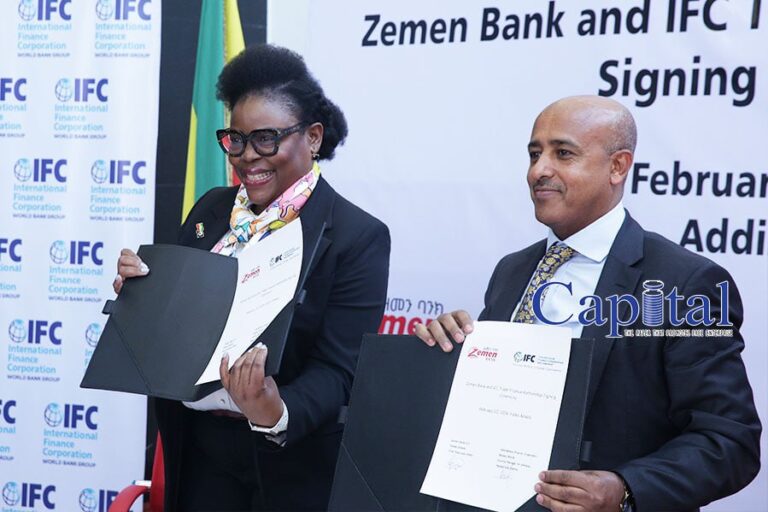
Zemen Bank secured a USD 30 million trade financing facility arrangement with the International Finance Corporation (IFC), the private sector arm of the World Bank.

The agreement serves as a guarantee for import-export trade facilitated by Zemen Bank, one of Ethiopia’s leading financial institutions. Amid concerns about foreign currency shortages and payment delays by certain local banks, this initiative aims to instill confidence in foreign commercial partners.

Dereje Zebene, CEO of Zemen Bank, acknowledged the challenges faced in managing foreign commerce, particularly during the period of unrest in northern Ethiopia, which was resolved with a peace agreement in November 2022. He reassured stakeholders that the situation is improving and emphasized the bank’s prudent approach to foreign currency management.

Speaking to Capital, Dereje emphasized the bank’s commitment to supporting its international clients with ample resources, addressing concerns about import and export transactions. He underscored that the recent agreement with IFC would further strengthen trust among trading partners and provide additional assurance to those doing business with the bank.

Under the agreement, Zemen Bank has joined IFC’s Global Trade Finance Program (GTFP) and gained access to a trade financing facility to facilitate Ethiopian imports and exports. The USD 30 million trade finance facility guarantee from IFC will bolster Zemen Bank’s trade finance operations and facilitate the establishment of new trade alliances for Ethiopian companies.

During the signing ceremony on Thursday, February 22, Dereje highlighted the program’s potential to significantly increase trade financing for import-export businesses, particularly during periods of global economic instability.

The initiative is part of IFC’s broader Africa Trade and Supply Chain Finance Program, aimed at promoting regional commerce in Africa and reducing the continent’s reliance on imports. Additionally, IFC will provide advisory services to Zemen Bank to enhance its credit and risk management and support small and medium-sized enterprise (SME) lending activities.

Madalo Minofu, IFC Country Manager for Ethiopia, expressed optimism about the partnership, stating that it would strengthen Ethiopia’s ability to finance essential trade and facilitate new trading partnerships for the country.

IMF Staff to visit Ethiopia amid concerns over birr devaluation

0

By Muluken Yewondwossen

The International Monetary Fund (IMF) has announced that its staff will be visiting Ethiopia in the coming weeks, raising speculation about a potential devaluation of the birr, the country’s currency.

Industry leaders and economists have urged the Ethiopian government to explore alternative solutions to address its severe foreign exchange shortages. This includes engaging in negotiations on multiple fronts simultaneously to meet the demands of foreign allies.

Ethiopia, grappling with acute foreign exchange challenges and seeking to stimulate economic activity, has been in discussions with the IMF for financial assistance. However, these discussions have yet to conclude, despite initial discussions about foreign exchange assistance early last year.

The IMF has outlined prerequisites for releasing the anticipated funds, including assurances and support from Ethiopian financiers and partners. Additionally, it has urged the government to narrow the gap between official and informal currency exchange rates.

Concerns have arisen among the public regarding the possibility of the government implementing a birr devaluation, a move the government has resisted for years. While the government has sought to downplay these reports and reassure the public, fears persist that external pressure and the foreign exchange shortage may prompt a change in stance.

Prominent industry commentators and investors have also warned against birr devaluation, citing potential negative repercussions. They argue that any benefits would be outweighed by disadvantages, including potential social and political unrest and economic instability.

Alemayehu Geda, a macroeconomic specialist, cited the example of Sudan in 2018, where a significant devaluation of the Sudanese pound, recommended by the IMF, led to skyrocketing inflation and a sharp decline in the exchange rate.

Similar challenges have been observed in Nigeria, Ghana, and Egypt, where currency devaluation resulted in soaring inflation rates and depreciation against major foreign currencies.

Analysts highlight the discrepancy between official and black market exchange rates, underscoring the complexity of implementing currency devaluation as a solution to foreign exchange shortages.

As Ethiopia navigates its economic challenges, the government faces mounting pressure to address foreign exchange issues while mitigating potential risks associated with currency devaluation. The forthcoming visit by IMF staff signals ongoing discussions and deliberations aimed at finding a sustainable path forward for the country’s economy.

As discussions surrounding a potential birr devaluation continue, experts have also raised concerns about the stability of exchange rates, particularly between official and parallel markets. Alemayehu, warned against attempts to harmonize exchange rates, citing past experiences in other countries.

Alemayehu expressed skepticism about the motivations behind Western pressure to weaken currencies, suggesting potential ulterior motives. He questioned the necessity of such measures unless there were underlying political agendas.

However, other Ethiopian experts argued that many goods are currently imported at prices aligned with the parallel market. Presently, the black market rate stands at 115 birr for one dollar, compared to 56 birr in the official market. These analysts believe that any attempt by the government to devalue the birr to match parallel market rates would have significant market implications.

They pointed out that approximately 70 percent of imports are conducted at official exchange rates, primarily for government purchases. Key imports such as petroleum, fertilizer, pharmaceuticals, and other essential goods are heavily reliant on official exchange rates. Alemayehu emphasized that a devaluation would lead to a doubling in prices for key commodities like petroleum, thereby driving up transportation costs and ultimately inflating food prices.

In terms of economic impact, experts projected that inflation would at least double in response to a devaluation, with subsequent effects on the government budget. Currently, the budget assumes a dollar exchange rate of 56 birr, but a devaluation would require a significant revision of these projections. Given that around 40 percent of the budget relies on foreign exchange, any adjustment would necessitate additional funding, likely through money printing.

Moreover, the decline in the tax-to-GDP ratio over the past decade has raised concerns about the government’s ability to generate revenue to cover increased expenditures. Internal conflicts within the nation further complicate efforts to boost tax collection.

Despite these challenges, proponents of devaluation argue that it is a necessary step to address the country’s foreign currency shortages. They advocate for implementing recommendations from financiers while seeking assistance from allies. However, opponents of devaluation maintain that the government must carefully weigh its options, considering the potential economic and social ramifications of such a decision.

One potential solution under consideration is the devaluation of the birr, coupled with obtaining foreign exchange assistance from external partners. However, experts caution that such a move could have significant repercussions on inflation and social stability.

Alemayehu and other experts propose an alternative approach, urging the government to advocate against devaluation and instead gradually depreciate the birr over time. Drawing parallels to Ghana’s successful devaluation of the cedi without causing inflation, they suggest a cautious approach to currency adjustment.

A key aspect of this alternative strategy involves aligning the remittance rate with the parallel market, thereby encouraging legitimate remittance flows. Additionally, exporters of non-traditional commodities would benefit from a discounted exchange rate, fostering growth in new export sectors. This approach, experts argue, would mitigate the risk of inflation while promoting economic growth.

While acknowledging the government’s challenging circumstances, experts stress the importance of effective foreign exchange management. They highlight the potential for significant revenue generation through measures such as curbing smuggling and enhancing forex management practices.

Julie Kozak of the IMF has confirmed ongoing discussions with Ethiopian authorities regarding economic policies and potential reforms. These discussions aim to support Ethiopia’s Homegrown Economic Reform Agenda (HGER II) and address macroeconomic vulnerabilities. The IMF team’s visit to Addis Ababa in October marked progress in identifying areas for IMF support, with further discussions planned in the coming weeks.

As Ethiopia navigates its economic challenges, policymakers face critical decisions regarding currency devaluation and economic reforms. The outcome of these deliberations will have far-reaching implications for the nation’s economic stability and growth prospects.

Ethiopia embraces local investors: New manufacturing policy opens doors to industry parks

0

By our staff reporter

In a bid to bolster domestic production and reduce reliance on imports, the Ministry of Industry (MoI) has rolled out a new manufacturing policy prioritizing import substitution.

MoI has devised strategies aligned with the recently endorsed manufacturing policy, which prioritizes the expansion of the import substitution subsector. Through the Investment Board, industry parks are now open to local investors, facilitating the implementation of these strategies.

Replacing a previous policy dating back 22 years, the updated manufacturing policy underscores import substitution as a primary pillar for sectoral development. Unlike its predecessor, which heavily emphasized export-led manufacturing, the revised policy shifts focus towards import substitution industries.

Experts highlight the nation’s substantial capacity for domestic production but note that significant foreign exchange is still being drained by imports of various finished products. In response, the new policy places particular emphasis on bolstering the manufacturing sector to curb import dependence.

Zerihun Abebe, Head of MoI’s Export Products Competitiveness, emphasizes that the shift in policy direction does not discredit the previous approach but rather seeks to strike a balance between export and import substitution. With imports surpassing exports by a significant margin, there is a pressing need to narrow the trade deficit by fostering local production.

The new policy is built on two main pillars. Firstly, it aims to enable the manufacturing sector to produce inputs required by manufacturers of finished products. Secondly, it seeks to boost domestic manufacturing output to reduce reliance on imported goods. Over the next three years, the policy targets the complete replacement of over 96 imported commodities with locally manufactured alternatives.

Crucially, the policy takes into consideration factors such as the most commonly imported products and the nation’s potential and resources for rapid substitution. By harnessing these resources and aligning strategies with the policy objectives, Ethiopia aims to strengthen its domestic manufacturing base and achieve greater self-reliance in key sectors.

He mentioned that the policy is now established, with several strategies under development, and an implementation plan set to follow suit. Zerihun disclosed, “following the recommendations, approximately 50 strategies will be formulated, and currently, four strategies have been devised, including the implementation tactic for import substitution.”

Zerihun highlighted the significance of one of the strategies, the incentive approach, which is on the brink of initiation. He explained, “distinct incentives will be extended to the import substitution and other manufacturing sectors to invigorate the industry.”

Recognizing the pivotal role of local investors in industry growth, the policy prioritizes their involvement. Zerihun emphasized, “To achieve the anticipated sectoral growth, we must prioritize local investors.”

In line with this, the Investment Board has given the go-ahead for local investors’ participation in industry parks predominantly owned by foreign direct investments. The new program aims to introduce performance-based incentives using innovative methodologies.

Discussing the incentive structure, Zerihun stated, “Under the new policy, incentives will be provided based on investors’ activities, diverging from the previous uniform approach.”

With a shift towards market-led manufacturing industry development, the policy has been revamped to emphasize productivity and competition, necessitating stable macroeconomic conditions, adequate financing, and access to land, infrastructure, and logistics.

Despite the dominance of traditional agricultural commodities in exports, the nation’s manufacturing sector exports goods worth approximately half a billion dollars.

The leadership of MoI is actively championing the new policy across various sectors. Notable achievements include the successful replacement of malt supply for brewers and the adoption of locally sourced coal by the cement industry. Additionally, textile and leather supply to specific sectors, notably the military, has witnessed substantial growth.