Wednesday, April 1, 2026
Home Blog Page 2421

Revitalizing the Horn’s logistics

0

Société de Gestion du Terminal à conteneurs de Doraleh (SGTD), is the operator of East Africa’s most modern and advanced container Terminal, a leader in regional trade and supply chain management. Launched in 2009, it is one of the largest port infrastructure projects undertaken by the Djibouti Ports and Free Zones Authority (DPFZA).
Located in the Republic of Djibouti, at the entrance to the Red Sea and on the second busiest shipping lane in the world, the Doraleh Terminal is a regional hub thanks to its unique presence at the heart of global container traffic.
The Terminal’s unique geographical position at the crossroads of three continents offers access to ports and cities around the world (Africa, North America, Asia, Europe, Middle East), and allows an exceptional opening to the markets of East Africa, bringing together more than 250 million inhabitants.
As SGTD continues to revitalize the Horn’s logistics, Capital met with the firm’s CEO, Abdillahi Adaweh Sigad, during his recent visit to Ethiopia for candid insights on the progress realized thus far, the ripple benefits to its Ethiopian customers amongst other logistical operation queries. Excerpts;


Capital: How are the operations in the port ferrying on? Is there any development improvements set to bolster the operation in the near future?

Abdillahi Adaweh Sigad: As the operator of East Africa’s most modern and advanced container Terminal, and a leader in regional trade and supply chain management, I would say that our operations are growing from strength to strength.
An attribute to our strengths of course stem from multiple effective services including that of our marine service which includes international and Ethiopian service. Our operations are running smoothly since we are well equipped in terms of equipment like tugboats and others. Complementary to our success is also due to our well dedicated team that works for Djibouti Marine Service. As a result our performances have registered positive results over the years.
When we trickle down to infrastructure, the key at the port consumed the majority of investment at the facility and currently we are well on our way to berth any sized vessel in the world at our port. Our chain of machinery such as Sea to shore (STS) cranes are currently eight and are due to be enhanced by additional next generation four STS cranes which are coming in May and that will be fully operational in September 2023.
The other performance of expansion is registered at the yard. We have cranes for charging and discharged at the yard. Besides eight TST cranes, we have 30 RTG and 80 internal tracks in the yard for moving the containers.
Beyond that, we have leveraged the power of technology to run our operations as the highest level of efficiency possible. We have a strong IT and terminal operating system which simplifies our day to day job.

(Photo: Anteneh Aklilu)

As you know, a vessel can be analogized as a small town, since is carries about 10,000 to 14,000 or more containers. So all these data points are well registered in the system allowing us to know what is to be discharged from the vessels.
So for instance when a vessel comes in containing ten thousand containers, with an average like 1000 being ours, we are easily able to identify and discharge ours, and at the other end since our customers also have relevant documents they are able to stay updated and are liberty to easily pick their cargos.
As mentioned earlier, similarly, the internal trucks, RTG, and STS are all connected to the terminal operating system. So there is a central chain of command and we are able to seamlessly plan and organize our data and send the instruction to the system. As a result, people on the ground can follow through with their small devices and know or have a clear idea of where the shipment is and what and when to take it.
This terminal operating system is the reason why we can handle this number of containers. And we know exactly where your container is because in the yard we have a virtual addressing system.
Besides the mechanical logistic element, as I previously stated, we have skilled human resource that are in charge of this organization, 1300 staff to be exact. Of the total, about 800 are permanent and 500 are temporary staffs who aid in the smoothness f the activity. This number of course will grow with time as our operations continue to expand.
In the last 4.5 years, SGTD has been managed by Djibouti Ports and Free Zones Authority and as a result its performance has improved. In contrast to years prior, SGTD’s performance has rocketed by more than 30 percent.

Capital: What led to such positive improvements? Can you attribute these growths from progress in the transshipment wing?

Abdillahi Adaweh Sigad: Performance efficiencies are actually not based on the volume. Transshipment brings volume and not performance.
For instance, our transshipment was quite high in 2019 and 2020 then with the COVID crisis hit and we ended up losing some transshipment. We also had a major customer called PIL, which faced difficulty which then led to volume reduction.
But since last July, we are starting to see gains in volume. But the commercial efficiency is just efficiency of whatever you have big or small, it is pegged on the service delivery aspect.
The 30 percent increase in efficiency is attributed to our capacity growths. In particular to our Ethiopian customers we would like to convey that we are bringing in more capacity to serve them. We have increased the storage capacity by 20 percent at the new yard coupled with the commissioning of more key cranes will catalyze our efficiency. The combinations of the two assets will increase the capacity of the terminal overall.
So the measure transformation is the new 20 percent level of yard capacity and almost 50 percent crane capacity. So with this two capacities, storage capacity and key operation capacity by the yard will enable the terminal to double its capacity.

Capital: What are the pocket costs of the new four cranes and yard expansion?

Abdillahi Adaweh Sigad: It’s about 44 million dollars for the crane and an additional 30 million dollars for the yard expansion, which makes its 74 million dollars in total.
The four new incoming cranes are now on the assembling stage and we have so far paid 75 percent.

Capital: At what level of capacity is the operation running at the moment?

(Photo: Anteneh Aklilu)

Abdillahi Adaweh Sigad: Up to now we are limited to vessels of up to 15,000 TEU. But with the coming of STS cranes it can accommodate any vessel of up to 23,000 containers which is the maximum level of accommodation existent in the world today. As per the expansion, we then shall be able to accommodate a vessel like a size of Malaccamax.

Capital: How many vessels can you handle per month?

Abdillahi Adaweh Sigad: The Doraleh Container Terminal Management Company can handle from 35 to 40 vessels of any size per month and 60,000 containers.

Capital: What is the main purpose of your visit to Ethiopia?

Abdillahi Adaweh Sigad: We came to inform our Ethiopian customers on first hand basis that we have indeed increased and transformed the SGTD capacity and performance in both storage and yard capacity by 20 percent handling.
As you know, the performance of the port has been recognized by the World Bank with a high score rating. Of course there are no doubts on our performance whatsoever but since our operations are customer centric we came to inform our customers of the progress made and the opportunities thereof.
We have also been awarded the European Quality Award in December 2022 by the European Society Quality Research for our quality standards like management system, service and safety.
Now I want to disclose that in connection with the new expansion, Ethiopian customers will be able to contract any sized vessel for their incoming cargo.
Our berth is already enough to harbor any size vessel but our crane, the eight that we have are limited for vessels up to 15,000. This new coming cranes will allow us to overcome the challenges in terms of handling huge vessels with 23,000 containers.
So we are ready for any surge of course for transshipment but also to accommodate any transit volume which comes from Ethiopia and from the region.

Capital: What was the main reason behind the expansion of your capacity at this level?

Abdillahi Adaweh Sigad: We need to increase our market share on transshipment and transshipment is a huge business as you may well know. Expansion is also crucial since the priority in our region is growing and as a result we have to be ready for the growing demand.
Having the ability to accommodate these colossal vessels will actually make the freights cheaper since they are accommodated in one big vessel which is quite beneficial to any customer in the long run.
So it’s something that our customer especially Ethiopian shipping lines are encouraging us to bring in more transshipment because they shall negotiate better with carriers.
This investment on capacity increase was decided on 2018-2019 when Djibouti took over the control of the port. And we didn’t stop during the period of turbulence like COVID and regional crisis but it is a long terms vision.
Of course financially we have to struggle a little bit more with that situation but now we are quite happy and positive that we made it happen.

Capital: Numerous crises are decreasing shipment in the world including the pandemic and Ukraine-Russia War. How fast do you think you can recover your investment?

Abdillahi Adaweh Sigad: This type of investment will be recovered within let’s say 10 years usually or more. But accommodating enough activity to make that recovery run is integral to our operations. So we have hope in the local and regional situations and their improvements will also boost our recovery.
Similarly, we are putting in a lot of effort to convince transshipment companies to use Djibouti port.

(Photo: Anteneh Aklilu)

Previously, they argued that we don’t have the crane capacity. Nonetheless, they proceeded to agree to work with us based on our good performance. But they critiqued that they weren’t able to send some vessels because of our in capability to accommodate them.
So since last September, we started making what we call the road-show or commercial tour all over the world to attract them to our port of which whom most the top 10 shipping line due in fact call on our port for work.
So we have the contract. When the new cranes come in to surge our capacity handling capabilities it will be a great boost to our work. We are quite confident that we will see some volume improvement towards the end of 2023 but the main real impact will come in 2024. Because the equipment will be fully in service in September and shipping companies need about six months to adjust their line.
Cognizant of this, we approached them to be ready from November that is almost a year before and we see already that some transshipment in small modest volumes is coming. They also send some big vessel to test us which is quite conclusive. We need to think what is the regional opportunity? And I think we have to serve better and better. We have the capacity, thus we need to bring more regional and international volumes for a sustained benefit.
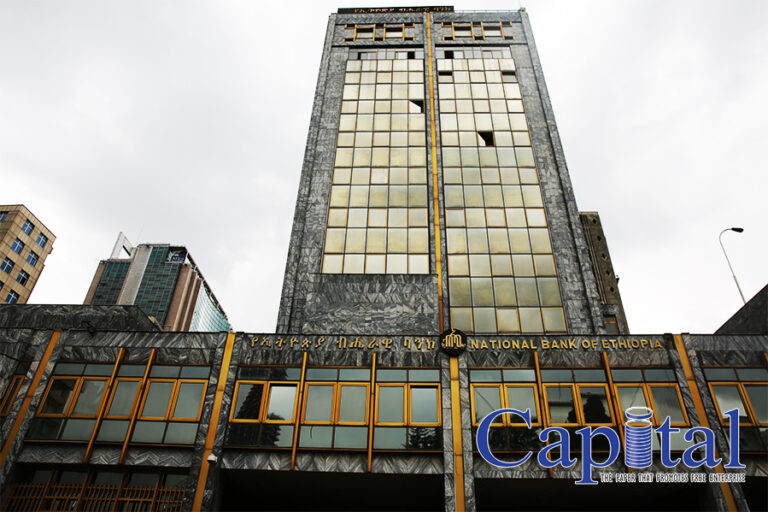
NBE,Capital Market Authority explore pathways to evolve retail banks to investment firms

The Ethiopian Capital Market Authority (ECMA) discloses that it is under discussion with the National Bank of Ethiopia (NBE) to explore avenues for current retail financial firms to step up as investment banks with a separate subsidiary in the upcoming capital market.
As per the current proclamation of the two regulatory bodies’, retail banks are not at liberty to have any form of involvement on the capital market business or investment banking activity. Reality on ground however signals that the retail financial firms have the potential star power at the inception of the new money market. As a result, considerations are being drawn ECMA disclosed, citing that the authority is under discussions with NBE to unlock the potential of retail banks to per take in the upcoming market as investment banks.
“We had carried out a study to know who would be a potential investment banks in Ethiopia and as per our evaluation the potential lies with our retail banks,” Sirak Solomon, Capital Market Legal Advisor at ECMA explained.
“As per the current laws of NBE, retail banks are not able to transition to investment banks at the securities exchange, thus, amendment on that front is crucial,” he said, adding, “We are working with NBE to find out how these banks can evolve to investment banks.”
The ECMA proclamation defines an investment bank as a non-deposit taking financial institution that facilitates the creation of capital for other companies, governments, and other entities through underwriting, acting as an intermediary between a securities issuer and the investing public, facilitating mergers and other corporate reorganizations and acting as a broker or financial adviser for institutional clients.
“It means that the retail banks are not allowed to register as a service provider at the upcoming securities exchange,” he explained in adherence to the proclamation.
Sirak, who has extensive financial experience stemming from northern America, showcased the experience of other countries citing that there are companies who operate as retail banks like Ethiopian financial firms who collect deposits and provide loans and advances, “and they may also have another subsidiary that is established as an investment banking system, with no direct relation to the retail wing.”
As he informs Capital, the plausible solution is to include retail banks in Ethiopia at the secondary market by allowing them to form a subsidiary.
The subsidiary will provide investment advice and will carry out underwriting service for share companies as investment banks.
The subsidiary that will be formed as a special company will be run independently and with a separate board and CEO but it may have the same owner at the retail bank level.
As experts indicate, the central bank may look deeper into its proclamation to amend the proclamation or directive that it issued in relation to the governing of banks, which are under its supervision.
During the discussion organized by Addis Ababa Chamber of Commerce and Sectoral Association, Brook Taye, the founding Director General of ECMA, said that the authority is undertaking the necessary preparations to issue licenses to capital market service providers.
He said that the authority has tabled 15 draft directives for the board of directors that is expected to approve for further consultation with stakeholders.
The proclamation indicated that the authority may issue eight licenses like credit rating, custodian, market makers, securities trading, securities issuance and investment advisory, and fund manager. However, since the proclamation gives a right under article 55 sub article I, the authority has added another seven licenses to be ratified through directives.

SGTD goes big to accommodate world’s largest vessel

Expansion to prove pivotal for cost of Ethiopian cargos

One of the top 20 well performing port facilities in the world, Doraleh Container Terminal Management Company(SGTD) of Djibouti is undertaking massive expansion to accommodate the next generation container vessels ‘Malaccamax’ that would ripple down to ease the cost of Ethiopian cargos and expand the operation of transshipment.
The state of the art port facility has also expanded its storage yard at an investment of USD 30 million.
The facility which has the capacity to berth virtually any sized vessel in the world stated that it is investing on additional ship to shore (STS) container cranes besides its current chain of eight cranes.
Abdillahi Adaweh Sigad, Chief Executive Officer of SGTD, told Capital that the logistics facility located at the entrance to the Red Sea has hired the sector prominent German company, Liebherr Container Cranes Ltd, to supply the Megamax STS cranes at a total investment of USD 44 million.
“The four new generation cranes are coming in May,” he explained.
The new expansion will allow the container terminal to handle the latest generation of Triple E class (3E) Class of vessels like Malaccamax with a capacity of over 22,000 TEUs from the current infrastructure, Super Post Panamax quay cranes.
“Currently, we are in the capacity to handle a vessel with 15,000 TEUs, but as we continue to expand we shall have the required capacity to manage the maximum vessel existing in any part of the world,” the CEO explained. Currently, SGTD is handling up to 40 container vessels per month.
Besides that the facility is also undertaking a container stacking yard expansion.
“Our performance in terms of efficiency is increase steadily in the past few years. New investments will see us increase the storage capacity by 20 percent and with commissioned four key cranes, the two assets will combine to uplift the containers terminal capacity by double,” Adaweh Sigad said, adding, “The new STS cranes will increase the crane capacity by 50 percent.”
“Key operation capacity by yard will enable the terminal to double its operation,” he explained.
The storage expansion work that cost USD 30 million will increase the accommodation capacity from 1.6 million TEUs to 2million TEUs per year and will further strengthen the leading position of the Doraleh Terminal in the region.
Regarding the harbor, SGTD has a capacity to handle any huge vessels in the world, while at the berth the eight STS cranes shall manage the vessel with 15,000 TEUs that will expand to a vessel with 23,000 TEUs when the new expansion becomes operational in the near future.

(Photo: Anteneh Aklilu)

“Now Ethiopian customers shall contract any type of vessels for their incoming cargos unlike in the past due to that we invested in additional cranes and yard,” Adaweh Sigad added.
The expansion has also been expected to boost the promising business, transshipment, and any transit services in the region.
According to the CEO, the expansion also targets the regional growing demand in the logistics sector.
He said that the transshipment business is also benefiting the Ethiopian customers and vessel operator since they shall get slots at affordable rates from global shipping lines who engage on the transshipment business through the regional hub, Djibouti.
On the 2021 Container Port Performance Index (CPPI) that was produced by the Transport Global Practice of the World Bank in collaboration with the Maritime, Trade and Supply Chain division of S&P Global Market Intelligence, SGTD was recognized as one of the well performing ports in the world, ranked 19th overall. On the 2020 CPPI raking, the port registered significant points as top in the Sub Saharan Africa, and similarly late last year it was awarded the European Quality Award from European Society of Quality Research for its operation in different parameters.

Issuance of RFPs for Ethio Telecom’s partial acquisition draws nigh

0

Tele starts digital tax payment facilitation via tele birr

The Ministry of Finance (MoF) gears up to issue a request for proposals (RFP) to complete the sale of a 40 percent interest in Ethio Telecom in two weeks time.
It is to be recalled that a request for expressions of interest in the partial privatization of the telecommunications giant was released by the MoF on November 16, 2022, which ran open for one month up until December 16, 2022.
Eyob Tekalegn, State Minister of Finance, told Capital that a number of businesses have expressed their interest in purchasing stake from Ethio Telecom. However, the state minister was reluctant to disclose the exact number owing to confidentiality of the matter. Nonetheless, Eyob stated that a request for proposals would be floated in two weeks.
Notable companies including, Etisalat and Orange are said to have keen interest in investing in Ethio Telecom.

(Photo: Anteneh Aklilu)

The Ministry, for the privatization process, has chosen Deloitte Consulting Limited as a transaction advisor to provide advice on the matter. In the past, Deloitte was also notable for the work it did in valuing the assets of the telecommunications firm.
The investment teaser known as “Project Nigat” – Partial Privatization of Ethiopia revealed that the most successful public company was valued at roughly 80 billion birr. However, Frehiwot Tamru, CEO of Ethio Telecom critically dismissed the figure claiming that the company has more assets than the 80 billion birr valuation.
Previously, the Ministry, which is in charge of the follow-up process along with the Public Enterprises Holding Administration Agency, issued an expression of interest in mid-June 2021, which closed after a month, and invited interested parties to submit proposals by bringing best practices in terms of operations, infrastructure management, and next-generation technological capabilities. Even though the offer was scheduled to be announced in January 2022, the government of Ethiopia decided to delay the privatization process due to recent events and swift macroeconomic changes on a global and national scale.
Ethio Telecom, under the direction of the CEO has “continually improved” financial results, according to the MoF, and a delay “would result in higher value for all the parties concerned.”
In order to increase the contribution of the private sector to Ethiopia’s economy, the government had established the framework for the privatization of state firms under the Public Enterprise Proclamation No. 1206/2020. As a result, Ethio telecom became one of the 27 mammoth public enterprises under Ethiopian investment holding. Additionally, expression of interest for the third telecom operator is also expected to be floated on February.
In related news, Ethio Telecom and the Ministry of Revenues have entered into a collaboration agreement that will enable the Ministry of Revenues’ customers to pay taxes via the telebirr digital payment system- a collaboration that officially kick started on Thursday, February 2, 2023.
Through the partnership agreement, which was signed by the two institutions, the Ministry of Revenues will be able to collect income taxes, private pension fees, and federal tax payments.
Additionally, as previously stated, the telebirr digital payment will; assist customers in receiving clearance and receipts upon real-time payment, and allow them to transfer past-due payments and make partial payments, as well as help them avoid fees associated with penalties for delays in updating taxpayer information on the Ministry of Revenues’ server.
28.2 million clients, 112 master agents, 98.8 thousand agents, 25.5 thousand businesses, and 615 support centers have all been added to the telebirr digital payment system thus far. Additionally, the platform has been integrated with 18 banks for bank to telebirr money transfers and with 15 banks for telebirr to bank money transfers with over 263 billion ETB in transactions made thus far.

(Photo: Anteneh Aklilu)

Furthermore, on January 30, 2023, Ethio Telecom signed agreements with Zergaw Internet Service Provider for the delivery of cloud solution services, Kulu Network PLC for the provision of Elf music streaming services, and Shedli Trading PLC for the delivery of teledrive mobile database services in order to jointly offer the services to customers in need.
It is said that customers can store massive volumes of materials, including pictures/photos, videos, SMS, contact information, and other crucial items, using Teledrive Mobile Database Service and retrieve them when needed.
Elf music mobile app is a brand-new platform that enables users to buy their preferred music through the Elf music app, enjoy/listen to the music whenever they want without using mobile data, and access online radio programs. The organization has constructed a cutting-edge and dependable cloud centers telecloud services in order to answer the continuously rising demands of private and governmental institutions for database and cloud services.
