Wednesday, April 1, 2026
Home Blog Page 2559

Ethiopia’s debt distress slows

0

Ethiopia’s external debt distress crashes by five percentages in the concluded fiscal year to stand at USD 27.9 billion. Negative new flow has been stated as one of the resultants of debt stock reduction. The inflow has shrunk for the second consecutive year, despite government’s commitment to service its debt.

As the annual public sector debt bulletin of the Debt Management Directorate at the Finance Ministry indicates, the 2021/22 fiscal year saw the country experiencing its lowest ever external disbursement in the sectors latest history.

Compared to the total service in the year, the inflow was only proportionate to a half.

According to the bulletin, the total external debt for the public sector as of June 30, 2022 was USD 27.9 billion, down from USD 29.5 billion as of June 30, 2021.

The decrease in external total public sector debt is approximately USD 1.59 billion, or a decline of more than 5 percent, “one of the main causes of this decrease in the stock of debt that can be explained by USD exchange rate variation, which is as a result of a relatively stronger USD against other foreign currencies during June 2022 compared to June 2021, which resulted in a reduction in the debt stock in terms of USD, which is about USD 1.03 billion, roughly about 65 percent of the reduction.”

“A negative net flow of USD 551.9 million as a result of total principal payments of USD 1.64 billion and disbursements made during the period of USD 1.08 billion, where principal payment is greater than new disbursements made during the period, was another factor causing the debt stock to decrease this year,” the annual bulletin stated.

Meanwhile, the total amount of external public sector debt service (principal plus interest and fees) paid over the course of one year that started July 1, 2021 was USD 2.13 billion (USD 1.64 billion in principal and USD 491.1 million in interest).

“The net resource transfer, calculated as disbursement (inflow) minus principal payments minus interest payments, was USD 1.04 billion,” it explained.

Regarding service, the central government is responsible for paying USD 566.85 million, which includes USD 224.14 million interest payment, of the entire public sector’s external debt service, while state owned enterprises (SOEs) are responsible for paying USD 1.56 billion of it.

The total external public sector debt disbursement over the past twelve months that ended June 30, 2022 has continued on its reduction for the second consecutive year.

The entire external public debt disbursement was USD 1.4 billion, and USD 3.1 billion in the 2020/21 and 2019/20 fiscal years respectively.

From the USD 1.08 billion disbursement for the year, approximately 73 percent went to central government projects from various creditors, the majority of which came from IDA, and the remaining 27 percent went to SOEs; primarily to Ethiopian Airlines.

“The overall amount of foreign financing disbursed over the last one year was lesser in comparison to the previous 4 years. The fact that SOEs haven’t taken out a loan in the previous three years and are disbursing for their older projects less and less as they get closer to completion with the amount of money disbursed to them dropping, is one of the factors contributing to the decline in disbursement,” the annual debt analysis document explained.

Experts have also stated that the external pressure at the central government in relation to the conflict at the northern Ethiopia is part of the reduction. Partners’ particularly western states and their affiliate organizations have put a hold on their disbursement on the aim of pressurizing the government.

Despite government facing a massive push in addition to hurdles in hard currency shortage affecting its activity, it has been highly committed to settle payments on external debt without default. In total, it paid USD 2.13 billion as service that include interest fees.

Regarding fresh loan commitment, in the year, only three loan agreements totaling USD 290.74 million have been signed with partners, with most of that amount being borrowed by Ethiopian Airlines (USD 279.52 million), for the purchase of aircrafts, and the remaining USD 11.22 million by the central government.

It can be recalled that based on the November 2020 G20 communique on Common Framework (CF) a discussion was underway with different development partners, “the creditor committee for Ethiopia’s CF application was established, but it has not moved forward as expected, thus the country has not benefited from this initiative, which might potentially raise the country’s debt distress rating to moderate risk from high risk.”

The creditor committee, co-chaired by China and France, for Ethiopia was formed on September 16, 2021, in application of “CF for Debt Treatments beyond the DSSI” endorsed by the G20 and the Paris Club in November 2020.

On its statement this week, the committee has expressed that it will move forward with the discussion which is welcomed by the Ethiopian government on strategies of managing its debt vulnerabilities in the long term which is also beneficial to its IMF support programme.

It can be recalled that the IMF board approved a three-year arrangement for Ethiopia under the Extended Credit Facility (ECF) and the Extended Fund Facility (EFF) in December 2019 with the ECF expiring in September 2021 and the EFF expiring in December 2022, while the two facilities only disbursed USD 309 million from the total approved USD 2.9 billion loan.

In total as of June 30, 2022, the country public sector debt that include domestic debt stood at USD 57.34 billion from USD 56.4 billion on June 30, 2021.

As of June 30, 2022, total nominal public sector debt in percent of GDP was about 50.3 percent out of which nominal external debt in percent of GDP was around 24.5 percent.

“Present value of external debt in percent of GDP was around 17.5 percent and present value of total public sector debt in percent of GDP is 43.3 percent both are way below the threshold for Low Income Countries Debt sustainability thresholds which are 40 percent for external debt and 55 percent for total public sector debt,” the MoF debt analysis document stated.

The total amount of external debt accounted for roughly 48.7 percent of total public sector debt by the end of June 2022.

The central government is in charge of 68.1 percent of the nation’s total external debt, while SOEs with and without government guarantees are in charge of 21.9 and 10.0 percent, respectively.

The total Domestic debt in USD terms was USD 29.43 billion, up from USD 26.91 billion.

The stock of treasury bills (TBills) as of June 30, 2022, was 317.7 billion birr, a rise of 163 percent over the balance as of June 30, 2021. Net issuance of TBills with varied maturities was approximately 196.7 billion birr during the previous year.

The majority of the rise from June 2021 to June 2022 was due to relatively higher issuances of 364-day Tbills, followed by 182 days, compared to the previous year.

Participation from the government commercial bank and private owned commercial banks on the TBills market has shown improvement, while the average yield for TBills of 28 Days,91Days,182 Days and 364 Days has increased compared to last year same period.

Since the commencement of treasury bills under the new initiative, the direct advance has sharply shrunk to 3.4 percent of the total domestic debt in the 2019/20 fiscal year from about 25 percent of the preceding year.

However, the budget deficit that occurred in relation to the northern conflict has resulted in a 7.1 percent increase in the 2020/21 fiscal year.

The 2021/22 fiscal year also saw a climb to 10.4 percent share of the direct advance from the total domestic debt which is still very low compared to the years prior to the reform period.

In connection to the conflict, the government expenditure for humanitarian and reconstruction works has been increased in the past two budget years.
Cross trade proves vital as ESLSE records top notch results

0

Ethiopian vessels make a mark on cross trade services amplifying the performance of the Ethiopian Shipping and Logistics Services Enterprise (ESLSE), a sole flag carrier in Africa.
Despite some of the expected incoming cargos like rebar and coal showing reduction in the budget year as well as some of the import cargos sourced from Djibouti International Free Trade Zone, the state owned mammoth logistics service provider managed 7.2 million metric tons of import/export cargos in the 2021/22 budget year that closed on July 7.
In the budget year, the vessels that were operated by ESLSE were in good condition to carry out cabotage services for cargos in neighboring African ports.
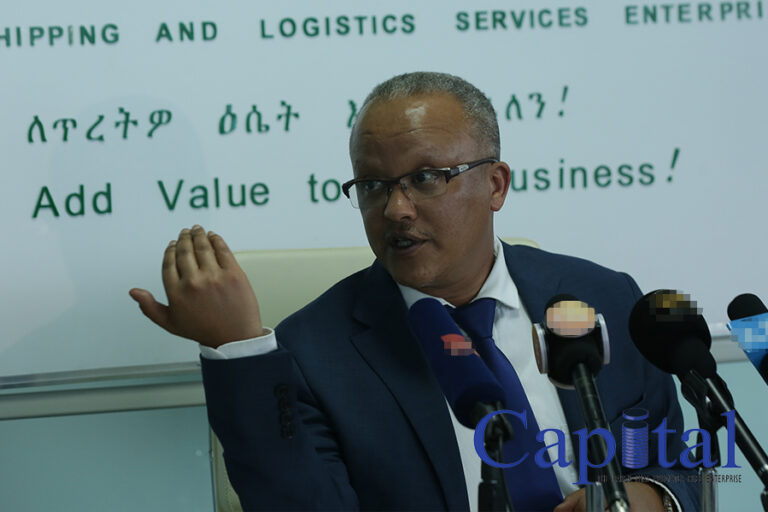
Roba Megersa, CEO of ESLSE, said that through the cabotage operation package, the export cargos from Massawa, Eritrea, and containerized cargo from Djibouti itself have been transported by ESLSE vessels.
“Our vessels have regular service for bulk and containerized import cargos to Somaliland, at the same time we have started services at Mombasa to connect the Kenyan port to other destinations and similarly the service has expanded to other ports in Tanzania and South Africa and occasionally to western Africa,” the CEO explained.
He said that the cross trade operation at some point is a good strategy for ESLSE to widen its presence besides a significant hard currency generation for the enterprise.
In the budget year, the vessels that ESLSE operates have contributed to generate 1.8 billion birr, “they have become profitable for the first time.”
“One of the major reasons for the best performance of our vessels was the cross trade,” Roba explained.
He reminded that when the vessels were bought about a decade ago, the target was to transport project cargos; however the reduction of the number of projects made it less lucrative, “so we have shifted the vessels for strategic operations including introducing cross trade that made them profitable.”
“We bridged destinations that made our vessels to be in high demand and now we are full of activity. Furthermore, the procurement and increment of owned containers allowed us to make our vessels containerized, which is very profitable,” he added.
The settlement of the remaining arrears has also contributed for the vessels to become more profitable.
Currently, ESLSE operates 11 vessels and nine of them, which included two tankers, were built about 12 years ago and financially backed by the Chinese EXIM bank having consumed USD 234 million.
The nine multipurpose vessels, ‘Handysize’, including the two relatively oldest one that Ethiopia operates, now have a capacity of about 28,000 dwt each.
Recently, ESLSE’s board has approved the procurement of two more ‘supramax bulk carrier’ that will have a capacity of 63,000 dwt.
The ‘supramax bulk carrier’ is currently highly preferred for bulk goods in the industry. Once the process is accomplished in the coming few weeks, the vessels will be built in two years time and will commence as a fleet thereafter.
ESLSE’s vessels have now transported 19 thousand import containers and 1.05 million metric tons of bulk cargos through cross trade business.
Roba said that because of COVID 19 and the conflict between Russia and Ukraine, the 2021/22 budget year made it one of the challenging years for the maritime business, “Nonetheless, our operation has been successful.”
In the budget year in total 7.2 million tons of cargos shipment have been managed through different operations including vessel, inland, freight forwarding and port and terminal services.
Regarding marine operation, it had targeted to transport 3.9 million tons, while the actual performance was 3.6 million tons or 93 percent of the target.
“The procurement of additional heavy duty trucks, 15 car carriers and 10,000 containers have accelerated the marine and inland transport,” Roba explained the success attained on the marine operation.
The containerized cargo fleet was 116,000, which is a share of 66 percent of the total containerized import to the country. In the year, for the first time the export cargo transferred through ports in Djibouti surpassed one million.
The enterprise has 25 percent market share on freight forwarding business segment, which is mainly operated by the private sector.
The enterprise that disclosed it made a history of zero demurrage for import of goods particularly fertilizer though Djibouti said that the transiting time for containerized cargos that operated through multimodal scheme was reduced to 5.5 days ahead of the grace period that is eight days.
Similarly, vessels berth time has been less than five days against the target of ten days.
The logistics giant has also disclosed that it is installing the state of the art IT solutions at its head office at the cost of 450 million birr.
The logistics enterprises that also operates its own vessels said that on the aim to be equipped with the latest IT system, it is developing Oracle’s tier III data center that would boost the IT management of ESLSE.
It will be the second after South Africa’s Oracle’s cloud computing system installed in Africa.
The Dire Dawa Dry Port that consumed USD 80 million covering 34 hectares is also expected to be operational in the near future.
Regarding the financial performance, in the budget year ESLSE has generated 51.4 billion birr in revenue and 5.64 billion birr profit before tax. The enterprise capital has also reached 64.85 billion birr.
In the budget year, USD 76 million has been secured.
As a challenge, ESLSE has stated that the public institutions are lagging behind in terms of settling the payment for the service that the logistics enterprise provides.
Similarly, the enterprise has faced a challenge from commercial banks in Ethiopia in terms of accessing its foreign currency savings, “the global price hike has also been a problem registered in the budget year.”

Yagout to soon debut in Ethiopia’s fintech scene

0

A new fintech company called Yagout pay financial technology gears to knock on the doors of the Ethiopian digital payment landscape by offering a payment system set up with an initial capital of 50 million birr.
The company which held its board meeting on Thursday August 25, 2022 indicated that upon securing a license from the national bank, it plans to become a payment gateway and POS operator in Ethiopia. The company has developed its digital payment platform “Yagout” courtesy of highly driven, well-skilled individuals from the fintech industry and is set to launch the service soon.
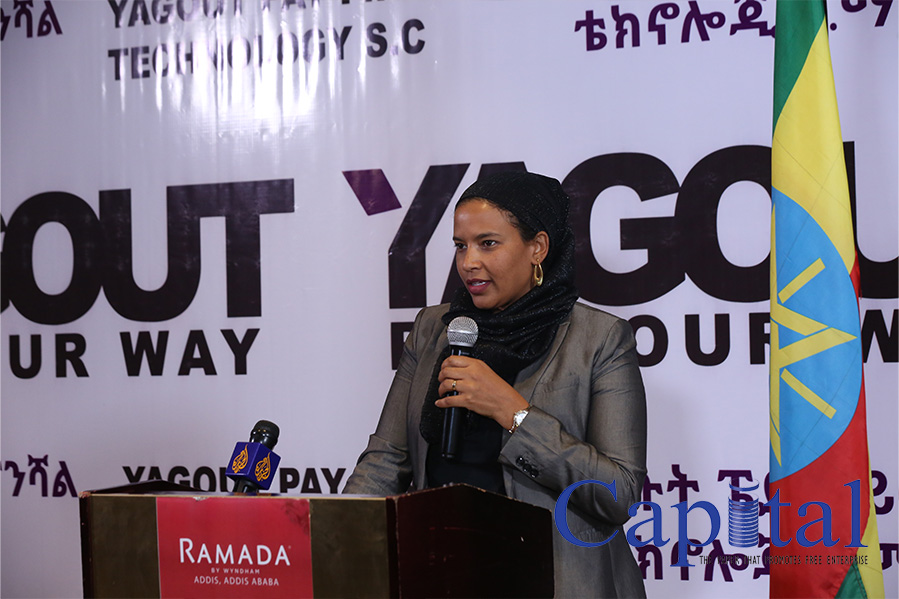
“We plan to contribute to the growth of digital payment systems in the country and promote financial inclusion,” said Khalid Mohamed, founder of Yagout, adding, “We are excited to join the industry where our solution could address many challenges in accessing financial services.”
This digital disruption comes in light of the National Bank of Ethiopia(NBE) approving a directive to License and authorize the Payment Instrument Issuers which gives prominence to innovative payment instruments which NBE believes is important to increase the use of financial services. The development allows any qualifying business to offer basic financial transaction services, which under a standard license covers saving, credit, insurance and pension products, including cash-in and -out; domestic remittances; bill payments; retail payments; over the counter transactions; and inward international remittance.

Ethio Telecom selects HyperSense Fraud Management

0

Ethio Telecom selects Subex’s AI-first HyperSense Fraud Management to replace the operator’s legacy system.
The solution, which is built on Subex’s AI orchestration platform, HyperSense, will replace Ethio Telecom’s existing legacy fraud management system, thereby enabling them to move from a traditional rules-based approach to an AI-first approach. This approach will, in-turn, enable them to detect new and unknown threats in real-time.
“The Ethio Telecom has recently launched a pre-commercial 5G network within the country. In order to sustain its market leadership by providing high-quality, and innovative offerings, Ethio Telecom wanted to enhance and broaden its risk management strategy by having a holistic defense mechanism,” said Subex on its statement sent to Capital.
As indicated on the statement with Subex’s AI-first Fraud Management system on HyperSense, which leverages AI in every step of the Fraud management process, Ethio Telecom will be able to bring in enhanced accuracy, coverage, and time-to-detect. These capabilities will, in turn, enable the operator to adopt a proactive approach to combatting risks such as SIM Box, Spoofing, SMS frauds, roaming frauds, subscription frauds, device frauds, mobile money risks, and credit risk management. Furthermore, with its earlier deployment of Subex’s business assurance, Ethio Telecom will now be able to consolidate its revenue assurance and fraud management approach to ensure the breaking down of silos and enhance operational efficiency.
“This win marks another chapter in our long-standing relationship with Ethio Telecom and it comes close on the heels of our recent Business Assurance deployment. With the implementation of our fraud management solution coupled with the existing Business Assurance solution, Ethio Telecom will now benefit from a holistic risk management approach as they gear up to provide 5G services. Today, our risk management portfolio sets itself apart by adopting an AI-first approach to mitigate threats accurately and faster,” said Shankar Roddam, Whole-Time Director and Chief Operating Officer at Subex whilst commenting on the partnership extension.
Ethio Telecom has consistently been at the forefront of adopting proactive measures to combat telecom risks and safeguard their business and customer as the operator recognizes the value of an approach which places AI at the core.
“Subex’s AI-first fraud management system will be vital in safeguarding our business and customers. We see this as a future-proof investment that aligns with our digital services initiatives,” said Tsegaye Emmanuel, Chief Information Security Officer at EthioTelecom indicating that for over two decades, Subex has been the leading group in the fraud management space.