Thursday, April 2, 2026
Home Blog Page 2709

Waste is expensive

0

Much food gets lost and wasted along the value chain, from production to transportation, through handling, at the market, during retail and last, but not least, at home. Also, food which is still edible, but which has passed its expiry date, is thrown away. This is the case in most parts of the world, and I wonder whether we are headed in the same direction with the rapid urbanization and changing lifestyles that we begin to see here in Ethiopia in general and more specifically Addis Abeba. We see that in Ethiopia, much food gets lost for similar reasons. Studies and research show that fruits and vegetables get damaged and unfit for consumption during their journey from the moment of harvest to the end consumer. It is suggested that 40% or more of tomatoes, papayas and mangos for example, don’t make it to the consumer. For bananas this is about 20%. Worldwide, due to poor practices in harvesting, storage and transportation, as well as market and consumer wastage, it is estimated that 30–50% (or 1.2–2 billion tonnes) of all food produced never reaches a human stomach. As we saw above, the problems may be different, depending on the development state of a country. In emerging economies like Ethiopia, wastage tends to occur primarily at the farmer-producer end of the supply chain. Inefficient harvesting, inadequate local transportation and poor infrastructure mean that produce is frequently handled inappropriately and stored under unsuitable farm site conditions.
In mature economies, more-efficient farming practices and better transport, storage and processing facilities ensure that a larger proportion of the food produced reaches markets and consumers. However, characteristics associated with modern consumer culture mean produce is often wasted through retail and customer behaviour.
This is bad news, more especially in the times we are living in today with worldwide and domestic unprecedented inflation, challenges in production, in access, import & export, availability of hard currencies. More and more people are finding it very difficult to provide nutritious, affordable meals for their family. Some of these factors are beyond our control, both at national and international level, while conflict is probably the main contributor to the negative trends we experience today. Where food becomes scarce, we need than ask ourselves if there is anything within our control that we can do to relief the situation somewhat.
In other words, one of the questions that we need to find answers to is what we can do to minimise wastage of food in our own context? Authorities, agencies, organizations and producers, involved in one way or another in the production, processing and marketing of food in this country, need to seriously look into this and agree on a way to identify problems that lead to food waste in Ethiopia and design and implement measures for improvement. In my search for answers, I came across an article by Reiner Jedermann, Mike Nicometo, Ismail Uysal and Walter Lang, titled “Reducing food losses by intelligent food logistics”.
They argue that food losses can be attributed to two main factors: (i) waste owing to oversupply and (ii) losses owing to the natural decay of food products, which cannot be stopped but are accelerated especially by lacking or poor temperature management or unhygienic conditions.
“Oversupply plays an important role in affluent economies, where people can afford to throw food away. Unnecessary losses of shelf life can also be found in any part of the chain, especially with regard to temperature management as farmers do not pre-cool after harvest, the actual temperature conditions during transport and storage often do not meet the optimal product-specific values; and customers keep fresh products for hours in the warm boot of their car or set the temperature of their fridge to achieve minimal power consumption, thus ignoring the recommended storage temperatures. The cold chain will become more important in the future owing to two factors given by Parfitt et al.: (1) as people’s income grows, they diversify their diet to less ‘dry’ starchy products, such as rice, potatoes and cereals, to more fresh fruits & vegetables, fish and meat, requiring chilled transportation and (2) whereas food is often sold the same day at local markets in rural societies, urbanization requires longer and more complex supply chains.”
What then can be done? In line with the priorities of the Government, programmes can be put in place that build capacity in engineering knowledge, design know-how, and suitable technology to help improve produce handling during the harvest and post-harvest stages of food production. Secondly, we can incorporate waste minimisation while planning and building transport infrastructure and storage facilities along the supply chains. Thirdly, the private sector is a main stakeholder to provide services along entire supply chains. Finally, where things go wrong now, there are great opportunities for Public Private Partnerships to provide solutions.
Where we are part of the problem, let us become part of the solutions instead.

Ton Haverkort

Fooled Again

0

By Chris Hedges
The naive hopes of Bernie Sanders’ supporters-to build a grass-roots political movement, change the Democratic Party from within and push Hillary Clinton to the left-have failed. Clinton, aware that the liberal class and the left are not going to mount genuine resistance, is running as Mitt Romney in drag. The corporate elites across the political spectrum, Republican and Democrat, have gleefully united to anoint her president. All that remains of Sanders’ “revolution” is a 501(c)(4) designed to raise money, including from wealthy, anonymous donors, to ensure that he will be a senator for life. Great historical events happen twice, as Karl Marx quipped, first as tragedy and then as farce.
The multibillion-dollar extravaganza of our electoral Circus Maximus is part of the smokescreen that covers the ongoing devastation of globalization, deindustrialization, trade deals such as the Trans-Pacific Partnership, endless war, climate change and the intrusion into every corner of our lives by the security and surveillance state. Our democracy is dead. Clinton and Donald Trump do not have the power or the interest to revive it. They kneel before the war machine, which consumes trillions of dollars to wage futile wars and bankroll a bloated military. To defy the fortress state is political suicide. Politicians are courtiers to Wall Street. The candidates mouth the clichés of justice, improvements in income equality and democratic choice, but it is a cynical game. Once it is over, the victors will go to Washington to work with the lobbyists and financial elites to carry out the real business of ruling.
While there is a difference in the temperament of the two major presidential candidates, that difference will play out only in how our poison will be delivered. Political personalities serve global corporate centers of power. They do not control them. Barack Obama illustrates this.
To neoliberals, everyone and everything are disposable. The failed states that have risen up across the Middle East, Africa, the Caucasus and Asia in the wake of the Cold War herald a neoliberal world driven by violence, corruption, greed and desperation. The drug traffickers, smugglers, pirates, kidnappers, jihadists, criminal gangs and militias that roam huge swaths of territory where central authority has vanished are the real faces of globalization. These nihilists define Islamic State just as they define the corporate state. Corruption may be more naked and cruder in Afghanistan or Iraq, but it has its parallel in the for-sale politicians and political parties that dominate the United States and Europe. The common good the building of community and solidarity has been replaced through decades of corporate indoctrination with the callous call to amass all you can for yourself and leave the stranger bleeding on the side of the road.
Is the Goldman Sachs commodity trader, who hoards futures of rice, wheat, corn, sugar and livestock to jack up prices on the global market, leaving poor people in Africa, Asia, the Middle East and Latin America to starve, any less morally repugnant than the drug trafficker? Are F-16 pilots who incinerate families in Raqqa morally distinct from jihadists who burn a captured Jordanian pilot in a cage? Is torture in one of our black sites or offshore penal colonies any less barbaric than torture at the hands of Islamic State? Are the decapitations of children by military drones any more defensible than decapitations of Egyptian laborers on a beach in Libya by self-described holy warriors? Is Heather Bresch, the CEO of Mylan, who raised the price of the lifesaving EpiPen by 400 percent or more and whose compensation since 2007 has risen by 600 percent to above $18 million a year, any less venal than a human trafficker who sends an overloaded boat and its occupants to their doom on the coast of Libya?
There is a new world order. It is based on naked exploitation. It not democracy is what we have exported across the globe. And it looks a lot like the anarchic state that Hobbes feared. The criminal gangs that deliver migrants to Europe make about $100 million a month for their work. They exploit and traffic human beings just as highly paid CEOs do.
The failed states of Iraq, Syria and Libya, a direct result of globalization, have their counterparts in Detroit, St. Louis, Oakland, Memphis, Baltimore, Atlanta, Milwaukee and the south side of Chicago. They are our versions of Mogadishu, complete with lawlessness, senseless killings, armed gangs, widespread hunger, fear, a population retreating into the numbing embrace of opiates, crippling poverty, dysfunctional state institutions, the growth of private security companies that protect the elites, and indiscriminate police violence that creates reigns of terror aimed at the poor. The more the global corporate forces extract from us in the name of austerity and the maximization of profit, the more parts of the U.S. will descend into domestic versions of the failed states overseas. The same system exists here and abroad. And it has the same result here and abroad. It may appear first in Somalia, Mali, Guinea-Bissau and Libya, but it will soon come to characterize much of America. The proliferation of weapons will do to our society what it has done to every other failed state where there has been unchecked access to arsenals—hand power to those with a penchant for violence.
“Anyone who wants to rule men first tries to humiliate them, to trick them out of their rights and their capacity for resistance, until they are as powerless before him as animals,” Elias Canetti wrote in “Crowds and Power.” “He uses them like animals and, even if he does not tell them so, in himself he always knows quite clearly that they mean just as little to him; when he speaks to his intimates he will call them sheep or cattle. His ultimate aim is to incorporate them into himself and to suck the substance out of them. What remains of them afterwards does not matter to him. The worse he has treated them, the more he despises them. When they are no more use at all, he disposes of them as he does of his excrement, simply seeing to it that they do not poison the air of his house.”
History has amply demonstrated where this will end up. The continued exploitation by an unchecked elite, and the rising levels of poverty and insecurity, will unleash a legitimate rage among the desperate. They will see through the lies and propaganda of the elites. They will demand retribution. They will turn to those who express the hatred they feel for the powerful and the institutions, now shams, that were designed to give them a voice. They will seek not reform but destruction of a system that has betrayed them.
Failed states czarist Russia, the Weimar Republic, the former Yugoslavia vomit up political monstrosities. We will be no different.
A form of fascism has already taken hold in two nations on the edges of the European Union, Hungary and Poland. Far-right parties, reacting to the flood of more than a million migrants that descended on Europe last year, are gaining ground in France, Austria, Sweden, Germany and Greece. Nationalism, buttressed by a deification of the military, will be used to compensate for individual powerlessness and a loss of national identity. Dissent in the U.S. will become “anti-American,” a form of treason. Enemies at home will be vilified along with enemies abroad. And this will lead to even more warfare in the Middle East. The far-right political parties in Eastern Europe flirt rhetorically with military conflict with Russia. And because of its membership in NATO, the United States would be obligated to enter any hostilities.
Voting for Hillary Clinton will not halt this slide into the apocalypse. It will only accelerate it. Donald Trump may vanish from the political landscape, but someone even more venal, and probably more intelligent, will take his place. Our job is to dismantle the machinery that is pushing toward the cliff. And this means sustained and massive civil disobedience. As exemplified by the protests at the Standing Rock Sioux Reservation and by prisoners across the nation who carried out work stoppages last Friday, it means doing everything possible not to cooperate with the elements of authority. It means disrupting the mechanisms of power. It means overcoming fear. It means no longer believing the lies we are told.

Chris Hedges, spent nearly two decades as a foreign correspondent in Central America, the Middle East, Africa and the Balkans. He has reported from more than 50 countries and has worked for The Christian Science Monitor, National Public Radio, The Dallas Morning News and The New York Times, for which he was a foreign correspondent for 15 years.

Easter festivities amidst all-time high pricing

High price increase of household products dim the celebration of Easter. Both demand and supply from the consumer and supplier standpoints show increase even when compared to previous holidays such as that of Christmas.
It is always a familiar sight to see the markets full to the brim during the last days of the holiday. However this time round most of the consumers seem to be complaining about the prices of commodities. Furthermore, the traders themselves are complaining that the market condition has escalated above proportion.
The food items price spike continues to be a headache to majority of the population. In most of the huge markets in the city as Capital has observed the market is showing double price increase even when compared to the Christmas festivities from few months back.
Both food items and non-food items are shooting in price as supply of the commodity is showing shortage. Furthermore there are instances of high stake-overs in terms of the price of vegetables and grains including, teff, and other necessities which has lasted over a month has financial burdened the population in addition to the continued surge in the prices of edible oil and spices (pepper).
Even though government is taking different mechanisms to stabilize the oil market it doesn’t seem to be working, since five liters of oil has hit highs of 1200 in the market. To put that into perspective similar periods of last year would cost a customer 400 birr per 5L. Likewise onion has shown a jump from 35 birr to 45 birr per kilo while a kilo of butter now ranges from 600 up to 800 birr up from 450-600 birr from last year.
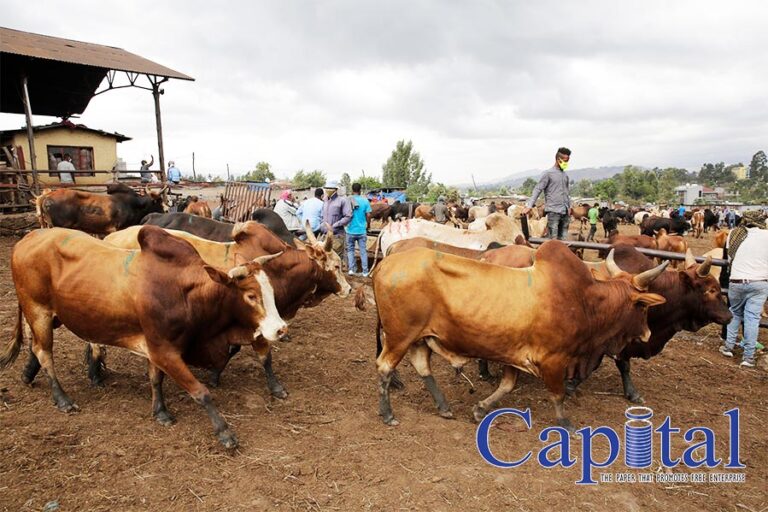
As a result, in a country that has seen double digit inflation rates for the last two years, meat markets has seen a spike in the prices of sheep and cattle, the latter fetching between 25,000 and 100,000 birr.
Mostly cattle, butter, eggs and chicken come to the city from various parts of the country, mainly from Harar, Gojam, Arbaminch and Jimma. However, the uprising conflicts in the country have made traders to fear to move from place to place thus the price of some products are increasing by double and some are showing significant increments.
Kera, Akaki, Shegole, Bercheko are the largest cattle markets receiving cattle from different parts of the country, mainly from Harar, Wellega, Bahirdar, Jimma, Gonder and Wolayita among others. Usually, sale of livestock inside the center reflects significant seasonal variations on demand and supply.
As Capital has learnt in most markets, the price of cattle is showing 50 percent increase when compared to Christmas. Usually, the price is based on the type, size and origin of the cattle.
The price of sheep ranges from 5000 to 15,000 birr while goats cost between 4000 and 10,000 birr. In most cases the price of an ox has shown the highest price increase as even the smallest in size is said to cost 40,000 birr which was 25,000 birr on Christmas.
“Recent unrest in some parts of the country has made it difficult to receive cattle from parts of the country. And on the last two days of the holiday the price is expected to be raised even more,” expressed one trader in an interview.
In most markets of the city traders are selling an egg between 8 and 9 birr which was 6 to 7 birr last year, whereas a chicken would set consumers back between 800-1300 birr based on their size which was between 450 to 650 birr last year.
Apart from the traditional markets in the city these days, digitalized market platforms are also becoming preferable.
HelloBeg is one of these platforms. A group of young entrepreneurs started selling live cattle per kilo sparking a new buzz in trend starting from last Ethiopian Christmas. For this holiday Hellobeg has prepared more than 3000 sheep and goats and 200 oxen. According to general manager Zekaria Ahmed, Hellobeg sells the cattle with about 30 up to 50 percent discounts from the traditional market. However price increase in the market and shortage of supply has presented a big challenge for the Easter market. As he indicates, when they started their operation in Christmas, the price of sheep was 150 birr per kilo and due to the increasing price of cattle it is now 200 birr per kilo. The price of goat per kilo is now 250 birr whilst that of an ox is 130 per kilo. Hellobeg also has a delivery mechanism for its customers.
Similarly, Mama’s Chicken has also presented about 2000 chickens with affordable price for the holiday according to the general manager, Daniel Tadesse. As he refers most of the chicken in the normal market is up to 900 birr while that of Mama’s chicken is sold at 600 birr including 10 eggs.
It is a well-known fact that Ethiopia has been going through many economic, social and political events since last year. The biggest problem for the people has been the rising cost of living.
Retailers and traders say that inflation and the high cost of living have weakened consumer purchasing power and that people who go to various malls for shopping have already halved their purchases.
Being a holiday season in the form of Easter and Ramadan the market is expected to increase because of perceived increase in demand against shortage in commodity.

An American journalist goes missing in Ukraine. The silence is deafening

0

Gonzalo Lira’s disappearance should have triggered outrage and calls for an investigation by the “freedom-loving” US government and media

By Scott Ritter
My personal journey into the drama-infused existence of Gonzalo Lira began in mid-February 2022, when I appeared as part of a panel discussion organized by Joe Lauria of Consortium News (CN), which included the British writer Alexander Mercouris.
It was just prior to the Russian “special military operation” kicking off in Ukraine. Alexander and I subsequently appeared on several CN-hosted panels to discuss the war in Ukraine, and in conversations following the broadcast he mentioned a fellow he called “Gonzo Lira” and asked if I followed him. I indicated that I did not, and Alexander replied that I should, as “Gonzo” resided in Kharkov, and had some first-hand insights into the conflict that I might find interesting. Alexander asked if he could forward my contact information to Gonzo Lira, and I agreed.
I must admit that I did not follow up on Alexander’s recommendation to follow Gonzo and had forgotten about our conversation about Mr. Lira when, sometime in late March, I was suddenly contacted by the man himself, who asked if I would agree to be interviewed by him for his YouTube channel. I did a quick Google search, and read several items about Gonzalo Lira, AKA Coach Red Pill, including a particularly unflattering article written by Mark Hay of The Daily Beast. I quickly decided that if Gonzo was making The Daily Beast uncomfortable, then I was more than happy to be interviewed by him.
The setup for the interview, which took place on March 30, was informative in its own right. Alexander’s colleague Alex Christoforou was providing technical assistance, and because of connectivity issues due to Gonzalo broadcasting from Kharkov (literally a war zone), the YouTube platform could not be accessed, and instead we shifted to Twitter Spaces (a somewhat ironic choice, given my later permanent suspension).
But the most interesting aspect of the pre-interview technical discussions was a to-and-fro between Gonzalo and Mr. Christoforou about Mr. Lira’s safety. Beyond the obvious reality of broadcasting from a city under attack (air-raid sirens were sounding in the background during this time), Gonzalo expressed a clear concern that he was being sought out by the Ukrainian Security Service (SBU). I opined that perhaps broadcasting from Kharkov might not be the wisest decision under these circumstances, a concern echoed by Mr. Christoforou, but this was dismissed by Gonzalo. “I’m taking precautions,” he said, without further elaboration.
The Twitter Spaces session was enjoyable, with Gonzalo asking relevant questions and, in the true spirit of the journalist/interviewer, allowed me to answer without any undue commentary from his end something so-called “professional” journalists in the mainstream media should do more often. According to Mr. Lira, it was “well received” by his followers.
Gonzo reached out to me again, on April 11, for a follow-up interview on his YouTube channel. This time, Mr. Christoforou was successful in surmounting the technical challenges surrounding Mr. Lira’s geographical realities, and the interview went off without a hitch. When we finished, Gonzo thanked me, and in the subsequent conversation, he relayed his concerns that the authorities in Kiev were not only displeased with what he had to say but were actively looking for him.
Gonzo’s pinned Tweet from March 26, in which he listed the names of eight Ukrainian politicians, journalists, dissidents, and human rights figures who had either been killed, arrested, or gone missing since the war with Russia had broken out, jumped out at me. The idea of having just completed a live-streamed interview lasting more some 77 minutes at a time when the Ukrainian SBU, which undoubtedly possesses considerable cyber skills sufficient to geolocate a lengthy online presence such as the YouTube broadcast we had just finished, bothered me especially in light of Gonzo’s own self-expressed concerns, and I said as much.
Gonzalo Lira was fatalistic about his future. “I know the risks,” he said. “And I take precautions.”
Gonzo’s last tweet was posted on his account (@realGonzaloLira, 54,400 followers) at 7.07am on April 15, 2022. “New Patrick Lancaster,” he wrote, referring to a US Navy veteran-turned war correspondent who has been actively reporting from the frontlines in the Donbass region of eastern Ukraine. “Must watch.”
“Only the guilty fear judgement,” Gonzo had written in his Twitter bio. “Only liars need stifle the truth.”
Gonzo posted Mr. Lancaster’s report on his Telegram account (over 89,000 subscribers) at 7.16am. The post has more than 130,000 views at the time of writing.
“Here I talk about whatever’s on my mind,” Gonzalo noted in his Telegram introduction. “Unvaxed – and if that makes you angry and makes you hope that I die soon, I want you to know that I have no such wish for you.”
No soldier believes that he or she will be shot until the bullet strikes home. And no political dissident or free speech advocate believes he or she will be silenced until the knock comes at their door.
I received a telephone call on Sunday, April 17 from a producer for George Galloway’s The Mother of all Talk Shows (MOAT). Gonzalo Lira was scheduled to appear as a guest, and he had gone missing. George wanted to know if I had heard from Gonzalo. Sadly, I had not.
On the same day, Max Blumenthal and Esha Krishnaswamy, writing for The Grayzone, published an article titled “‘One less traitor’: Zelensky oversees campaign of assassination, kidnapping and torture of political opposition” which, in light of Gonzalo’s disappearance, was not only timely but deeply disturbing.
Citing war-time necessity, Ukrainian President Volodymyr Zelensky has declared martial law and banned all real opposition parties (the neo-Nazi parties and organizations, however, remained untouched.) “The activities of those politicians aimed at division or collusion will not succeed, but will receive a harsh response,” Zelensky stated.
“As he wiped out his opposition,” Blumenthal and Krishnaswamy wrote, “Zelensky ordered an unprecedented domestic propaganda initiative to nationalize all television news broadcasting and combine all channels into a single 24-hour channel called ‘United News’ to ‘tell the truth about war.’”
The order directing this action was signed on March 18, 2022.
Zelensky, The Greyzone authors noted, had ominously warned that “there would be consequences for collaborators.”
And now Gonzo Lira had gone missing.
On April 19-20, Twitter user @Anabel_Villeroy posted a series of tweets compiling evidence that “Azov SU @botsmanua (i.e., Sergei ‘Boatswain’ Korotkikh) identified Serhiy Velychko, call sign ‘Chilli’, as Gonzalo Lira’s kidnapper.”
Korotkikh is a notorious member of the Azov Battalion who recently posted a video showing his men committing atrocities in Bucha on April 1, 2022.
According to the @Anabel_Villeroy Twitter account, Velychko was the commander of the “Azov Reconnaissance and Sabotage Battalion (a.k.a. KRAKEN unit) in Kharkov.” The tweet contained a number of screenshots from the @botsmanua account (which has since been removed from Twitter) bragging about the capture, possibly even death, of Gonzalo Lira.
Recognizing that this information did not constitute anything remotely resembling verified fact but enraged at the audacity of persons proclaiming to be affiliated with the Azov organization gloating about the death of Mr. Lira, I took to Facebook to give voice to my outrage.
“When Belarusian authorities,” I wrote, “pulled Roman Protasevich, a blogger who had served a combat tour in the neo-Nazi Azov Battalion before working for Radio Free Europe’s Belarus channel out of Prague, off an airplane in May 2021 on charges of inciting political opposition (roughly the equivalent of sedition), the world went crazy, accusing Belarusian President Alexander Lukashenko of trampling on free speech. Protasevich is alive and well, living under house arrest while awaiting trial.”
However, when reports emerged that Gonzo Lira, a California-born social media “influencer” who resided in Kharkov, Ukraine, and who published online content critical of the Ukrainian government, was kidnapped, tortured, and murdered by the Kraken Unit, part of the Azov Battalion affiliated with the Ukrainian Security Service (SBU), the West kept silent.
Free speech isn’t a one-way street. To remain silent in the murder of Gonzo Lira is to be complicit in his possible death, and the deaths of all journalists who pursue the truth, even if it runs counter to the mainstream narrative. Critical thinking should not be a death sentence. Unfortunately for Gonzo Lira, it seems it was.
The internet being the internet, my post was immediately cited as my “confirmation” that Gonzalo Lira had, in fact, been kidnapped and murdered by the SBU. I quickly sent out a follow-on post to correct the record.
“A point of clarification,” I wrote, “I have no direct evidence that Gonzalo has been killed. I was clear I was referring to ‘reports emerging’ about his demise. But Gonzo said any disappearance of more than 12 hours should be treated as if something bad had happened to him. It’s been five days. If this had been a New York Times reporter disappearing in Russian-controlled territory, it would be headline news especially if a Chechen ‘hunter killer’ team had taken credit for his death. But with Gonzo silence. Which was the whole purpose of the post: To raise awareness about his disappearance.”
There is an increasing outcry from independent media about Mr. Lira’s disappearance, and the Chilean government (Lira was a dual citizen of the US and Chile) has stated that it has been in touch with the “relevant entities” in Ukraine about Gonzalo’s disappearance.
But there is a shocking silence in the mainstream media. One only need recall the justified outcry in 2018 over the disappearance and murder of Jamal Khashoggi, a Saudi journalist critical of his government who worked for the Washington Post, to see the double standards. As Mark Crispen Miller, a New York-based academic and media critic, noted in his Substack, “Whatever they think, those of us who still have democratic principles, including a belief that journalists (and that means not just “credentialed” members of the press, but anyone who seeks out, and reports, the news) should not be snatched and killed for what they tell us, must see Gonzalo Lira’s disappearance… as a bad sign for all of us.”
That the US government has not demanded that President Zelensky launch an immediate investigation into the fate of Gonzalo Lira is a travesty. That the mayor of Kharkov, Igor Terekhov, whose approval would be required for any SBU operation targeting Mr. Lira, hasn’t been called out by name by the collective of journalists, American and foreign alike, to account for the actions of Sergey Velichko and the Kraken Unit, is hypocrisy in its highest form especially given the insistence by these same entities for similar investigations into allegations of the suppression of journalistic free speech in Russia.
“What would things have been like if every security operative,” Aleksandr Solzhenitsyn wrote in his epic work, The Gulag Archipelago, “when he went out at night to make an arrest, had been uncertain whether he would return alive and had to say goodbye to his family? Or if, during periods of mass arrests, as for example in Leningrad, when they arrested a quarter of the entire city, people had not simply sat there in their lairs, paling with terror at every bang of the downstairs door and at every step on the staircase, but had understood they had nothing left to lose and had boldly set up in the downstairs hall an ambush of half a dozen people with axes, hammers, pokers, or whatever else was at hand?”
What Solzhenitsyn called “the cursed machine” would have “ground to a halt,” he believed, “if…if…”
But there was no resistance. “We didn’t love freedom enough,” Solzhenitsyn lamented. “And even more we had no awareness of the real situation. We purely and simply deserved everything that happened afterward.”
We can’t ambush those who took Gonzalo Lira in the staircase of his Kharkov apartment. But we can call out Zelensky’s “cursed machine” for the crimes it is committing every day in defense of a perverted vision of Ukrainian nationalism that has mainstreamed the odious ideology of Nazi Germany, giving voice to its hate-filled logic, and empowering its minions to silence the voices of those who, like Gonzalo Lira, dared speak truth to power.
Don’t remain silent in the face of the ongoing collective effort to silence dissent. Become the “ambush in the stairwell.” Otherwise, free speech and the ideas manifested in that concept will die, and there will be no one left with the moral capacity to mourn its loss.
And we will have deserved everything that subsequently transpires.

Scott Ritter is a former US Marine Corps intelligence officer and author of ‘SCORPION KING: America’s Suicidal Embrace of Nuclear Weapons from FDR to Trump.’ He served in the Soviet Union as an inspector implementing the INF Treaty, served in General Schwarzkopf’s staff during the Gulf War, and from 1991 to 1998 served as a chief weapons inspector with the UN in Iraq. Mr Ritter currently writes on issues pertaining to international security, military affairs, Russia, and the Middle East, as well as arms control and nonproliferation.