

Foreign mobile money operators or digital financial service givers will be allowed to operate in Ethiopia even before the revising of banking proclamation is done as digital payment proclamation is under preparation for the first time.
The Digital Payment Proclamation bill will allow foreign investors to offer mobile money services, boosting firms such as Safaricom- Ethiopia that are seeking to start operations in the country this year.
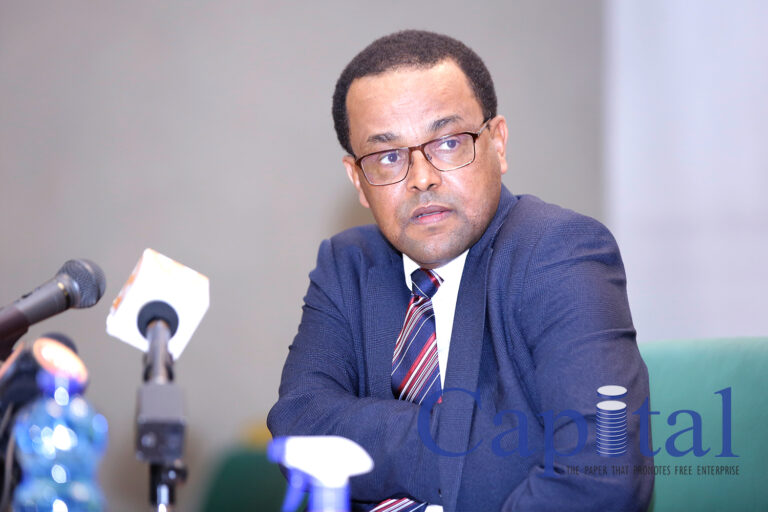
“Revising the banking proclamation and allowing mobile money operators is different,” said Yinager Dessie, governor of the National Bank.
A he explained the mobile money operators will be liaising with the local banks, as opposed to working independently, which is different from bring in foreign banks.
A firm that stands to benefit from this proclamation is Safaricom Ethiopia, with its mobile money platform M-Pesa.
“When the proposed law is approved, including M-Pesa and other foreign Fintech firms will be allowed to operate,” said Yinager adding that Safaricom Ethiopia will be able to get a new license to launch its M-Pesa services.
According to the current banking proclamations, Digital Financial Service institutions including payments, remittances and insurance accessed and delivered through digital channels with foreign investors cannot be able to fully or partly own businesses that provide these services in Ethiopia.
On related news, as part of increasing digital financial inclusion, the national Bank has given a green light to Ethio telecom’s telebirr so as to start giving micro credit and saving services.
“We are working to strength the digital economy in order to enable citizens to have an easy system whilst promoting financial inclusion,” said Yinager indicating the central bank’s go ahead decision to the new services.
Ethio telecom has been requesting for a license to the National Bank to start giving loans and saving services through telebirr as part of expanding its digital financial service, and that seems to have borne fruit.
As Yinager explained, this will allow a huge portion of citizens to be beneficial in the financial sector.
Similarly, Ethiopia plans to open up its banking industry to foreign competition as soon as parliament passes policies permitting it.
The committee has already begun working on reforming Ethiopia’s old financial services code. The first draft of the new code will be ready this December and will stipulate the modalities for foreign banks to operate in Ethiopia.
A new financial services code in Ethiopia is expected to allow foreign banks to invest in Ethiopia as the existing proclamation does not allow foreign banks to come and operate in Ethiopia.
“Opening up the sector will benefit both the economy and local banks more importantly it will increase investment,” underlined Yinager indicating that the country needs more investment.
“The opening up will be done in a win-win situation, without affecting local banks and will highly benefit the economy, local banks and also other businesses,” said Yinager as he highlighted that many African banks are already showing interest to come and invest in Ethiopia.
Upcoming proclamation to unlock foreign digital finance
Loans weigh hefty for hoteliers

A dozen of high standard hoteliers in Addis Ababa are working to sell their hotels as a result of not being able to make their loan ends meet.
Despite the Addis Ababa Hotel Owner’s Trade Sectorial Association requesting the national bank for a policy decision for commercial banks to extend their loan repayment period, the plea as it stands seems to be left up in the air.
As Aster Solomon, President of the association explains, only 3 months remain as per the repayment period, and many hotel owners are on their way to selling their hotels as a result of difficulties of repayment. On the flip side, banks are kick starting the process of auctioning off unpaid hotels.
The severe impacts of COVID-19 brought the hospitality industry to a standstill. As a result, the government decided to provide loans for the hotel and tourism sector. Accordingly, the government has been able to lend 3.3 billion birr for six months from June 2020, despite the hotels request of 6.6 billion birr for one year.
“The government’s move saved the sector at the time, however, the threat to the hotel sector remains unresolved unless the loan term is extended,” said Aster explaining that hotels are still in danger if their repayment period is not extended as they already have loans for construction and other purposes other than the Pandemic Rehabilitation Loans.
“Even if lenders understand the problem of hotels and want to extend the repayment period, they will not be able to do so without a directive from the National Bank of Ethiopia,” Aster explained.
“Commercial banks have understood the difficult situation that the hotel and tourism sector has found itself in. Likewise, the Addis Ababa City Tourism Bureau is also working to find a way to support the association,” Aster expounded on the matter.
As the hotel industry, both here and globally continue to recover from the hard hitting pandemic, most if not all hotel industries are operating in nil profits with their revenues dwindling drastically. The hotels are not making profits at this difficult time and are thus not able to repay their loans which could increase the non-performing loan of banks which could result to the closure of hotels.
Operators in the sector recommended that it would be commendable if the banks can relieve them of loan repayment, reduce interest, and the government to provide assistance to the hospitality industry with failure to do so proving catastrophic for the industry.
Mixed bag of companies’ line up to supply white cane sugar
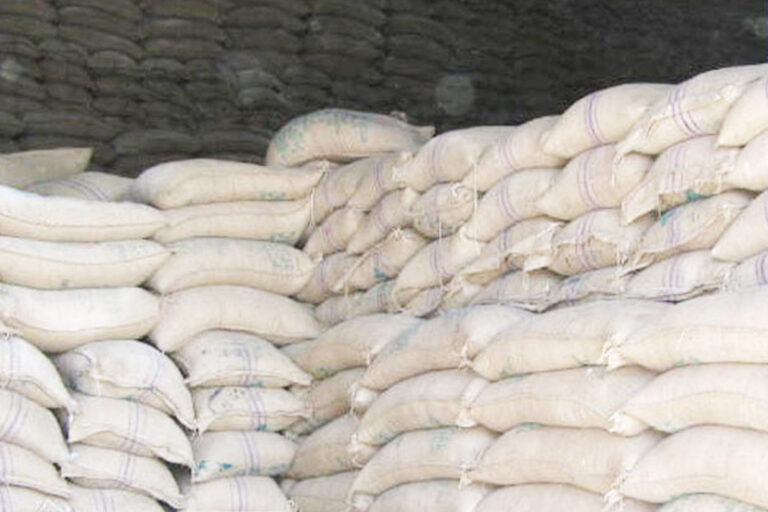
New faces on white cane sugar procurement dominate the Ethiopian Sugar Corporation (ESC) invitation to supply the sweet.
It is recalled that last week, the corporation invited global interested suppliers to submit their technical and financial proposal for the procurement of at least 200,000 metric tons of plantation white cane sugar.
On the technical opening on the morning of Thursday May 9, seven companies have submitted their proposal, while four of them are inexperienced for such or similar tenders in Ethiopia.
As per the information that Capital obtained, Husbandry International, Osirius Group, Murba Foreign Trade, Mill House International, ED and F MAN, Agrocorp International and Sucden have appeared with their documents.
However, Osirius Group and Murba Foreign Trade, who are US companies, in addition to Mill House International of South Africa and Husbandry International are the fresh face offering their bid in Ethiopia.
According to the information, Husbandry International and Murba Foreign Trade have been disqualified because of lack of bid security and manufacturer certification respectively.
Experts in the sector have however pushed for vigilance so as not to have a repeated case as that of the 600,000 ton wheat procurement. It is to be recalled that the wheat procurement failed to go through as a result of the awarded companies going missing for not having performance bonds.
In the current scenario, ED and F MAN, Agrocorp International and Sucden are well known for commodity tenders in Ethiopia. The Singapore based Agrocorp International was the company that won the last tender to supply 200,000 metric tons of sugar a year ago and supplied the first 100,000 metric tons, while the second batch was not transported owing to ESC not issuing the letter of credit (LC) as per the contract time.
The latest tender is targeted to supply the commodity on differed payment LC scheme that might be paid in a year or 18 months’ time that shall depend upon the contract agreement between the supplier and buyer, while the tender document has given optional price quotation LC at sight payment.
The latest tender has opened to suppliers to choose their shipment proceed.
A day after the opening of the technical document, on Friday May 20 afternoon the financial document of four companies were opened, having passed the technical part.
New potential suppliers, Osirius Group of USA, disclosed to load the cargo from Brazil, offered CFR Djibouti USD 580, USD 608 and USD 900 per ton for LC at sight, and the 12 month and 18 month differed LC payment respectively per ton with USD 3,000 of port visit. Although, as required per the tender document the company didn’t mention the FOB and freight rate on its financial offer.
Agrocorp offered FOB USD 618.35 and USD 679.86 for LC at sight and LC for 12 months respectively in addition to USD 120 fright rate. On its offer for CFR Djibouti the Singaporean company that stated the commodity origin as India put USD 738.35 and USD 799.87 for LC at sight and LC for 12 months respectively in addition to USD 120 fright rate.
ED and F MAN of the UK, which is also known in the Ethiopian market following its good track record like Agrocorp and Sucden, gave its offer for the three payment options. On the LC at sight and LC for 12 months it offered USD 710 with USD 99 for freight whilst for LC for 18 months it offered USD 800 with similar freight rate.
The company that mentioned India, Thailand or UAE as commodity origin offered USD 809 for at sight and 12 months payment modality and USD 899 for 18 months LC payment. The fright price was the same as mentioned on FOB.
Sucden which expressed its interest to supply 100,000 metric tons of the sweat also offered its rate on the three payment options. The French company offered FOB USD 621.63 per ton for the supply of sugar in the payment modality LC at sight. Regarding LC for 12 months and LC for 18 months the company offered FOB USD 1, 011.63 and USD 1, 411.63.
On its CFR Djibouti offer it has given USD 721.63, USD 1, 111.63 and 1, 511.63 for LC at sight, and the 12 month and 18 month differed LC payment respectively per ton. Sucden’s freight cost is USD 100 and the origin would be India, Thailand or UAE.
All the three companies have offered USD 20,000 in port visit expense.
INEPTITUDE IS COSTLY
It is only when things start to go decidedly wrong, citizens begin to ask pertinent questions about their predicaments. In good times important issues relevant to their (citizens) general wellbeing tend to be relegated to the back burner, so to speak. To be sure, most of the global citizenry is without much of a foresight about the bigger pictures of collective existence. The average sheeple doesn’t seem to have the penchant for insightful observation, be it about the past nor the present. Hence, the sheeple is destined to regard many eventual encounters as complete surprises. It is only those competently engaged that can potentially forecast (relatively accurately) the outlines of pending developments. It is because of this failure, mostly on the account of the incompetency of the power that be, repetitive social chaos continue to haunt collective humanity!
In this regard, the inability to see/foresee the demise of the prevailing world order is bound to have serious ramifications. Recognized or not, the current world system, which has been around for about half a millennium has entered its final disintegrating/bifurcation phase. Outcomes will not be pleasant, however much the global status quo pushes its regular numbing palliative narratives. To alleviate some of the major problems associated with the impending collapse, collective humanity must take firm stand against tendencies to bring back or preserve remnants of the old system. Humanity should thrive to institute a global regime that is more egalitarian, more democratic and more resiliently sustainable. Neglecting such a comprehensively economic, social and ethical agenda will open space for more of the same, like the rigidly hierarchical, hence polarizing social reality of the past, continuous past to be more precise. To this end, we must, from the outset, dispel many of the common misconceptions that pervade all cultures and societies. For instance, we should insist that institutions of orientations or more precisely, ‘institutions of indoctrination’ must change their ways. It should be very clear that passing the advertised road signs (credential-ism) doesn’t make one an enlightened person. What it does is make her an educated person, educated to serve the system and not to challenge it!
The main purpose of mass education in the modern world system is to massively produce functionaries to serve man-made capital, directly or indirectly! These days, even the so-called pure scientific researchers are effectively directed to serve the interests of monopoly capital. Recent findings indicate many (about half) of the research publications are neither here nor there! Plenty of them are conducted with a view to find something that can be readily converted into profit. It might come as surprise to many a sheeple, but (these days) scientific efforts are not necessarily geared to help deepen knowledge! Those research directions without much potential to make money can hardly secure funding/grants, even that of taxpayer’s. Open inquiries with potential to interrogate/disprove some of the false claims of paid scientists (scientists on the pay) at the service of profiteers, are visibly discouraged! So given such a scenario one would be naïve to expect enlightened discourse (on all and sundry) within the realm of establishment institutions, wherever they might be! Many of the obvious problems of countries stem from such inabilities to foresee new developments (while discarding old ones) that would inevitably impact their short/long term strategies.
Moreover, incompetence, because it lacks confidence, congregates and swiftly sets up a united front against enlightening knowledge it deems beyond its conceptual grasp. This is how ineptitude managed to run bureaucracies roughshod, all over the world, for ages. For political survival, ineptitude has to make sure excellence is consistently undermined so that it can shine supreme and reign unchallenged! Psychopathic politicos and their affiliated private operators do not thrive because they are confidently competent; no, no, no, they thrive because they are parasites, unashamedly taking undeserved advantages of the hard work of compassionate souls, who unselfishly and persistently try to serve society as a whole. The born incompetents operate without much analysis and foresight. If anything, their proven capacity is to make conditions worse than they were/are. Don’t get us wrong; we have nothing against proven idiots who want to flaunt their wares, after all, the whole charade can be quite entertaining. Just look at Ethiopia’s parasitic elites that are good for nothing, except impostering and grand corruptions! Be that as it may, problems start when these clowns, adorned with phony credentials (compliment of cash or the system’s need to have useful idiots, etc.) are enabled to run our collective lives, directly/indirectly. That is when the sheeple draws the line, but these dimwits, as expected, are failing to recognize the boiling wrath!
Africa’s leadership (not only political), to a large extent, belongs to this mediocre genre. No wonder our continent wallows in a frighteningly fantastic ignorance!
