

As far as the prevailing modern world system is concerned, Africa is the last of the inhabited continent that still promises accumulation at a relatively decent scale. Even though the anticipated accumulation might not be as plenty as in the early phases of industrialization, (the Gilded Age, etc.) it is still expected to be significant, compared to other places on the planet! One should take serious note of the existential problem the system is facing. Since the early 1970s, the rate of profit has been consistently falling all across the world, in particular within the advanced industrial countries (core countries). The collapse of the Bretton Wood Accord (1973-the abandoning of gold-currency convertibility and its replacement with pure fiat money) openly ushered the end of the golden era of the system. This is the main reason why all sorts of financial and other concoctions (various trade agreements, currency manipulations, etc.) came to dominate the capitalist world system!
The expansion of massive un-payable debts to all and sundry is one critical design that has kept the system going. To prop up falling demand as well as stagnant income in the OECD (rich countries), the global regime introduced a credit system, which has been unprecedented in all of human history! From nation states to provinces, from counties to municipalities, all administrative structures of the modern nation states saddled themselves with unsustainable debts. From the largest corporations to owner-operated garages in the villages, debt became the mainstay of businesses all across the world. Business is no more a profit sustained economic activity; rather, it is a global hatchery of debt slaves, mostly in the monetized world. Even individuals or consumers as they are now called (starting from the humble school janitor all the way down to the well paid professionals) have not been spared. The sheeple are now wallowing in massive debts, compliment of the fraudulent financial system of the global order (fractional reserve banking, fiat money, etc.). Family/social lives as well as the general health of individuals and society at large (due to polarization/inequality, etc.) are all in dire distress, because of the systemically implemented global debt peonage system! Without the continuous creation of massive debts, the system will not last a single day. Like it or not, the day of reckoning will be upon us, sooner than later!
Behind this poser, there is still a dilemma. There is enormous capital in the world system that cannot find sufficient productive outlets ensuring reasonable rates of return. That there is a glut of capital (phony finance) in the system is one of the best-kept secrets of the reigning order. The narrative that is incessantly preached by global dominant interests about capital not being readily available is almost wholly false. If that were the case, bond yields in the OECD would not have become negative. In other words, what obtains today on the ground is; one has to pay money for the privilege of lending it to states (Germany, et al.)! Moreover, if capital were in short supply, the global pension funds, the real investors in capital markets, (equity or otherwise) wouldn’t have been in such dire strait. These funds assumed (all along) and of course wrongly, they would secure a return of about 7% per annum on their invested capital. Today that is a pipe dream, so to speak. These funds will be lucky if they can have an average return of 1% per annum. The story goes: it is not return on capital one has to be worried about, but rather the return of capital! As it currently stands, pension funds are having difficulties meeting their obligations to their members (i.e., pensioners). As a result, they are engaged in the old game of ‘kicking the can down’!
It is such scenarios (inadequate return, demographic change and saturation of markets at home, etc.) pressuring capital to look at territories in the periphery of the system. The intended mode of accumulation, we hope, might not be as wicked as those days of past (colonialism, slavery, etc.). The African states, gullible as ever and hardly knowledgeable about the ways of the world, continue to open up their territories for all sorts of so-called investments. To help implement this lopsided scheme, the continent has acquired plenty of learned idiots (products of the mill = universities) to do the bidding for their masters from abroad. These useful idiots have become increasingly confident and vocal, as they are encouraged by the power that be (TPTB) to flaunt their superficial knowledge about the world order. Committed activist intellectuals, particularly those in positions of responsibilities, must thoroughly articulate and challenge the prevailing global order that continues to undermine our fate. We shouldn’t fall for the likes of ‘Africa Rising’ memes, which, besides being vulgarly vacuous, (a symptom of internalized insecurity) are also predicated on commodity exports (renewable/non-renewable). Its associated domestic side effects of speculation and rent seeking, for example, in countries like Ethiopia and Kenya, are also facing boomerang effects. Beware, higher order accumulation that significantly leverages politicized ethnicity is neither cohesive nor lasting!
AFRICA-THE FINAL FRONTIER
Gov’t forms committee to help investors following AGOA departure
Government has formed a committee to assess ways to support investors and exporters in order to minimize the effect of Ethiopia’s suspension from the African Growth Opportunity Act (AGOA).
On December 23, 2021-U.S. President Joe Biden announced that he has determined that Ethiopia, Guinea, and Mali do not meet the AGOA requirements. Due to the conflict that erupted last year between the federal government and the Tigray People’s Liberation Front (TPLF) requirements described in section 506A(a)(1) made Ethiopia ineligible to be part of the act.
Aimed to support investors to resist the effect of Ethiopian termination from the AGOA, a committee has been established from the Prime Minister’s office, Ministry of Finance and the Ethiopia Investment Commission.
In order to find alternative market options especially for the textile industries, rearranging tax and tariffs, expanding duty free schemes, giving loan relief, minimizing transport subsidy and also minimizing shade leasing cost are some strategies to be used.
Since Ethiopia is not a WTO Member State, the country’s standard tariff schedule for access to the US market has far higher tariffs than would be the case under normal tariff relations (NTR). A loss of AGOA removes preferential access to 6,500 tariff lines.
Following the temporary suspension of Ethiopia on November 2, 2021, Ethiopian officials had warned that the suspension could take away 1 million jobs, disproportionately hurting poor women who are the majority of garment workers.
Experts at the time explained that one of the efforts that the government is working on was to change the decision of the US government and also going forward, perhaps finding alternative market and increasing the product is the mainstream market which will be impactful for the future.
In a statement issued by the Ministry of Foreign Affairs, “Removing the preferential agreement will affect the livelihoods of more than 200,000 low income families, mostly; women who have got nothing to do with the conflict, it will also considerably impair the lives of one million people who are engaged in the supply chain ecosystem.”
The ministry expected a balanced view on the situation from the international community and asked the US government to reverse its decision that may only embolden the terrorist group while endangering the aspirations of Ethiopians to extricate themselves out of poverty.
AGOA brings Ethiopia about $100m in “hard cash” annually and directly generates employment for about 100,000 people. Ethiopia exported 237 million dollar duty-free to the U.S. last year, U.S. Commerce Department data said.
Almost half of Ethiopia’s 524 million dollar in exports to the US in 2020 utilized AGOA preferences – mainly for apparel and footwear, two sectors reliant on AGOA preferences with most of the exporters found in Industrial parks.
From the total 24 Industrial Parks developed in the country, 22 are now in operation and the country has managed to attract more than 250 domestic and foreign investors which till August 2021 created employment opportunities for 86,837 unskilled laborers and more than twenty thousand posts for skilled labor and graduates, excluding the three Industrial Parks in Tigray region which have ceased operations for the last one year.
According to the Industrial Parks Development Corporation (IPDC), inclusive of the ones in the Industrial Park context, currently more than 65 textiles and apparel, and 67 major leather products, and gloves manufacturing industries employ over 200,000 direct jobs of which 80 percent of them are women and youth and generate about 230 million dollars per annum.
Nyala insurance avails new product for diaspora
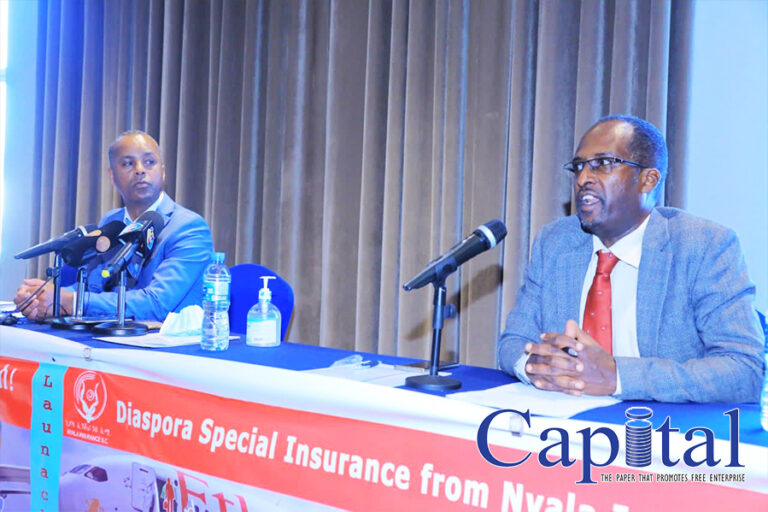
Nyala insurance launches a new insurance product called Diaspora Special Insurance in a view to provide insurance cover to Ethiopians and Ethiopian born individuals who are permanently residing outside their home country.
According to the company, the product is to be relied in collaboration with the world’s largest reinsurance group which will effectively deal with scenarios such as hospitalization, surgery, medical fees, and pharmaceutical products while the insured pays a visit to his/her country for a short period of time to a maximum of 90 days with reasonable cost.
As the company indicated, the cost will be worked out up to a limit of 10,000 Euro or 13,000 USD or in Ethiopian birr 640,000 followed by an amount of 50 USD excess applicability per individual claim request.
“In addition to the medical insurance, the new scheme in case of death of the insured in his country of residence, the diaspora special assistance policy will cover the cost of transportation of the mortal remains from the place where the death has occurred to Ethiopia,” officials from the insurance company disclosed.
Also in addition to the insured, the scheme will also cover cost of transportation of close relatives to the insured which will be in the most suitable means of transport accommodation to accompany the mortal remain from the place where death occurred to Ethiopia.
The insured are expected to pay 57 USD or 75 USD to buy the insurance calculated based on their resident country, and the agreement should be renewed every year. Customers can buy the insurance from agents of Nyala Insurance across the world, through website and applications.
ECA halts selection process for a second telecom operator
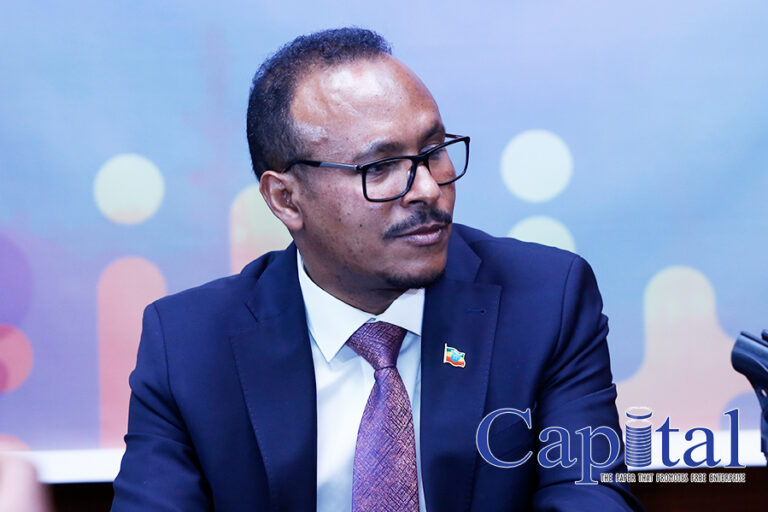
The Ethiopian Communications Authority (ECA) announces that the process of selecting the second telecom operator has been terminated.
It is to be recalled that the authority refloated the second tendering in September on the aim to get an additional telecom operator in Ethiopia besides the incumbent state giant Ethio Telecom and Safaricom Telecommunications Ethiopia Plc.
On the statement issued on Wednesday December 22, ECA stated that the bidding process has temporarily been relinquished as per the request of bidders.
It said that ECA issued a Request for Proposal (RFP) for the second new full service nationwide Telecommunications Service License on September 28th 2021 and the bidding process was ongoing, “however, ECA received concerns and requests from several prospective bidders to delay the process and to issue the RFP at a convenient time in the future, which the authority fully concurred.”
“Accordingly, ECA has suspended the RFP process for the new second license and will re-launch the process in the near future,” on its announcement the authority said.
Just a year ago the government had floated a bid for two additional telecom licenses and on the process an international consortium named the Global Partnership for Ethiopia, comprising Safaricom Plc, Vodacom Group, Vodafone Group, Sumitomo Corporation and CDC Group, was awarded a license to operate telecom services in Ethiopia in May. The consortium company called Safaricom Telecommunications Ethiopia is on the process to commence to operation early 2022.
Safaricom Telecommunications Ethiopia secured the operational license with USD 850 million fee, while the other company selected to join as operators, MTN of South Africa failed to pay at least the amount that the Safaricom consortium paid.
Due to that the authority refloated the bid for one more time in September. Sources said that some interested bidders have bought the bid document however the exact number of bid document buyers has not been revealed.
“The conflict that has been flamed by the terrorist group which has expanded its operation to the south is seen as the reason that has led interested bidder to insist the authority to revise its schedule,” experts on the sector who closely followed the case expressed their guess on the matter. Moreover, they explained that owing to the latest developments in the county which has seen the terrorist capacity dwindling and contracting, more bidders will be drawn in as the authority looks forward to reinstate the process.
