

Federation of food, beverage, tobacco and allied trade union raises concerns that employees of Meta Abo Brewery are not receiving the right information even though BGI Ethiopia started managing the factory without the approval of the Ethiopian trade competition and consumer protection authority on the transition.
Employees of Meta Abo Brewery have also piled their complaints as the company remains silent about its transition and their future.
Due to continued complaints of Meta employees, the federation has held several meetings with top managements of Meta and government bodies and as Dereje waktola, president of the federation said, there is no clear information given to the federation.
“Even if we ask to see legal agreement of sale and minutes the Diego management team at the time told us that they didn’t have any information as the agreement was made only between the owners of the two companies,” said Dereje.
As Dereje pointed out, the federation has been trying to find these documents from the authority but has failed to obtain it as the two companies did not submit the sale agreement and documents to the authority.
Girmachew Mandefro, chairman of the trade union of Meta which has about 340 members from the total of 500 employees informed Capital that the management teams of Meta from Diageo has left the company without giving clear information about the new owners and their agenda for its employees.
As he explains, the employees have not received any information whatsoever on the matter. “Both Diageo and BGI Ethiopia have stayed silent after making agreement on the acquisitions of the company,” Girmachew stated, adding, “we have concerns about our future, on whether they are going to let us continue our job or make us leave.”
However BGI refuted the allegation. Gebre Selassie Sifer, Commercial PR Manager of BGI in a written response to Capital said, “the statement couldn’t be any further from the truth. BGI Ethiopia has submitted all the necessary documents on time and in full to the Trade Competition and Consumer Protection Authority (TCCPA) and it is now waiting for the necessary approvals to commence the takeover process. TCCPA and all involved government stakeholders have been exceptionally supportive and speedy in their support. It is our firm belief that we will be granted with the necessary approval once the review process is complete.”
The statement further reads, “BGI Ethiopia remains committed to the process and hasn’t been and will not be involved in the operation of Meta Abo Brewery until all the proper approvals are secured. Meanwhile, BGI is working on plans to channel its expertise and experience to keep and rejuvenate the brand Meta and rekindle the passion of the staff at Meta.”
Recently, BGI Ethiopia which has plans to rejuvenate the brand, in its statement sent to Capital disclosed that after having concluded the agreement to procure Meta Abo Brewery S.C. from Diageo, BGI Ethiopia is now waiting for the approval of the ETCCPA.
According to the Trade Competition and Consumers Protection Proclamation No. 813/2013, no agreement or arrangement of merger may come into effect before obtaining approval from the Authority pursuant to Article 11 of this Proclamation.
To this end, the federation requested the two companies to give clear information on the matter and to decide the future of employees.
The brewery which is based out of Sebeta, Oromia region has about 3.7 billion birr in government tax debt starting from 2017.
Diageo thus entered into an agreement for the sale of Meta Abo Brewery, to BGI, which is part of the Castel Group. The sale was subject to approval by the conditions of ETCCPA with everything set to completion by early 2022; however this has faced a slight delay.
Following the acquisition, Meta Abo joins BGI’s other five breweries i.e., St. George Brewery in Addis Ababa, Kombolcha Brewery, Hawassa Brewery, Zebidar Brewery and Maychew Northern Brewery with a combined production capacity of 3.6 million Hectoliters of beer annually.
Meta Abo staff still in the dark

Khat gets a stimulating change in directive
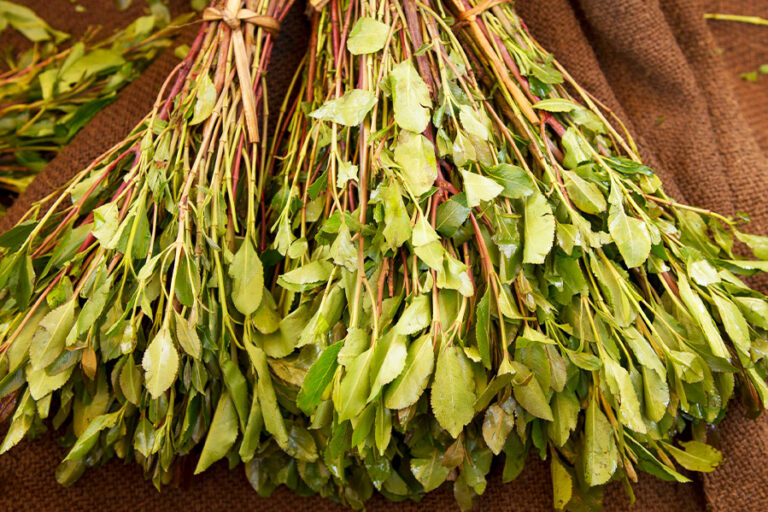
Ethiopia drafts a strategy for one of the major export earning items for the country, khat. After decades in waiting, the stimulant’s export tariff to Somalia market has also faced revision.
On his appearance in parliament whilst presenting his eight months performance, Gebremeskel Chala, Minister of Trade and Regional Integration, said that the ministry in tandem with relevant government bodies is working to improve the khat trading and export earnings.
He explained that changes emplaced in the budget year are improving the sector business.
According to the Minister, the khat trading directive has been in placed for about 41 years with out any change. He said that this made the stimulant leaf traders not to attain the full benefit of the export which consequently reduces the earnings that the country is supposed to secure from the export.
“Experts have since then gathered from different offices in order to identify the problem from the various studies drawing from the identified gaps as result the new trading directive has been developed to boost the khat trading,” he said.
He added that the export trading guideline and action plan have been developed, and it is on due process to be sent to the National Macro-Economic Committee for ratification.
As per the study conducted by experts, the minimum export rate to the Somalia market has been revised from the former and long established five dollar to double that amount.
Starting from January 23, 2022, the new price increments were officially introduced.
According to Gebremeskel, similar to other export commodities, khat is affected by contraband, “Owing to supply deficiency and the rise in contraband, government in conjunction with stakeholders are working to control the illegal activity and improve the benefit from the sector foreign trade.”
Similarly, the Oromia region has also embarked on an initiative to benefit the khat farmers, rather than the middlemen.
Recently, Shimelis Abdisa, President of Oromia region, told Capital that the region is also establishing four khat trading centers to modernize the stimulant leaf business.
He said that the region, which is the major source of khat export, is also working aggressively to change the market and productivity for the stimulant leaf, “We are giving the necessary attention to khat as like the coffee sector,” opined Shimelis.
“We are working to improve the khat market, which has been taken hold by the middlemen, rendering them to profit as opposed to the actual producers of the leaf,” he explains, adding, “we are strongly working to pushing out the illegal actors for the benefit of farmers.”
To improve the khat market; trading centers are developing at Awoday, which is the only and long established trading center for export khat. Likewise, Bedessa, Addis Ababa and Dire Dawa are similar trading centers.
The trading facilities will have standard storage area, packaging centre and other facilities on the aim to keep the export quality.
The productivity is also the focus area to expand the production and export.
According to Shimelis, the country is generating huge amounts of hard currency from khat.
The earnings from the stimulant that is mainly exported to neighboring countries takes almost a quarter from the total agricultural commodities export earnings within the first eight months of the budget year.
This makes the commodity the second largest exporting agricultural product after coffee and it stood at third position from the total export earning items in terms of earnings. From the total export earnings coffee and mineral exports stand a top respectively.
In the first eight months of the budget year that closed in early March, the country secured USD 280 million from khat export, which is a full accomplishment of the projection, while the volume has reduced by 10 percent when compared with the target.
In the stated period the country has exported over 44,400 tons of khat. Mostly the eastern Ethiopia, which is pioneer for the stimulant cultivation, khat product is highly promoted for export rather than other areas. However the production and local consumption has swiftly expanded in other parts of the country for the past few decades.
Most of the other areas of khat production are supplied to local consumers well known as khat chewers.
Safaricom Ethiopia, Nokia strike 500 million USD infrastructure mega-deal

Safaricom Ethiopia PLC signs a 500 million dollar deal with Nokia for its infrastructure development and network expansion in Ethiopia. The agreement between the two companies is said to be a long-time agreement.
Accordingly, Nokia’s network expansion is said to be focused on the core network infrastructure in Addis Ababa and its surrounding areas.
Safaricom Ethiopia which was formed by the amalgamation of Safaricom, Sumitomo Corporation, CDC Group and Vodacom secured its operational license from the government in early June 2021 and is set to officially do business in Ethiopia as a second telecom company after the state-owned Ethio Telecom.
Additional to Nokia, previously the company shortlisted the Chinese global telecom giant Huawei to set up its infrastructure.
The company signed a deal with Huawei Technologies of the Chinese multinational technology corporation for the infrastructure development that it aspires to realize in a short period. To this end, Huawei will cover the rest of the country with its infrastructure development for Safaricom Ethiopia.
Both companies are not new to similar activity in Ethiopia. For instance, the Finnish company was engaged in the second massive mobile network development project in the country that ended in the early 2000s and other IT projects. Similarly, the Chinese company, which is leading the global telecom network development with Nokia, is engaged in the massive mobile network expansion with ZTE of China in the fourth and last phase of the major mobile network sector development. It has also recently concluded the national 4G network expansion and network upgrading for Ethio Telecom.
Safaricom- Ethiopia is expected to gear up for its commercially launch operations in a few days with the company planning to provide 4G and 5G internet service. It is also said that by 2023 a low orbit satellite will be put in place to provide nationwide 4G coverage by the firm.
To get the license Safaricom -Ethiopia paid USD 850 million to the government and promised to invest up to USD 8.5 billion in the coming decade.
The company is now starting engagements with Ethio Telecom, which is expected to provide rental service of its infrastructure for the new telecom operator.
As part of its network expansion, Safaricom is also working to build towers, fiber extensions, broadband connections and so on within the ICT Park, with expansions including site selections to establish towers for the 5G trail.
Hawassa Textile and Industrial Park eyes one year completion
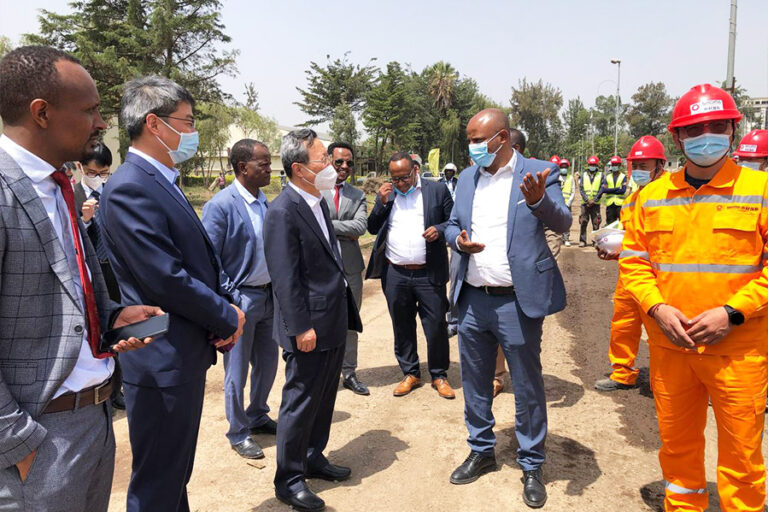
During Zhao Zhiyuan’s, Chinese ambassador to Ethiopia, visit to the industry park located 258 km south of Addis Ababa at Hawassa town of Sidama region, Ahmed Abderuf, CEO and one of the three owners of the Hawassa Textile and Industry Park, said that although the project did not pan out as planned, in the past one year the project has accomplished its earthworks and footing.
Ahmed explained that the escalation in price of construction materials and shortage of cement and rebar primarily hampered the project, which is managed by the Chinese state giant, Sinoma International Engineering Co Ltd.
“So far the civil works of the project, which is the foundation structure, has been accomplished by 37 percent. The remaining works are steel structure and electrical installation which is very easy and will be done swiftly,” Ahmed explained.
The CEO added that a Chinese company has already been hired to manufacture the steel structure and expressed his hope that the project which includes the construction of 14 sheds will be finalized in a year’s time. The 14 sheds are to be erected in 11,000 square meter areas each.
As per senior staffs of the park, at the current stage,most of the construction works is financed by the company itself owing to the National Bank of Ethiopia sanctions for commercial banks to pause on fresh loan provision that was lifted few months ago.
Ahmed said that they are on process to access finance from the state owned financial enterprise to support the project with additional financial sources. When the project lunching ceremony was held about a year and half ago, Ahmed told Capital that they were expecting financial backing from the Commercial Bank of Ethiopia since the project demands huge resource in order for it to materialize.
The new project is expected to consume four billion birr. At this stage interested global textile and garment producers have been showing their interests to lease sheds at the compound.
Besides new sheds development, the company is renovating the existing facility that it bought few years ago at a cost of half a billion birr.
Now the old textile machines at the existing sheds are being replaced by brand new equipment to commence yarn production. The newly installed machines will have two production lines for acrylic yarn and nylon that will be provided as input for local and global textile industries.
“Most of the installation work for acrylic yarn line has been concluded to produce seven tons of acrylic yarn per day, while machinery procurement for nylon line is on process to produce ten tones of nylon yarn per day,” the CEO said.
The revamping work on the oldest facility has consumed 600 million birr. According to the information Capital obtained from the company, Hibret Bank is supporting the renovation works with undisclosed amount of finance.
Hawassa Textile and Industrial Park S.C is located on a 35 hectare piece of land at the southeast outskirt of the regional capital.
Sinoma which built the Dangote Cement factory and the expansion of Muger Cement now has involvements on the development of the Hawassa and Dire Dawa industrial parks.
The first Ethiopian owned Garment Park commenced the construction of 14 sheds at Hawassa at a cost of two billion birr.
On a ceremony held on the 6th of September, Hawassa Textile and Industry Park announced that it has commenced the construction of the garment sheds. The ceremony was graced with the presence of the President of the Sidama Region- Desta Ledamo and state Minister of Trade and Industry- Misganu Arega.
The former Awasa Textile, which changed its name to Hawassa Textile and Industry Park that commenced operation three decades ago has been one of the public enterprises that have passed different privatization scheme, which was introduced by the former ruling coalition, EPRDF, which controlled the political power in early 1990s.
During the early stages of the privatization process the company was leased to foreign investors and later on became fully privatized. At these stages when it was not performing accordingly it was controlled by banks as collateral until the current owners secured the facility. It is currently located at the South Eastern outskirt of Hawassa town.
CEO and one of three owners of the Hawassa Textile and Industry Park, Ahmed Abderuf affirmed that both him and his partners secured the facility three years ago and now the old textile machines at the existing sheds are being replaced by brand new equipment to commence production in the coming few months.
“To secure the factory, we paid half a billion birr. The purchase and installation of the new machines cost us 200 million birr and in the future an additional 200 million birr will be set for the additional equipment on the textile production at the port,” said Ahmed to the media at the press conference held in relation to the construction launch ceremony.
The factory will have a capacity to produce 14 tons of textiles per day when it commences operation in the coming four months.
He added that the new 14 shades will be erected in 11,000 square meter area each will be ready for production in less than a year.
The new project that is currently on a 35 hectare piece of land is being constructed by Sinoma International Engineering Co Ltd. “Prominent global brands like Gap have already shown their interests to invest in the sheds,” Ahmed said.
Most Textile and Garment industry parks in the country are controlled by the government. Furthermore, foreign investors are actively involved in the development of the industrial parks. However this is a first for Ethiopia investors to manage the ‘garment park’ and even fully invest on the parks. In addition Ahmed states that his company will expand similar facilities in other parts of the country.
The park in Hawassa is expected to accommodate up to 30,000 jobs. “In terms of size and job opportunity our park will be the second facility,” the CEO explained.
Currently the biggest park in the country is the state owned Hawassa Industry Park, which is located in a similar area just few kilometers from Hawassa Textile and Industry Park.
According to the CEO, most of the products from the existing textile factory and the future facility will be exported.
Misganu explained that the government has a target for this industry to contribute to the GDP from the current 17 percent to double this percentage. He adds that they will provide support to this investment which will contribute massively in job creation and urbanization.
Ahmed further informed Capital that United Bank was the financier for the textile factory investment. The Commercial Bank of Ethiopia is also expected to provide support for the project.
Desta, who leads the new region, said that his government will provide every support that is required in realizing the investment.
