

Ethiopia Sugar Corporation (ESC) invites shortlisted companies to offer their price following the latest international sugar bid bearing no fruit.
It is to be recalled that few weeks ago the corporation opened an international bid to procure 200,000 metric tons of plantation white cane sugar which attracted three bidders; Sucden, ED & F Man and SY General Trading Fzco – East African Djibouti Holding.
The first two companies; Sucden, ED & F Man, which are by no means fresh faces to similar commodity bids in Ethiopia were able to comfortably pass the technical evaluation of the bid. However, experts who closely follow the case explained that hurdles were met on the financial opening which forced the duo to retreat.
Sources said that initially, the bid documents gave the bidders eight working days price validity, while the corporation requested them to give additional five days for the validity. To this end, Sucden refused and ED & F Man gave the price validity extension until the financial opening, which technically expired on the date that was March 8.
Based on the national sugar producer and supplier changes, the procurement thus resorted to short listed invitation.
Sources said that about six prominent global companies in commodity supply like Al Khaleej Sugar, Wilmar Sugar, Agrocorp International, and the two companies that were involved on the failed bid were invited mid last week to provide their offer until Monday, March 21 afternoon.
Agrocorp International, which won last year’s 200,000 metric ton sugar bid and successfully delivered the first 100,000 metric ton, neglected to participate in the latest open bid to which sources point out that it was disappointed by the corporation’s failure not to receive the remaining 100,000 metric tons of sugar that it won for the bid.
Recently, Weyo Roba, CEO of ESC, told Capital that it was the government’s direction to annul the procurement of the remaining 100,000 metric ton sugar from last year’s bid.
Experts argued that last year, the measure taken by the ESC affected this year’s bid which has resulted in international prominent bidders to lose trust on the country’s procurement system.
“I suspect that the low number of bidders for the last bid was an outcome of last year’s failure to buy the sweet as per the expectation,” one of the sector experts said.
He said that such kind of poor decision affects the country’s image on the eyes of global suppliers. “For instance the issue has been raised for discussion between stakeholders on the latest global sectoral event, Dubai Sugar Conference, which was held early this week. The concerns were raised on the country’s default on the bid,” the expert said, adding, “I advise government officials and the bidding committee members to be meticulous in such kinds of global bidding system including other commodity imports.”
Other expert on the sector also added that extending the biding and procurement process also affects the country. “Currently, commodity price is frequently hiking, which directly affects the country and the society,” one expert opined.
The expert argued that if the government procure last year’s 100,000 metric tons of sugar, it would restore an added advantage and trust in the process.
Experts explained that in last year’s bid, Agrocorp had agreed to offer the commodity by USD 549 C and F Djibouti. Currently, they estimate that the C and F price of sugar at Djibouti would run from USD 660 to USD 680.
The global commodity price is skyrocketing due to the after effect of the global pandemic which also spikes the freight price.
However, experts said that so far the Russia-Ukraine crisis is not visible on the sweet sector, while it has contribution for logistics cost increment.
The country annually imports up to 350,000 metric tons of sugar to address the gap. ESC has targeted to produce 413, 000 metric tons in the current budget year.
The sugar demand has been growing from time to time and it is estimated that the country’s annual sugar demand caps at about 1.2 million metric tons. Thus the remaining gap is covered by other importers who have special permit from the government and those who have Franco-Valuta privileges.
Sugar corp resorts to shortlist bid invitations
Key stakeholders’ partner to increase barley production

Public entities and private enterprises team up to boost barley production and income by 20 percent before 2025.
The scheme under the motto ‘better income through improved barley production’ (BITIB) brought together the Maltsters and GIZ GmbH to develop a framework for the funding program which GIZ will implement on behalf of the Ministry of Economic Cooperation and Development of German.
At the project launching ceremony held at Inter Luxury Hotel, it was stated that key stakeholders of the barley value chain will come together to form a development partnership with the private sector.
Based on the new initiative local maltsters, Assela and Gondar malt factory along with Boortmalt Ethiopia, will partner with the Ethiopian Institute of Agricultural Research (EIAR) to provide new varieties of barley seeds that will be developed at the prominent research institute to local farmers.
The aim of the project is to sustainably improve the availability of quality seed of locally adopted barley varieties fulfilling industry standards, benefiting small farming households as the seed producer, in addition to sustaining the raw barley for malt and beer production.
Ethiopian Maltsters Association (EMA) shall intensify its technical cooperation and will provide investments in the barley breeding program of EIAR to ensure the timely release of new varieties as well as the production of sufficient and high-quality early generation seed by the institute.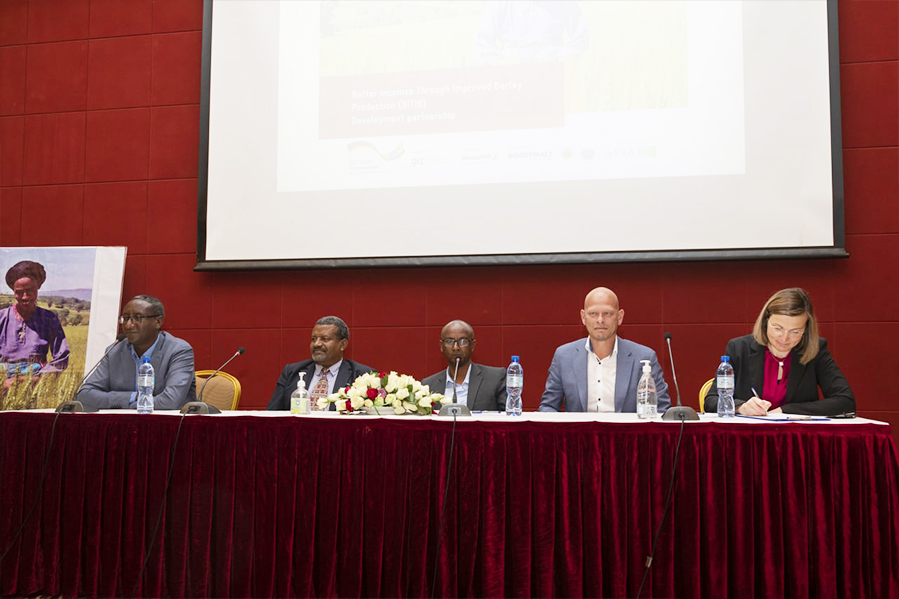
“A new barley variety that is quickly available to farmers in the form of certified seed will reduce the use of fertilizer and fungicides, increase productivity compared to currently used varieties and thus increase the income of small farming households,” it has been stated.
Diriba Geleti, Deputy Director EIAR, noted that the aim of the project is to enhance the public-private partnership (PPP) modality in the agriculture sector. “This project will also enhance capacity and productivity of small holder farmers,” said the deputy, adding, “interpreting researches that are conducted on malt barley into reality is essential.”
Despite barley production having some changes in the past years, benefiting about 180,000 household farmers, the output is very low compared with the sharply increasing demand in the market.
Andria Ruediger, Project Manager of GIZ, said that Ethiopian highlands are suitable for barley production, while the actual supply for the market is very low compared with the demand mainly at the maltsters.
She said that in the past two years, the malt barley demand has increased by 160,000 tonnes due to two international malt companies that include Soufflet joining the barley value chain. “Currently, the malt barley demand in Ethiopia is 260,000 tones and in 2021 only 100,000 tones were collected locally,” Andria stated whilst highlighting the gap.
“Very limited seed production and a long time to market, are further challenges for the sector,” she added.
Tadesse Kassahun, Head of Gondar Malt Factory, said that the four Ethiopian maltsters are producing over 1.8 million quintals of malt barley per annum.
“To produce the stated amount, companies need about 2.6 million quintals of beer barley as input, while the actual local harvest was one million quintals last year, which shows that an additional 1.6 million quintals are needed,” Tadesse commented at the event.
String of charges hit long time partners

Court postpones Al- Amoudi’s lawsuit
The Civil Bench of Federal First Instant Court adjourns to hear the case that Sheik Mohammed Hussein Ali Al-Amoudi filed against his long-term partner and intimate friend Abinet Gebremeskel. The hearing has been set to take place next week.
The Civil Bench of Arada Division that appeared late this week gave an order for the lawsuit filed by the prominent tycoon to be heard this coming week owing to the absence of a judge ready to preside over the case.
In the charge which was filed in August last year through his lawyer Eshetu Woldesemayat, the business magnate and former chief attorney general of the then Ethiopian Revenue and Customs Authority, Al-Amoudi, claimed that the defendant abused the power which the plaintiff gave over Bole Towers Plc.
The company which was formed by the two individuals about 20 years ago, belongs 60 percent to Al-Amoudi while the remainder is owned by Abinet. With regards to management, Abinet was given the responsibility to manage the company, while Al-Amoudi had the power of attorney.
Al-Amoudi on July 15, 2021, then revoked the power of attorney that he gave to Abinet.
The plaintiff claimed that despite the general manager and representative of the major shareholder being expected to administer the company as per the memorandum of association and article of association, the defendant did not play by the rules.
The file added that the defendant transferred the plots of land sized 3,383 and 1,971 meters squared each which have a facility worth 120 million birr for his own, about three and two years ago respectively. The file claimed that as a result, the defendant damaged the interest of the major shareholder. Further adding that about seven months ago, the defendant tried to transfer the properties to third parties.
The lawsuit also entails the failure of the defendant to produce documents such as audit reports, minutes and accounting balance which are crucial for the case.
As per the claims, the plaintiff appealed to the civil bench for the defendant to make available relevant documents of the company, whilst he also called for the removal of Abinet from the general manager post at Bole Towers, which is located around Wollo Sefer, in addition for an appeal of audit of the company.
Year on year inflation narrows in February

February 2022 general year-on-year inflation stands at 33.6 percent showing slight decrease after reaching 34.5 percent in the previous month, according to the Central Statistics Agency (CSA) monthly report.
The year-on-year food inflation has increased by 41.9 percent in February 2022 as compared to the one observed in February 2021. In the current month, cereals showed an increase in most cases, while, vegetables showed a decline as the report stated.
Teff, wheat, maize and sorghum showed price increase in most cases, as, milk, cheese and eggs, and spices (mainly salt and pepper) cooking oil and butter slightly increased in the current month. In addition coffee beans and non-alcoholic beverages prices have also increased continuously.
The non-food inflation showed an increase of 22.9 percent in February 2022 as compared to the one observed in February 2021.
The rise in non-food inflation was mainly due to rise in the prices of alcohol and tobacco, stimulants (chat), clothing and footwear, housing repair and maintenance (house rent, cement and corrugated iron sheets), and energy (firewood and charcoal), furniture and home furnishings, fuel, medical care and jewelry (gold).
Inflation based on comparison of current and last month at country level general Consumer Price Index (CPI) for February 2022 has showed an increase of 3.4 percent and the food items inflation increased by 4.8 percent as compared to the preceding month of January 2022. During the same period non-food CPI has shown 1.4 percent increase.
According to the report, the February 2022 country level CPI has increased by 34.5 percent as compared to February 2021. Also the country level overall inflation rate rose by 29.1 percent in February 2022 as when contrasted to a similar period of a year ago, according to CSA.
The country level food inflation increased by 34.7 percent as compared to the one observed a year ago while non-food inflation rate increased by 21.9 percent in February 2022 as compared to the one observed in February 2021.
This increase in the general consumer price index has been attributed to the rise observed in the indices of food and non-alcoholic beverages 41.9 percent, alcoholic beverages and tobacco by 32.0 percent, clothing and footwear by 19.7 percent, house rent, construction materials, water and fuel and power by 17.9 percent, furniture, furnishings, household equipment and operation by 42.2 percent, health 37.9 percent, transport 6.8 percent, communication by 4.4 percent, recreation and culture by 46.7 percent, education by 28.4 percent, restaurant and hotels 24.6 percent and miscellaneous goods by 26.2 percent.
