

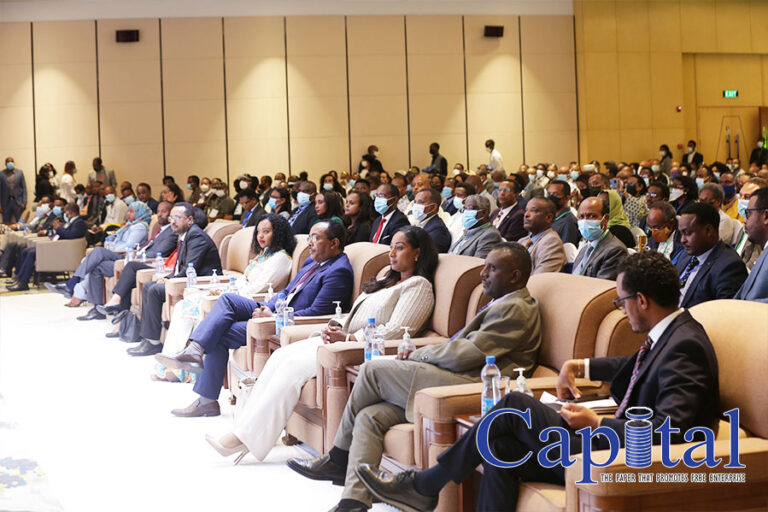
Aimed to increase the engagement of the diaspora community in trade and investment activities in Ethiopia, the Ethiopian Investment Commission held a four-day diaspora investment and exhibition forum which started Tuesday January 11, 2022 stretching to Friday January 14 at skylight hotel Addis Ababa.
Opened with a view to promoting investment potentials in different sectors across Ethiopia, the four-day event served more than 700 participants of the diaspora community by promoting priority sectors identified by the Ethiopian government.
Lelise Neme, Commissioner of Ethiopian Investment Commission, and Ministers from various government organizations presented reports on several investment opportunities identified as priority sectors for Ethiopians in the Diaspora to engage in the Ethiopian market. Presentations were made from the ministries of: Health, Mining, Tourism, Trade and Regional Integration, Agriculture, Industry, as well as the Ethiopian Industrial Parks Development Corporation (IPDC). Furthermore, EIC held panel discussions regarding investment opportunities on the sectors.
According to the commission, the priority sectors identified are health, mining, tourism, trade, agriculture, and manufacturing.
Commissioner Lelise Neme during the occasion called on the Diaspora to invest in their areas of interest and promote the untapped economic potential in Ethiopia as ambassadors.
“EIC aspires for more private sector engagement in the priority sectors,” said the commissioner whilst speaking about the first five months of this year’s performance.
The commission has attracted 1.34 billion dollars in Foreign Direct Investments up from 1.1 billion dollars last year same period showing growths of 21.8 percent.
Diasporas engage in Ethiopia’s priority investment sector
Careers align at Dereja career expo
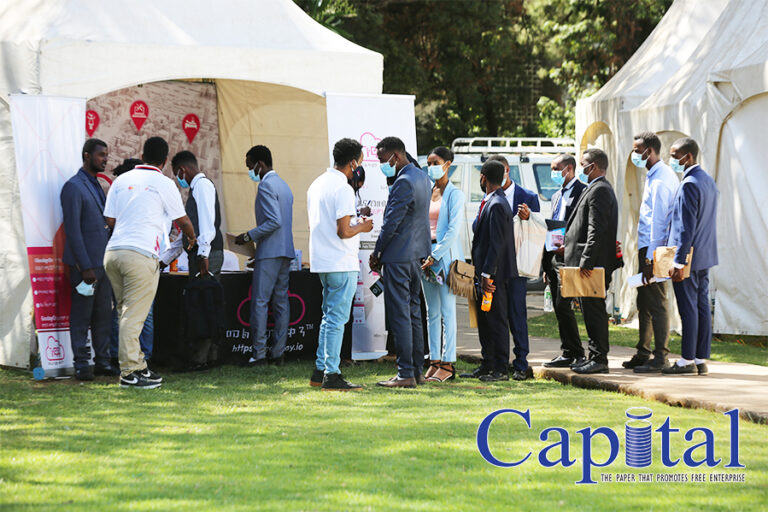
The annual job fair for fresh graduates, Dereja career expo was held for two days on January 13 and 14 at Ghion hotel.
The two day event aligns thousands of fresh graduates with potential employing companies to which more than 60 companies participated at this year’s job fair.
The curtains of the event were raised in the presence of Nigussu Tilahun, Commissioner of Ethiopian Job Creation Commission and project managers of the Dereja.com, Info Mind Solution.
Dereja.com is a social enterprise of Info Mind Solutions PLC. (Ethiojobs.net). Established in 2017. The enterprise is dedicated to supporting the over 200,000 fresh graduates entering the labor force by starting their career on the right path.
Kazak unrest
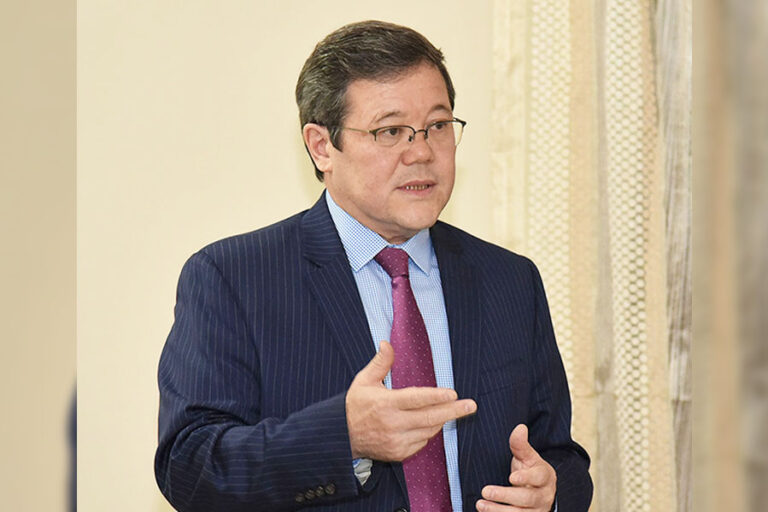
Kazakhstan is experiencing the heaviest unrest in its history recently. For a long time, Russia’s second most important ally in the post-Soviet realm was known as stable so what happened? Last week several hundred residents of Zhanaozen, an oil town in western Kazakhstan, took to the streets to protest high prices for liquefied petroleum gas, also known as autogas, a popular type of fuel. The protest wave has since spread across the entire country, with thousands joining street marches. Demonstrators have also taken to the streets of Almaty, the former capital. A presidential palace was torched. Capital sat down with Barlybay Sadykov Ambassador of Kazakhstan to Ethiopia to talk about the recent developments in Kazakhstan and what it means to the rest of the world. Excerpts;
Capital: How do you describe recent events in Kazakhstan?
Barlybay Sadykov: First of all, protests started in Western Kazakhstan were of an economic nature. It is important to note that there were no clashes between the police and civilians. The police did not use any force. All persons detained during unauthorized protests were released.
Unfortunately, peaceful demonstrations in Almaty, the biggest city of Kazakhstan, have been hijacked by terrorist groups and bandits seeking to undermine law and order in the country. Their criminal activities led to riots, robberies, rapes and mass violence. Almaty was attacked by almost 20 thousand armed groups and terrorists trained outside the country. They destroyed administrative buildings and military facilities, seized the airport and took foreign passenger and cargo planes hostage. This indicates a high level of readiness and coordination of the actions of criminals.
To deal with the national security threats, to protect countries’ sovereignty and integrity, protect people lives and property of citizens President Tokayev ordered to launch a counter-terrorism operation starting from January 6, 2022.
Capital: What was the main goal of the people involved in the unrest?
Barlybay Sadykov: We need to differentiate them. Those people how organized the riots in Kazakhstan are definitely terrorist groups. Their armed, coordinated and aimed to coup the State power by military means.
And we also know, that people peacefully participated in the protests are ordinary citizens. That is why all persons detained during unauthorized protests were released. The main goal of peaceful but unauthorised demonstrations, started on January 2, 2022, in the Mangystau region of western Kazakhstan was against the increase in retail prices of liquefied petroleum gas. The protesters demanded for prices to be reduced to the previous level, and requested a solution to some other socio-economic issues.
Following instructions from President Tokayev, the Government of the Republic of Kazakhstan promptly responded to the demands of the citizens and took measures to reduce gas prices, and imposed a moratorium on price increases for socially important food products, fuels and utilities.
Capital: It was said some of those arrested came from outside, who are those that are involved and where did they come from?
Barlybay Sadykov: The analysis of the situation showed that Kazakhstan was subjected to armed aggression by well-coordinated terrorist groups trained abroad. According to preliminary information, there are persons among the attackers who have experience of combat participation in «hot spots» on the side of radical Islamist groups. Currently, law enforcement agencies are investigating as part of a counter-terrorism operation, and all internal and external participants of the armed attack will be identified.
While the initial rallies in Western Kazakhstan were peaceful and accompanied by demands of a socio-economic nature, the participants in the subsequent mass riots did not put forward any specific economic or even political demands. They had no intention to negotiate with the authorities, and instead aimed at violently overthrowing the constitutional order.
Capital: How did the government not see this coming?
Barlybay Sadykov: Terrorist groups appeared due to the activation of the so-called «sleeping cells». Unfortunately, the law enforcement agencies of Kazakhstan were not ready for such massive and coordinated attacks in the different regions of the country simultaneously.
President Tokayev has instructed law enforcement agencies to form an investigative group to conduct a large-scale investigation and bring all those responsible to justice. The results of the investigation will be presented to the international community once ready.
At the same time, due to the sharp aggravation of the situation, President Tokayev assumed the post of Chairman of the Security Council of Kazakhstan, dissolved the Government and declared a state of emergency until the situation will be fully stabilized.
In this situation, Kazakhstan was compelled to seek help from the Collective Security Treaty Organization (CSTO), which has deployed a peacekeeping force totaling approximately 2,500 personnel to assist in the stabilization of the situation. The mandate of the peacekeepers included the guarding of strategic facilities and providing cover-up for Kazakhstan’s forces. It is important to note that the main combat operations against terrorist groups are conducted by the law enforcement agencies and armed forces of Kazakhstan.
Now the counter-terrorism operation is continuing in the country. The police, the National Guard and the Armed Forces are carrying out large-scale and coordinated actions to neutralize terrorist and criminal groups. However, peaceful protesters are not subjected to any persecution. Since situation is under control, on 13 January 2022 CSTO started withdrawing peacekeeping troops from Kazakhstan.
All that happened is a huge tragedy for us, the relatives of the victims and the entire Kazakh people.
It is important to emphasize the unity of the people of Kazakhstan at this difficult time. Citizens support the measures taken by President Tokayev to restore peace, and have established communal groups to protect social facilities.
Capital: What will the future hold?
Barlybay Sadykov: The large-scale counter-terrorist operation will be completed in the near future and there is a lot of work ahead and lessons to be learned from the tragic events.
After the New Prime Minister Alikhan Smailov has been appointed by Parliament on January 11, President of Kazakhstan, Kassym-Jomart Tokayev set a number of tasks for the reform of the country’s law enforcement agencies. All measures to reform and strengthen law enforcement agencies and the armed forces are aimed at protecting the population from external threats. To radically reform the law enforcement agencies, President gave instructions to increase the combat readiness and equipment of law enforcement agencies in general, and Special Forces in particular. The legal protection of the police will also be strengthened. In addition, President emphasized the importance of strengthening the border service and intensifying work to counter religious extremism.
Capital: Do you want to add something?
Barlybay Sadykov: The tragic events in our country highlight the problems of democracy and human rights in a new way. As stated by President Tokayev, only law and order can guarantee the wellbeing of all civilized states, including Kazakhstan.
As Almaty tragedy demonstrates, violence and anarchy, unlawful actions of criminals and terrorists not only undermine the security of civilians but also lead to violation of fundamental human rights.
Democracy is a work in progress and we continue learning from experience. We are defending our democracy and Constitution from Islamist radicals and terrorists. Kazakhstan remains committed to the protection of fundamental human rights and freedoms.
We have come a long way to building our state from scratch. And will do all it takes to protect our democracy and our people from any unlawful interference both at home and abroad.
The economics of electric cars and biofuels

An electric car or battery electric car is simply defined as an automobile that is propelled by one or more electric motors, using energy stored in batteries. Compared to internal combustion engine (ICE) vehicles, electric cars are quieter, have no exhaust emissions, and lower emissions overall. In the United States and the European Union, as of 2020, the total cost of ownership of recent electric vehicles is cheaper than that of equivalent ICE cars, due to lower fueling and maintenance costs. Charging an electric car can be done at a variety of charging stations; these charging stations can be installed in both houses and public areas.
Out of all cars sold in 2020, 4.6% were plug-in electric, and by the end of that year there were more than 10 million plug-in electric cars on the world’s roads, according the International Energy Agency. Despite rapid growth, only about 1% of cars on the world’s roads were fully electric and plug-in hybrid cars by the end of 2020. Many countries have established government incentives for plug-in electric vehicles, tax credits, subsidies, and other non-monetary incentives while several countries have legislated to phase-out sales of fossil fuel cars, to reduce air pollution and limit climate change.
Dr. Robert Duran of Norwich University stated that the Tesla Model 3 became the world’s all-time best-selling electric car in early 2020, and in June 2021, became the first electric car to pass 1 million global sales. Earlier models with widespread adoption include the Japanese Mitsubishi i-MiEV and the Nissan Leaf.
The United States, the European Union, China and General Motors want to make battery-powered electric cars the champion of motorists worldwide. At the same time, United States and European agricultural interests and investors are pouring serious money into biofuels that go into cars and trucks running on liquid fuels. The billion-dollar question is whether they can both be right about the future of transportation. The answer may not be as simple as it seems.
Right now, electric cars clearly have the momentum and the “inevitability” narrative on their side. The Biden administration’s ambitious infrastructure proposal sets aside $174 billion to subsidize electric cars, but little for biofuels. As Bloomberg News has reported, Europe is taking unprecedented steps to phase out gasoline and diesel cars and “bring an end to the almost 150-year-long era of the internal combustion engine.” The United Kingdom has imposed a 2030 ban on the sale of cars lacking a plug, and Germany has extended for four years its subsidies for electric vehicles. China plans to produce 8 million of the vehicles by 2028.
Ian Johnson, Secretary General of the Club of Rome, stressed that the biofuels cause isn’t helped by a legacy of controversy and environmental opposition. This dates back to early concerns about the value of agricultural fuels in abating greenhouse gases, as well as worries about their impact on food prices and fragile ecosystems. That makes it easy to dismiss the idea of pursuing two paths forward as a waste of time and resources. Others suggest this is another sorry example of the schizophrenic policies that we end up with when politicians shy away from choosing between powerful interests, in this case farmers and environmentalists.
But with liquid fuels powering 1.3 billion vehicles around the world now, a “both of the above” approach makes sense. Graham Noyes, Executive Director of the Sacramento-based Low Carbon Fuels Coalition stated that “A strategy of skipping biofuels and electrifying everything means choosing to use massive quantities of fossil fuels that emit the most toxic and carbon intensive emissions,”
That same logic explains why the $135 billion a year global biofuels industry is betting that new innovations and investments in efficiencies will not only widen their products’ climate advantage over fossil fuels. It also believes these investments will keep the industry competitive with zero emission vehicles deep into a coming age of electricity, and even beyond.
A California fuel importer explained it to media that “Electricity out here is the new gold rush, but bright shiny objects aren’t going to get us to the promised land. Investors, corporations and farm-level bio-refineries have been backing that idea with their wallets”.
Last June, for example, Raizen, an energy company based in Sao Paulo, Brazil, announced it would open a new 21 million gallon a year refinery converting sugarcane to ultra-low-carbon ethanol “to cater to increasing demand for cellulosic biofuels.” Toyota has been experimenting with a new “flex-fuel” Prius hybrid capable of using up to 100 percent very-low-carbon ethanol. This could result in a climate impact no greater than that of electric passenger cars that plug into dirty power grids in countries such as the United States or Brazil.
According to Graham Noyes, at the same time, a heartland biofuels industry that underpins the economies of hundreds of American farming communities is pinning its hopes on such things as a planned $2 billion dollar multi-state pipeline network. By some estimates, this could shrink bio-refineries’ carbon footprint by as much as 25%. The pipeline will capture carbon dioxide emitted during ethanol fermentation and bury it deep underground in North Dakota. California’s unsung workhorses.
In California, the home state of Tesla and also the country’s largest fuel market, biofuels made from mundane agricultural products have been key in cutting the climate impact of transportation in the state by 7.5% since 2011. The unsung workhorses of this improvement include biofuels made from corn, soybeans, hog and beef fat, manure gases from dairies, and used cooking grease.
A biofuels executive with a knack for politically incorrect metaphors stated that renewable diesel from “choice white grease” – the daintier name that traders use for pig fat – already powers some Amazon delivery trucks. “It’s the prettiest girl in town,”.
What is unclear is how a dual track to the future of transportation will play out in marketplaces and supply chains. In the United States, the outlines of a coming conflict have already begun to appear. “Ahead: Collapsing corn prices?,” a report recently commissioned by the Agricultural Retailers Association which is representing companies selling farm equipment, seeds and other inputs, predicts collapsing corn prices and farm revenues if the sale of new liquid-fueled passenger cars is banned, as California Governor Gavin Newsom has ordered starting in 2035.
The 6 million member American Farm Bureau Federation has joined an alliance with the United States oil industry to fight federal and state electric car subsidies seen as discriminating against biofuels and farming communities.
But many in the United States biofuels industry believe that competition on a level playing field would be much better for the industry and the effort to curb climate change than a brawl in the courts and Congress. They support the expansion of commercial carbon markets, such as one in California, in which fuels and technologies are rewarded based on their contribution to greenhouse gas abatement, as determined by regulators using data and science.
For that they are finding some powerful support. A newly-formed alliance of United States car companies argues that improved internal combustion engines will be needed for years. These will benefit from lower-carbon, high-octane liquid fuels, including renewables.
